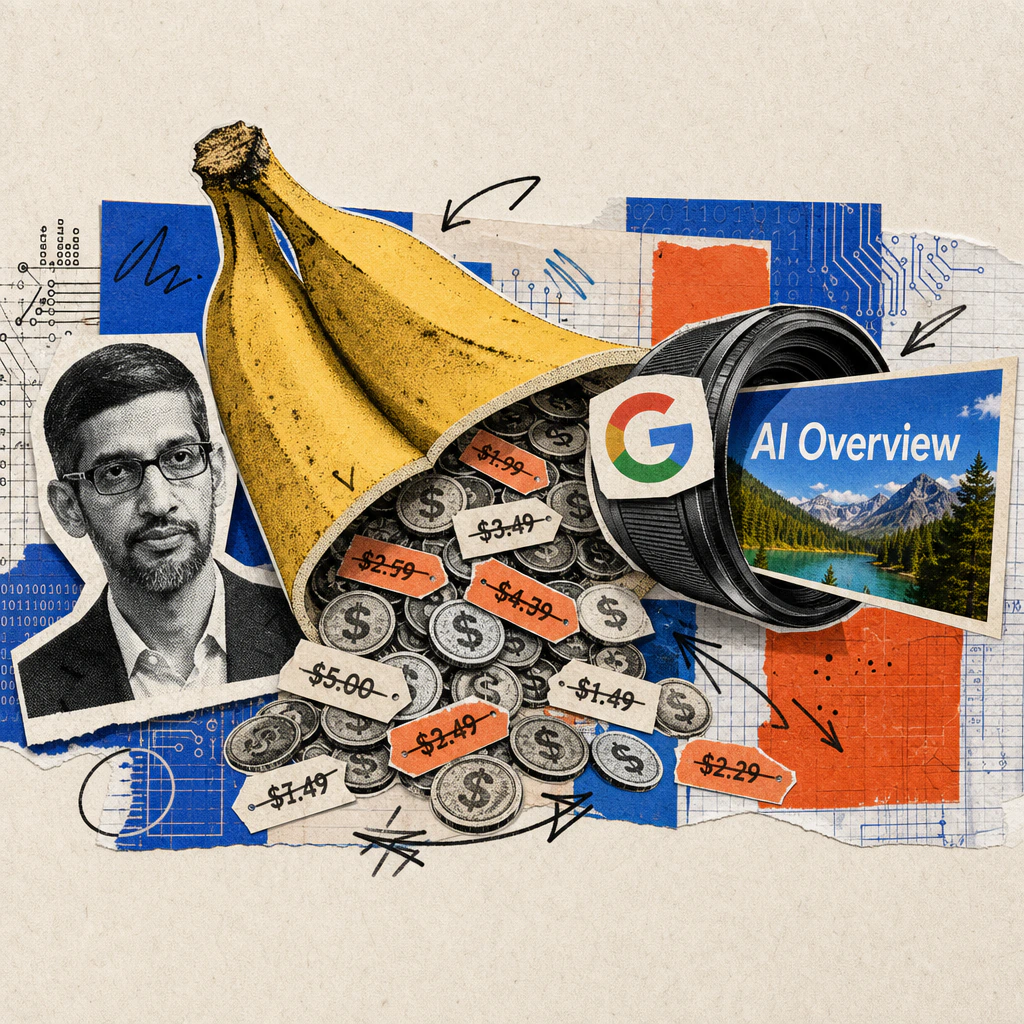
Google DeepMind released a new image model, Nano Banana 2.1, on October 6, 2026, which replaces its predecessor, Nano Banana 2. An image in standard resolution now costs only about 3.4 US cents instead of the previous 6.7 cents – a price reduction of about fifty percent.
At the same time, the model reportedly improves text rendering and the consistency of multiple figures across an entire image series, according to Google.
Price for standard images halves
Google DeepMind lists the new rates in the official pricing documentation for the Gemini API. A generated image in standard resolution (1K) costs $0.0336 there.
With Nano Banana 2, it was still $0.067, almost twice as much. At a resolution of 4K, the price drops from $0.151 to about $0.113, a discount of about 25 percent.
For editorial teams and marketing departments, this means instead of about 150 standard images, around 300 images can now be generated for ten US dollars. The more expensive flagship model, Nano Banana Pro, remains significantly more expensive at $0.134 per image at the same resolution.
Those working through the batch API pay half of the standard rate again, according to the price list. This significantly reduces the costs for automatically generated product images, social media graphics, and illustrations at companies.
A new contract or plan change is not necessary, the lower price applies automatically when switching to the new model. For heavy users with daily image series, the difference quickly adds up to several hundred dollars a month.
Further price steps for current AI models are bundled in the ongoing model and price tracker from beckmann.ai.
New version improves text and figure consistency
Nano Banana 2.1 is based on Gemini 3.6 Flash, according to the official model card from Google DeepMind. It processes up to 14 reference images at once and maintains up to four figures and ten objects consistently across multiple image variants, the model card states.
In Google's own preference tests, the score for text-to-image outputs rises from 990 to 1050 Elo points. The accuracy of facts in infographics grows from 0.179 to 0.521.
Users choose between three thinking levels – minimal, medium, and high – that trade computational effort against image quality. The model can also connect to Google Search, for example to pull current information into generated infographics.
Input accepts up to one million tokens, while output images remain capped at 4K. Limitations persist, according to Google, with small text and spatial representations.
The model also lacks up-to-date world knowledge, since its knowledge cutoff only reaches March 2026. For illustrations with current relevance, the search connection therefore remains the only reliable source of new information.
Rollout runs parallel to the predecessor model
The new model is now available across several Google products. These include the Gemini app, Google AI Studio, the Gemini API, the AI mode of Google Search, Google Ads, and the tools Flow and Stitch.
Enterprise customers reach it additionally through the Gemini Enterprise platform. The model card names no separate regional block for Germany or the EU, unlike the separate app Gemini Spark, which remains blocked there.
Google's overview of model deprecations does not yet name a shutdown date for the predecessor Nano Banana 2. Both versions therefore run in parallel via the API for now.
Industry watchers at the tech blog TestingCatalog reportedly spotted references to the new model in a test build of Google Flow in late September, several days ahead of the official unveiling.
The Nano Banana family remains under heightened scrutiny. Google had to temporarily shut down the AI image generator in Google Earth in August.
Users had generated fake satellite images of explosions with the predecessor model. In Google Search, a light version of the predecessor has been adding its own AI images to AI overviews since July, whenever the web does not supply a suitable photo.
What matters now is whether the lower price actually pushes professional users toward more automated image series. It also remains open whether the new model generation carries the same safeguards against misuse that Google had to retrofit after the Google Earth incident.