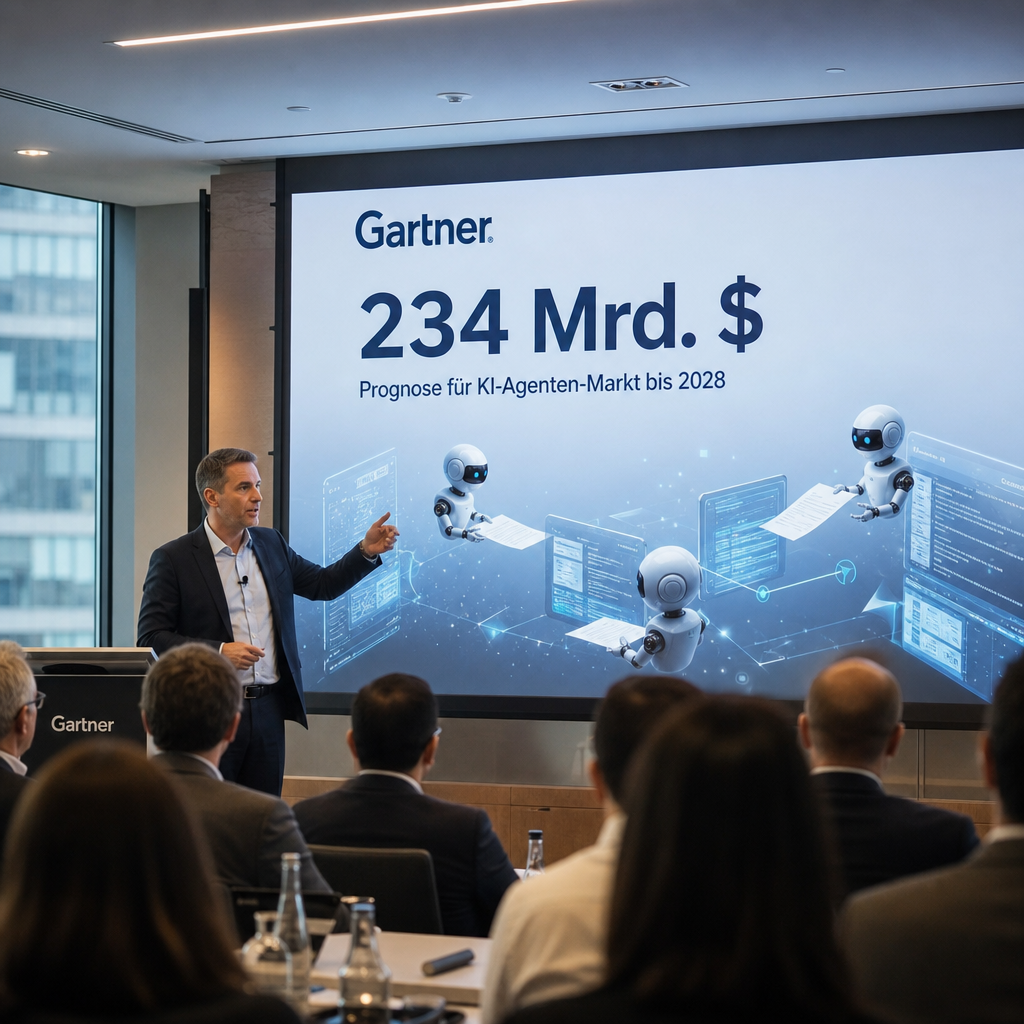
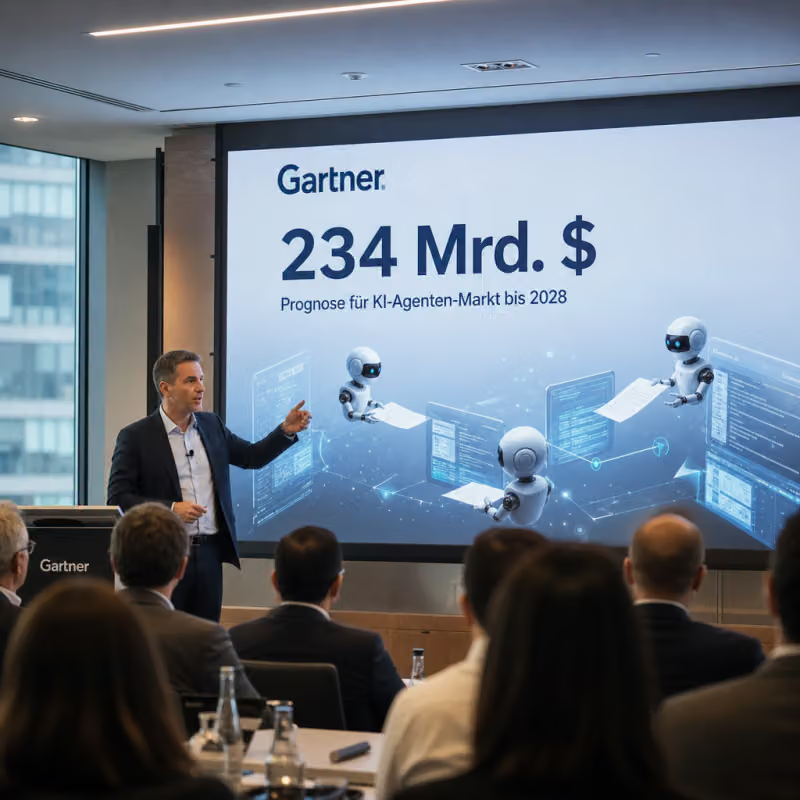
Agentic AI is changing the way companies buy and use software. According to a recent forecast by the market research firm Gartner, by 2030, up to $234 billion of global spending on enterprise application software (SaaS) is at risk from so-called "agentic arbitrage" – which would correspond to about 20 percent of global SaaS spending in this segment.
What Gartner Means by "Agentic Arbitrage"
Gartner describes "agentic arbitrage" as a scenario in which AI agents autonomously perform tasks across multiple enterprise systems while bypassing traditional software interfaces. Human users will then need to interact less directly with individual applications, as agents coordinate processes in the background and deliver results directly.
This strikes at the core of the traditional SaaS business model: licenses are traditionally sold per user account (seat). As tasks are increasingly performed by agents instead of employees, the number of active seats decreases – and potentially the revenue of many providers, even if the underlying work continues to be done.
George Brocklehurst, Managing Vice President at Gartner, sums it up in the Gartner press release: Agentic systems deliver results directly, making software somewhat invisible, which breaks the link between user growth and revenue growth for many providers.
In an interview with CIO.com, he also explained that software has been evaluated for decades based on user interface and user experience – a metric that loses significance once AI agents become the primary users.
Not an Apocalypse, but a Metamorphosis
Gartner explicitly does not classify the development as the downfall of the SaaS model, but rather as its restructuring. Brocklehurst speaks of a redefinition of the much-cited "SaaSpocalypse": SaaS will not be destroyed, but will take on a different form.
For established providers, this means both risk and opportunity, according to Gartner – depending on how quickly they adapt.
Specifically, Gartner advises software providers to shift the value contribution of their products from the user interface to measurable outcomes and to embed agentic capabilities directly into business processes. Those who cling to rigid, interface-centered pricing models risk losing market share – not only to other established providers but also to AI-native startups and service providers that act as an orchestration layer between multiple enterprise applications.
What This Means for CIOs in Procurement and Contracts
According to Brocklehurst, CIOs will need to evaluate software procurement differently in the future. The key factor is no longer primarily the user interface, but whether an AI agent can handle everything – and more – through a system's application programming interface (API) that a human would do on the screen, and whether a provider's contractual terms even allow for that.
This also shifts the focus in contract negotiations. Gartner recommends scrutinizing contracts as closely as the technology itself, as vendor clauses could technically or financially restrict or completely prohibit autonomous use by third-party systems.
CIOs should therefore negotiate agent permissions into new software contracts now, as many existing contracts will still be valid even when enterprise agents become the standard.
Knowledge Sovereignty as a New Point of Contention
Another aspect concerns the question of where operational knowledge remains that is generated in dealing with AI agents. Every correction, every exception, and every work step handled by an agent generates organizational knowledge, according to Gartner.
The company refers to an organization's ability to retain this knowledge as the "Knowledge Retention Rate" (KRR).
If this knowledge flows into a provider's shared models, it may enhance the operational experience of a product that competitors also use, Brocklehurst explained to CIO.com. Gartner sees the risk of a new form of vendor lock-in if operational learning remains with the software provider rather than the customer.
Therefore, the central contractual clause of the next generation of software is: Who owns what the system learns from a customer's data?
Governance Before Autonomy
Gartner also advises companies to establish governance frameworks before autonomous AI agents become commonplace. Autonomy should not be granted implicitly or inconsistently; organizations should instead explicitly define where agents may act independently, who authorizes these decisions, and how frequently permissions are reviewed.
Market Reactions: Providers Are Already Experimenting with New Pricing Models
The shift in the pricing model for enterprise software is already evident in practice. As CIO.com reports, the HR and finance software provider Workday has introduced a two-tier pricing model, where customers receive a quota of "Flex Credits" for the use of AI agents in addition to the traditional subscription.
Workday CTO Gabe Monroy explained that the value of enterprise software will no longer be measured by the number of employees but by actual system usage.
Analyst Melody Brue from Moor Insights & Strategy classified this as part of a broader trend: providers are increasingly defining their own proprietary units for billing AI usage on top of existing subscriptions – with the risk of unpredictable cost trajectories for customers without adequate monitoring.
Classification: Forecast with Interests
The figure of $234 billion comes from Gartner's own modeling and has not yet been externally verified by independent market analyses. As is common with market research forecasts, it is based on the company's assumptions about market size, adoption speed, and substitution effects, which are not detailed in the press release.
Additionally, it should be noted that Gartner itself offers commercial consulting services around software procurement and AI strategy, as evidenced by the webinar mentioned in the article. This does not necessarily diminish the plausibility of the analysis but should be considered when interpreting the figures.
Conclusion
Regardless of the exact amount of the quantified sum, Gartner's analysis describes a trend that is also supported by other market observations and initial pricing model adjustments from providers like Workday: enterprise software is increasingly being built, evaluated, and priced not just for humans, but for agents.
For CIOs, this means specifically incorporating contracts, API access rights, and the question of knowledge sovereignty early into the procurement strategy – even if agentic systems are still hardly in use in their own companies today.