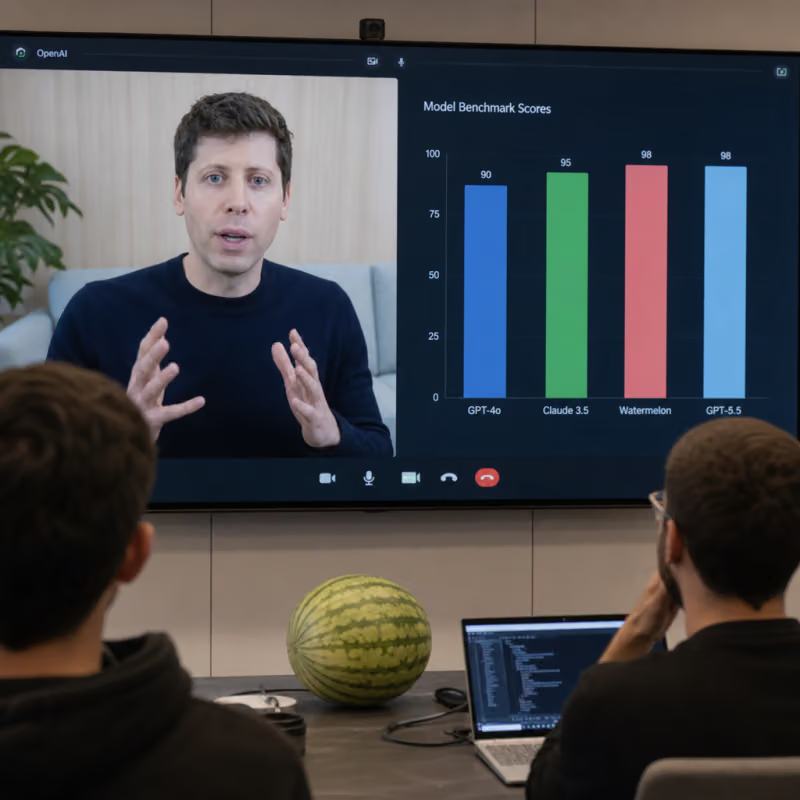
Meta is apparently positioning itself more strongly in the race for the most powerful AI models again. According to a report by Business Insider, Alexandr Wang, head of Meta Superintelligence Labs, told employees at an internal town hall meeting that the upcoming Meta model codenamed "Watermelon" has caught up with internally tracked benchmarks for OpenAI's GPT-5.5.
What Wang reportedly said
Business Insider cites two people familiar with the matter. According to them, Wang said at the town hall: "Watermelon, our next model after Avocado, is currently in training." "Avocado" is reportedly the internal codename for Muse Spark, the first model from Meta's model family released in April.
Wang added that Watermelon uses "an order of magnitude more computing power than Avocado."
The original scoop comes from Business Insider reporter Charles Rollet, who first published the statements on X before the detailed article appeared at Business Insider.
According to the report, it is unclear which specific benchmarks Wang was referring to. Neither Meta nor OpenAI commented on the statement when asked.
Context: A single, anonymously cited source
Important for the context: The statement comes from an internal meeting and has not been publicly confirmed by Meta or substantiated with published benchmark data. It is a report based on anonymous sources from a single media outlet, not a verifiable statement communicated by Meta itself.
Without published test results, a model card, or independent evaluations, the comparison with GPT-5.5 cannot currently be verified.
Additionally: OpenAI already released GPT-5.5 in April and showed a limited preview of the successor model GPT-5.6 at the end of June 2026, which, according to reports, is currently only accessible to selected partners approved by the U.S. government.
If Wang's statement is confirmed, Meta may have caught up to a model that OpenAI internally already considers outdated.
Background: Muse Spark and Meta's catch-up race
Meta released Muse Spark in April 2026, the first major model since Wang's hiring, who previously led Scale AI. According to several reports, Muse Spark achieved solid benchmark scores but fell behind the leading models from OpenAI and Anthropic.
Wang now leads the TBD research team at Meta as well as other AI initiatives, including a recent foray into the hardware business.
On the day of the town hall, Wang also commented publicly on a related topic on X: an update for Muse Spark with "significant improvements in coding and agentic capabilities" is imminent and will be rolled out via Meta AI and a new API.
This statement reportedly referred to comments made by Meta CEO Mark Zuckerberg at the same town hall, indicating that progress on AI agents has not accelerated as expected over the past four months.
Context: Zuckerberg's cautious tone
According to a Reuters report by Katie Paul and Courtney Rozen, based on an audio recording of the meeting reviewed by Reuters, Zuckerberg was noticeably more cautious at the same town hall than Wang.
He reportedly said that the development of AI agents "hasn't really accelerated in the way that we expected" over the past four months, and that the company's bets on the new organizational structure "haven't come to fruition yet." He also said the recent reorganization, including job cuts, had not been as "clean" as it could have been, and that executives had misjudged the timing of the changes.
According to Reuters, Zuckerberg also noted that, early in the year, executives had been "super optimistic" about tools like Anthropic's Claude Code. These contrasting tones within the same meeting – Wang's progress report on Watermelon on one hand, Zuckerberg's caution regarding agents on the other – have been highlighted multiple times in the reporting.
Why computing power is the real core of the report
Regardless of whether Watermelon actually catches up to GPT-5.5, the reported statement about computing power provides a concrete, verifiable signal: according to Reuters, Meta is projected to spend as much as $145 billion on AI infrastructure this year, a significant portion of Big Tech's more than $700 billion collective outlay on the technology this year.
A model generation that, according to Wang, requires "an order of magnitude" more computing power than its predecessor fits this aggressive scaling strategy.
Conclusion
The statement that Watermelon has caught up to GPT-5.5 is so far a single, anonymously sourced statement from an internal meeting – no published benchmark result and no confirmed statement from Meta. However, it fits into a larger picture: Meta is aggressively scaling training computing power while CEO Zuckerberg, at the same meeting, acknowledges that progress on AI agents is falling short of its own expectations.
Whether the benchmark parity is confirmed will likely only become clear when Meta actually releases Watermelon and provides reliable, independently verifiable results.