A German research consortium has released Soofi S, an open language model trained specifically for German and English. According to its developers, the 31.6-billion-parameter model surpasses the open models Apertus 70B and Olmo 3 32B on combined benchmarks.
Consortium trains model on Telekom infrastructure in Munich
Soofi S is built on a hybrid architecture combining Mamba-2 layers with a mixture-of-experts approach that activates only part of the network per request. Of the 31.6 billion parameters, only 3.2 billion are active per token, which significantly increases compute efficiency compared to classic dense models.
The model handles contexts of up to 256,000 tokens.
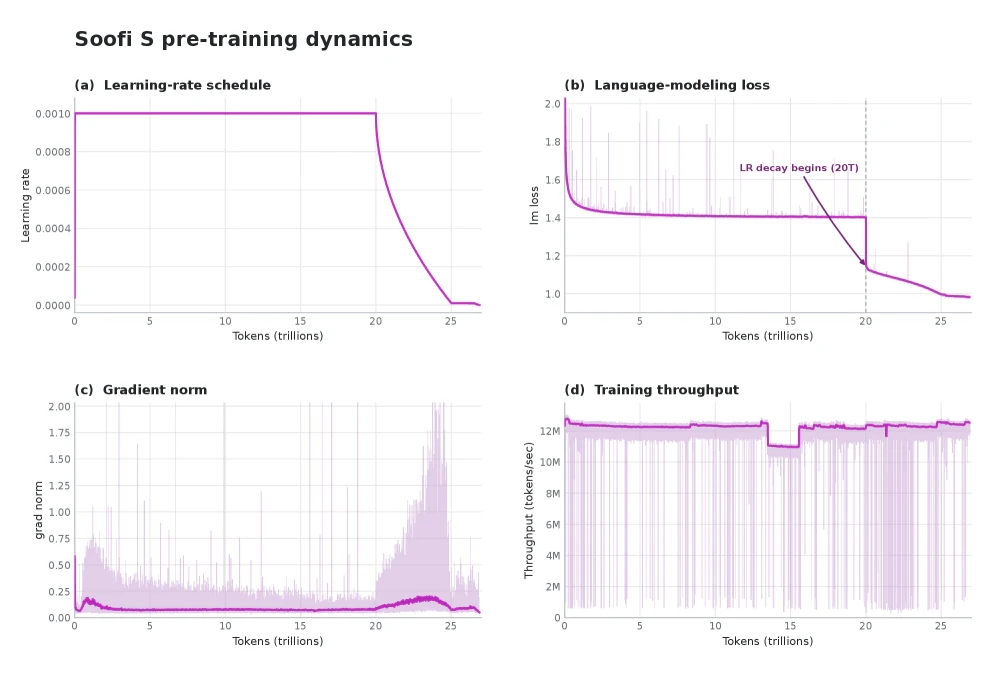
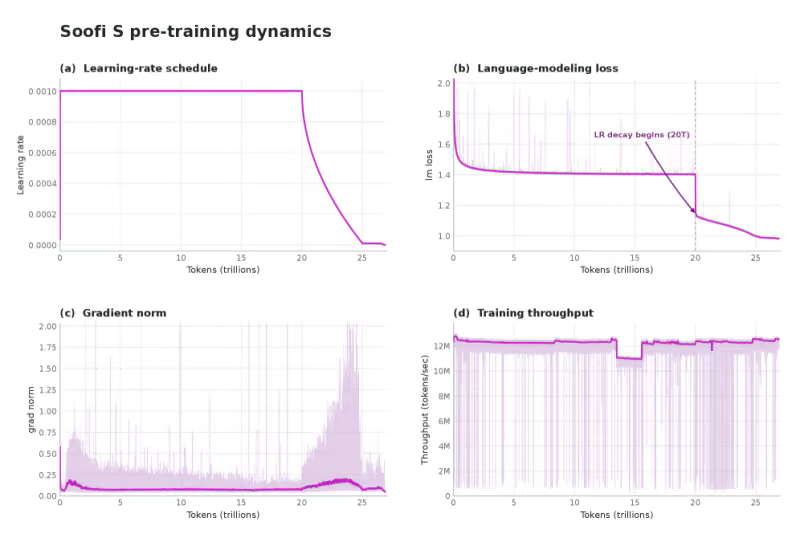
According to the Soofi project's technical report, training ran from March to May 2026 on up to 512 Nvidia B200 GPUs at Deutsche Telekom's Industrial AI Cloud in Munich and consumed roughly 253,000 GPU hours.
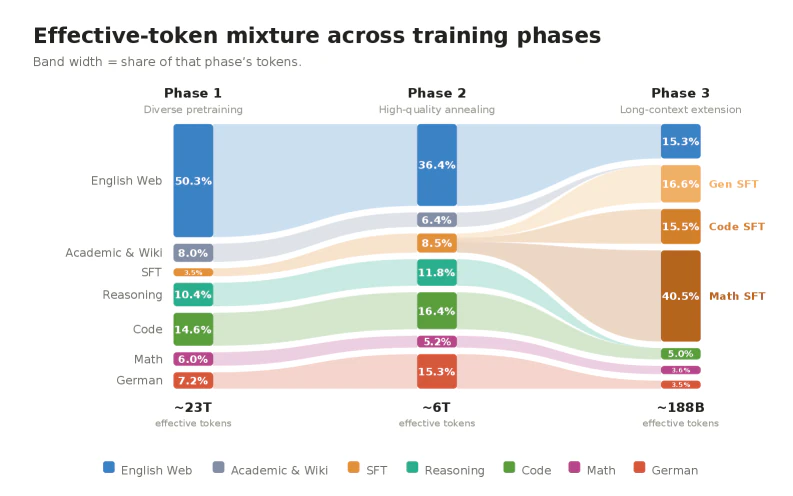
The facility runs on renewable electricity and uses water from the Eisbach canal for cooling. In total, Soofi S processed about 27 trillion tokens across three phases.
The German-language share rose from 7.2 percent in the first phase to 15.3 percent in the second – far above the roughly five percent typically allotted to all non-English languages combined in international models.
The initiative is coordinated by the KI Bundesverband, Germany's AI industry association. Participants include the Fraunhofer Institutes IAIS and IIS, the German Research Center for Artificial Intelligence, and the universities TU Darmstadt, University of Würzburg, and the L3S Research Center at Leibniz University Hannover.
Also involved are the Berlin University of Applied Sciences and the companies ellamind and Merantix Momentum. Germany's Federal Ministry for Economic Affairs and Energy is funding the project with around 20 million euros through the European IPCEI-CIS program.
Benchmarks show an edge on German-language tasks
Among models classified as open, Soofi S takes the top spot in combined German-English benchmarks, according to the project's own figures. On the HumanEval coding test, the model scores 73.8 percent, and 84.2 percent on its German counterpart, MBPP-DE.
On the INCLUDE-DE knowledge test, which covers multiple-choice questions from several subject areas in German, it reaches 61.2 percent. On logical reasoning over everyday and scientific questions in ARC-Challenge-DE, the score is 92.3 percent.
These figures come from the consortium's own evaluation and have not been independently verified.
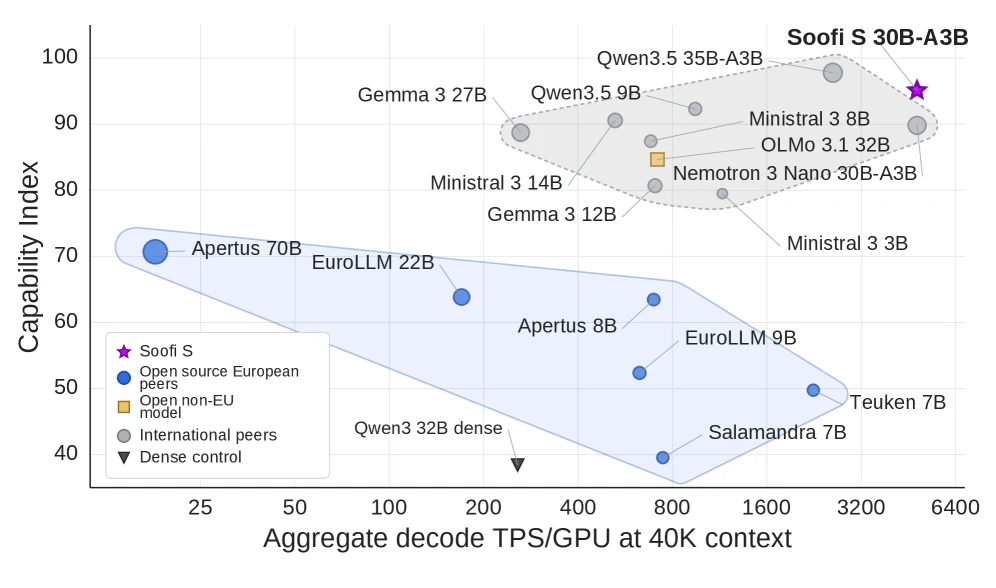
In overall performance, Soofi S thus reaches a level comparable to dense models with 14 to 27 billion parameters. At a context length of 40,000 tokens, it also delivers eight- to nine-times higher throughput than comparable dense models.
According to the technical report, the model shows weaknesses in German competition-level mathematics and in extracting individual words from texts beyond 32,000 tokens. Intermediate training checkpoints and the base model are available on the platform Hugging Face; an instruction-tuned version is expected to follow.
Project partners see a contribution to Europe's digital sovereignty
The team led by Kristian Kersting at TU Darmstadt contributed, among other things, an AI-powered pipeline for checking training data quality and a module for logical reasoning.
Jörg Bienert of the KI Bundesverband frames the project's strategic significance this way: "Whoever controls the foundation models controls a central part of future digital value creation." The L3S Research Center likewise stresses the importance of independent European AI systems, noting that access to powerful foreign models is not guaranteed to remain available.
The project joins models such as Switzerland's Apertus and the European Teuken model in a growing number of state-funded, open language models built outside the US and China. Unlike purely academic projects, Soofi ties in commercial infrastructure from the outset through the Telekom cloud and industry partners such as Merantix Momentum.
What remains open is whether the instruction-tuned version will turn the model's currently provisional license into a fully open release, and whether German companies will actually put the model to productive use once industrial testing is complete.