
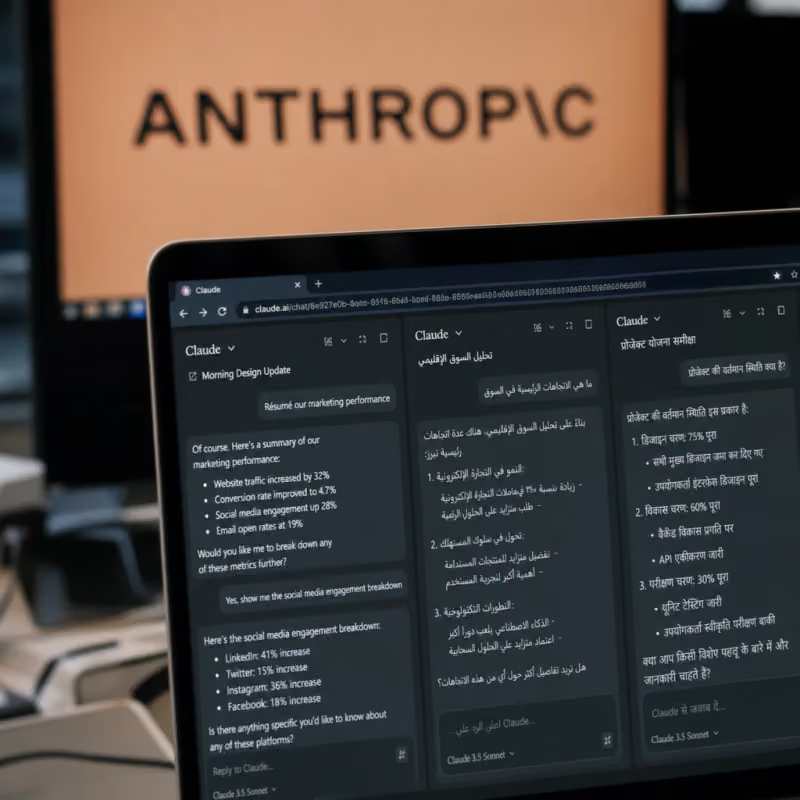
Anthropic has published a study on the values of its AI model Claude, which finds significant differences depending on language and model version.
In Hindi and Arabic, the model responds warmer and more reserved, while in English and Russian it is stricter and more critical. The basis is more than 300,000 anonymized conversations from three model versions.
Study evaluates over 300,000 Claude conversations
For the investigation, Anthropic analyzed 309,815 anonymized conversations from Claude.ai users from May 2026 (independently unverified). The team initially identified 3,307 individual value terms and condensed them into 339 overarching values.
Subsequently, the researchers reduced this multitude to four axes that describe the response behavior: Reserve versus Caution, Warmth versus Accuracy, Depth versus Brevity, and Openness versus Goal Orientation.
According to Anthropic, the four axes explain only about 15 percent of the remaining variation after statistically controlling for task, topic, and the values expressed by users themselves. The three models compared were Sonnet 4.6, Opus 4.6, and Opus 4.7.
For the language analysis, Anthropic had 800 conversations translated into eight languages and additionally evaluated the 20 most used languages on the platform. The analyzed conversations come exclusively from real usage situations on Claude.ai, not from controlled test environments.
A privacy-friendly procedure based on Claude itself automatically marked the values in each conversation. Anthropic intends to use the four axes in the future to evaluate new model versions.
Language influences warmth and strictness of responses
The results show significant differences between the languages. In Hindi and Arabic, the model is particularly warm and accommodating: it uses polite formulations, humor, and affirming statements.
In contrast, English and Russian are dominated by strictness – the model questions assumptions more frequently, corrects details, and demands evidence more often.
Further axes present an inconsistent picture. Indonesian tends towards a goal-oriented, detailed response style, while Dutch deals most openly with uncertainties and its own mistakes. Arabic is simultaneously the most reserved and brief, while English provides the most detailed and cautious explanations.
Anthropic attributes the differences, among other things, to an unequal distribution of training data by language, but also points to possible cultural differences in conversation norms. According to Business Today, Anthropic also notes that two people could receive different evaluations of the same business idea in different languages because the model frames its assessment differently depending on the language.
For companies with multilingual teams, this can mean that identical requests yield noticeably different feedback depending on the language used.
Model versions differ in caution and pace
In addition to language, the model version also shapes the tone. Sonnet 4.6 responds warmly, reservedly, and briefly, uses humor, and confirms user statements more often than the other models. The Warmth axis for Sonnet 4.6 is about 0.17 standard deviations above the average of the three models.
In contrast, Opus 4.7 relies on caution and depth, with values of 0.24 and 0.23 standard deviations above the average, respectively. The model questions assumptions and points out risks and its own uncertainties more often.
Users have noted, according to Decrypt, that Opus 4.7 relativizes its responses noticeably often even before the study. Opus 4.6 combines accuracy with a concise, goal-oriented response style and stays closer to the actual task of the request.
The study builds on an earlier investigation called “Values in the Wild”, for which Anthropic had already categorized 308,210 conversations into five value categories.
It was shown that Claude reflected the values of users in 28.2 percent of cases, but also sometimes introduced alternative viewpoints.
It remains open how much of the language differences can actually be attributed to an unequal distribution of training data and how much to deeper cultural influences of the respective language community. Anthropic itself admits that it does not know exactly which characteristics of the training data trigger the effects and has not yet decided how much of the observed variation is even desirable.
What will be crucial is whether the company derives concrete adjustments from the findings so that users receive comparably helpful and cautious responses regardless of their language.