
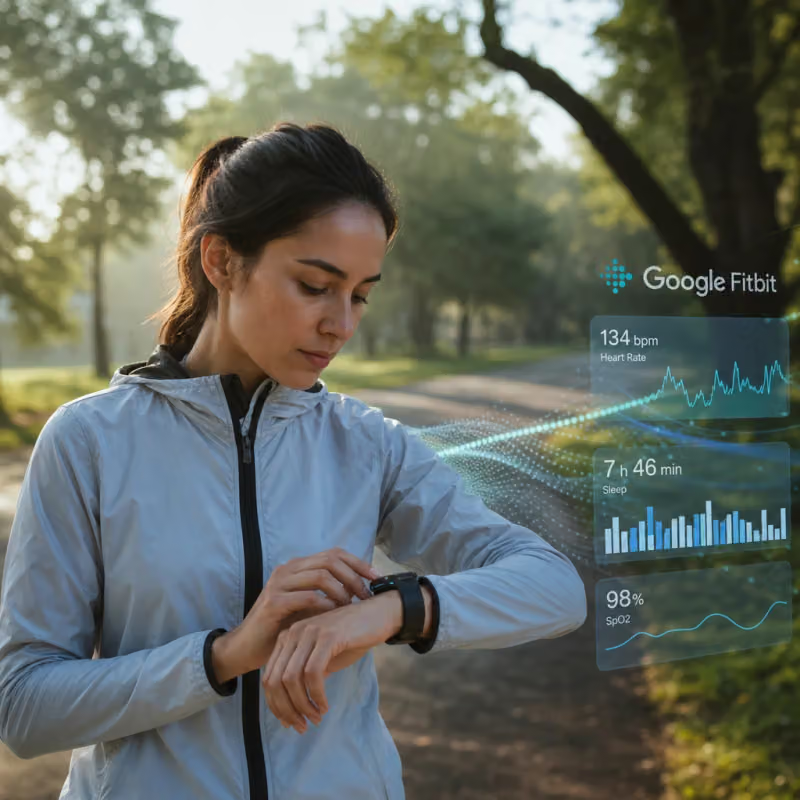
Google Research has introduced SensorFM, an AI model that learns general patterns of human health from wearable data.
It is built on more than a trillion minutes of sensor readings from five million people in over 100 countries. In tests, the model reportedly outperforms specialized predecessor systems on 34 of 35 health tasks.
Fitbit and Pixel Watch Data From Millions of People Form the Basis
For training, Google says it drew on readings from more than 20 Fitbit and Pixel Watch models, collected between September 2024 and September 2025 from five million consenting individuals across more than 100 countries and all 50 U.S. states — figures that are independently unverified.
The dataset comprises 34 minute-level features drawn from five sensor types: pulse waves (photoplethysmography signals, or PPG), motion, electrodermal activity, skin temperature, and altimetry. Because wearables produce gaps in measurement, for instance when a device is not worn overnight, SensorFM uses a technique called Adaptive and Inherited Masking.
It treats missing values as a normal part of the data rather than filling them in afterward or discarding them entirely. According to Google researchers Xin Liu and Daniel McDuff, this approach improves reconstruction by up to 74.8 percent for randomly missing signals and by 83.7 percent for larger, contiguous data gaps.
Unlike earlier models that each predicted only a single measure such as sleep quality or calorie expenditure, SensorFM is meant to deliver a reusable representation that transfers across many health domains at once. The accompanying study appeared on July 9, 2026 as a preprint on arXiv and has not yet been peer-reviewed.
Model Beats Specialized Systems on 34 of 35 Tests
Google evaluated SensorFM on 13,985 participants from three clinically reviewed studies and tested 35 health tasks spanning cardiovascular health, metabolic risk, sleep, mental health, and demographic and lifestyle factors.
Four model variants of increasing size — from 138,740 to roughly 111 million parameters — were compared using proportionally larger training datasets ranging from 5,000 to 5 million people. The largest variant reportedly achieves a mean AUC of 0.752 on classification tasks and a Pearson coefficient of 0.612 on regression tasks, compared with 0.664 and 0.386 respectively for the smallest version.
Both scores improved steadily as model size and data volume grew, pointing to the kind of scaling behavior familiar from large language models. When selecting suitable prediction heads, Google also tested architectures automatically designed by AI agents, which outperformed simple linear probes on 16 of 20 classification tasks and 12 of 15 regression tasks.
In a further test, SensorFM served as the basis for a so-called Personal Health Agent. According to the authors, clinician-rated summaries based on the model's predictions did not differ significantly from actual measurements taken in the studies.
Wearable Industry Shifts Value From Sensors to Interpretation
According to Forbes, the value of wearables is shifting from raw sensing toward the interpretation layer: not the chip inside the device, but the model that makes sense of the raw data, is what creates clinical value.
As evidence, the magazine points to coaching features such as Whoop Coach and Oura Advisor, which it says users already prefer over plain data displays without interpretation. Looking ahead, competitive advantage could shift from model architecture to the clinical validation data used to test new predictions — an area where Google may have an edge through its own study database, since the architecture itself could be replicated relatively easily by well-funded competitors.
This shift also explains why Google places particular emphasis in the study on its three IRB-reviewed cohorts: they supply the kind of clinically labeled comparison data that, according to Forbes, could become the real competitive advantage.
Investment flowing toward companies that emphasize this kind of agentic interpretation layer rather than pure sensor hardware, the analysis suggests, signals that wearables are moving from fitness trackers toward always-on clinical intake systems.
It remains to be seen whether Google will make SensorFM available to developers or other research teams: so far, only the scientific publication exists, with neither model weights nor a public programming interface available.
Also decisive for its clinical relevance is whether the results can be reproduced on independent datasets not curated by Google.