
Microsoft has begun, according to Bloomberg research from July 7, 2026, to no longer exclusively forward a portion of the AI requests in the Office applications Excel and Outlook to models from OpenAI and Anthropic, but to its own MAI models.
As Bloomberg reports, citing sources familiar with the process, this is the first known shift of Microsoft 365 Copilot traffic to in-house models on a productive scale – albeit so far only for a small part of overall usage.
What changes specifically in Excel and Outlook
According to Bloomberg, the MAI models now process tens of thousands of requests from Excel and Outlook weekly. Among the models used are the reasoning model MAI-Thinking-1 as well as other in-house models for coding tasks and image generation.
Which model handles a given request is decided in the background as a technical routing choice – Microsoft 365 Copilot users see nothing of this in the interface. A Microsoft spokesperson did not officially confirm the details of the shift to Bloomberg.
The technology behind MAI-Thinking-1
According to the official model announcement from Microsoft AI, MAI-Thinking-1 is built as a sparse mixture-of-experts model: of roughly one trillion total parameters, only about 35 billion are active per request, which is meant to lower compute costs compared with densely activated models.
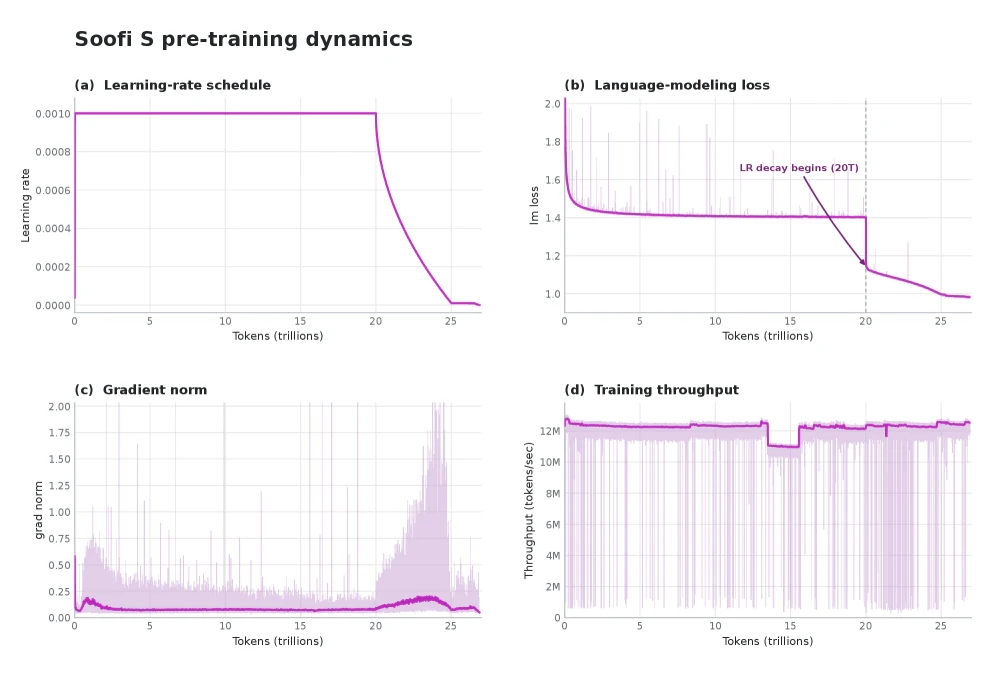
The model has a 256,000-token context window and, according to the company, was trained on roughly 30 trillion tokens of commercially licensed data – without distillation from GPT or Claude outputs, as Microsoft emphasizes.
On the coding benchmark SWE-Bench Pro, Microsoft says it matches Anthropic's Claude Opus 4.6; for the math benchmarks AIME 2025 and AIME 2026, the company cites scores of 97.0 and 94.5 percent respectively. The independent ranking site BenchLM.ai placed MAI-Thinking-1 44th out of 123 models on its provisional overall leaderboard as of June 12, 2026.
The model scores particularly well there on instruction-following, while landing more in the middle of the pack on pure knowledge tasks. BenchLM.ai also notes that at the time of evaluation only 14 of 247 tracked benchmark categories had been published for the model – so the data picture is still incomplete.
Cost pressure as the driver
As the reason for the shift, Microsoft AI chief Mustafa Suleyman explicitly points to the cost of the Anthropic partnership. Speaking to Bloomberg in June, he said in essence that "Anthropic is extremely expensive, and I think many are urgently looking for alternatives." According to later reporting by TechTimes, Microsoft is estimated to have recently spent roughly $500 million a year on Anthropic models – a figure drawn from earlier, unconfirmed reporting.
Suleyman also floated a "tenfold cost efficiency" for Microsoft's own models versus frontier models during his Build 2026 keynote; that claim, too, comes directly from Microsoft and has not been independently verified.
Not a break with OpenAI or Anthropic
Despite the shift, Microsoft remains contractually close to OpenAI: the licensing agreement between the two companies, revised in April 2026, reportedly runs until at least 2032. According to PYMNTS, a Microsoft spokesperson emphasized that the company continues to rely on "a mix of models" – including OpenAI models as part of the partnership, alongside Microsoft's own and open-source models.
More complex, demanding tasks reportedly still run on the more capable but pricier OpenAI and Anthropic models; the MAI models are for now mainly absorbing high-volume routine requests.
Context
The episode illustrates just how much cost pressure has built up around production AI services: even a company like Microsoft, which is simultaneously OpenAI's largest investor and holds a long-term API partnership with Anthropic, is visibly shifting part of its compute load to wherever it can control the cost itself.
For Anthropic and OpenAI, the move underscores that even close partners are increasingly trying to reduce their dependence on any single model provider – a pattern also visible recently at other large technology companies that run their own models alongside external frontier models.
Whether the shift will extend beyond Excel and Outlook to other Microsoft products has not been officially announced.