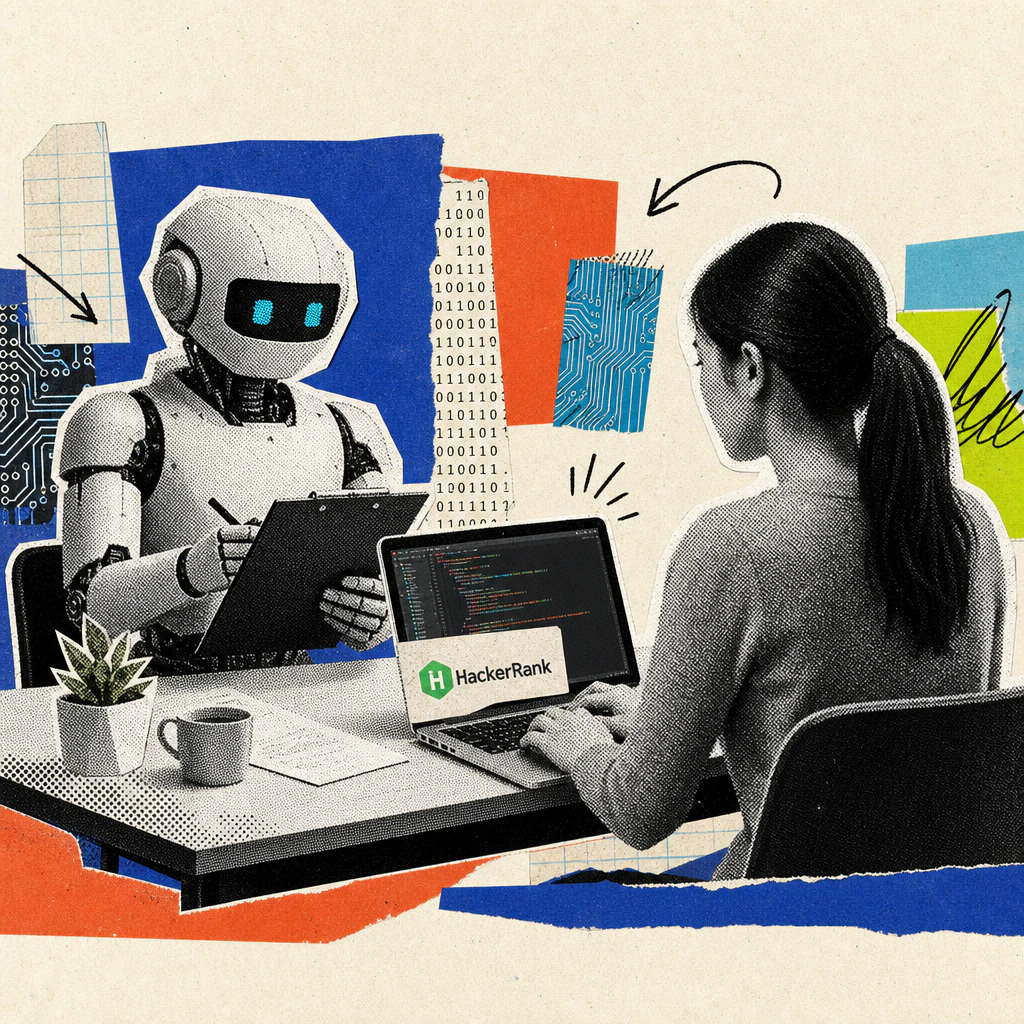
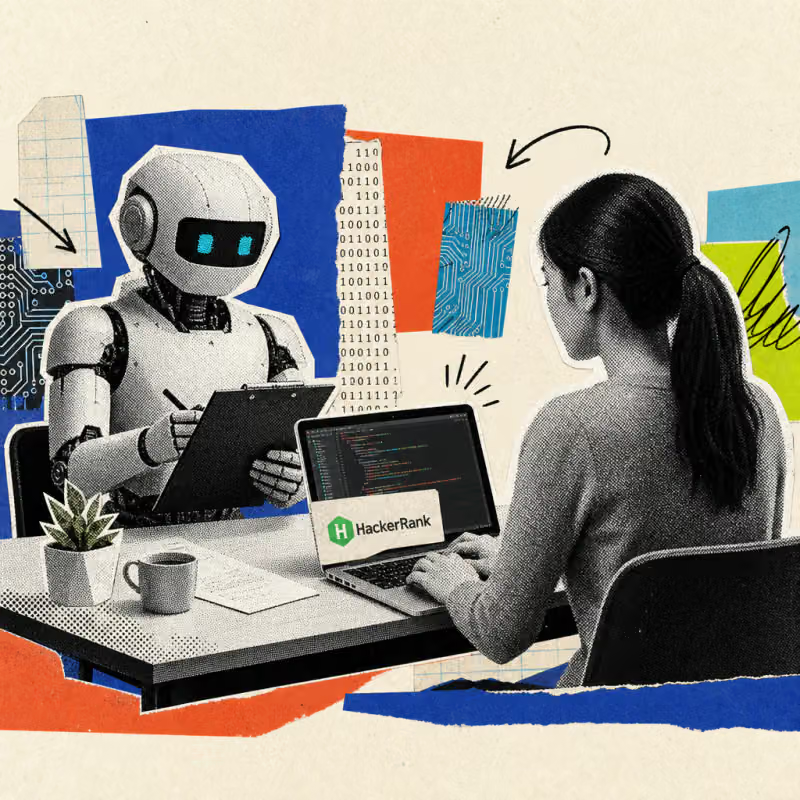
The developer portal HackerRank has released its AI interviewer Chakra for all customers on October 5, 2026, after six months of testing. The system conducts technical interviews via video and code environment independently, replacing the previously common three separate interview rounds.
More than 500,000 test interviews have already been conducted with the product.
One AI conversation replaces three interview rounds
Candidates work on real programming tasks in Chakra in a work environment that resembles a real development tool and includes an integrated AI assistant. The system evaluates not only the finished solution but also the thought process and judgment.
Additionally, there is what HackerRank calls "AI fluency": how candidates formulate problems for an AI tool and assess its suggestions. Companies define role, skills, and evaluation criteria in a chat dialog and invite candidates via email, link, or directly from their applicant tracking system.
So far, Chakra primarily covers technical roles, such as AI Engineer, Forward Deployed Engineer, Customer Experience Engineer, and AI Product Manager. The company, founded in 2012, claims to have more than 3,000 business customers, including Amazon and Nvidia, as well as a developer community of 30 million members.
For candidates, a single adaptive conversation thus replaces the traditional sequence of initial screening, technical interview, and case study. Senior Product Manager Mayur Moorthy justifies the move with the growing volume of applications, lengthy scheduling, and increasingly AI-polished or even fabricated application materials.
HackerRank itself once debuted at the founder conference TechCrunch Disrupt before becoming an established provider of technical hiring tests.
Fewer cheating attempts than in traditional tests
The six-month testing phase before the official launch began back in April 2026. Suspicious behavior, such as unauthorized aids or outside help, reportedly occurred 70 to 80 percent less often than in conventional hiring tests.
This figure is not independently verified. HackerRank co-founder and CEO Vivek Ravisankar explains this by saying that candidates with legitimate AI access have less incentive to cheat secretly.
He compares the shift to Apple's move from the iPod to the iPhone and sees it as the company's future direction. Across these test interviews, candidates reportedly rated the experience an average of 4.8 out of 5 points.
The first customer companies include the software firm Snowflake, the data company Snorkel, and the consulting group Capgemini. Companies get access through HackerRank's own platform, chakra.sh; the company has not published pricing information.
It has not said which countries will get the offering first. Besides video and a code editor, the system can also display a virtual whiteboard on request, for example for system-design questions.
Critics point to discrimination risks in AI interviews
Automated evaluation systems can, according to experts, inherit or even amplify biases from their training data. That holds even when a well-calibrated system discriminates less than a human interviewer would.
Ravisankar acknowledges this risk, while also pointing to bias audits by outside reviewers that HackerRank says it regularly commissions. New York City already mandates bias audits for automated systems that help decide on hiring.
Affected candidates must also be notified in advance. The final decision on acceptance or rejection still rests with a human, not the algorithm – Chakra only supplies the evaluation basis.
A similar trend is already visible in the ongoing dossier on AI and the labor market: an analysis by the Indeed Hiring Lab had previously linked the growth in open US software jobs to the rise of AI coding tools.
What will matter is whether Chakra actually judges more objectively in practice than human interviewers do. It is just as plausible that the system merely carries forward its training data's biases in a new form – independent research on that question is still pending.
For candidates applying to technical roles, the shift already brings a new requirement: programming skills alone no longer suffice, and working visibly and traceably with AI tools becomes part of the selection process.