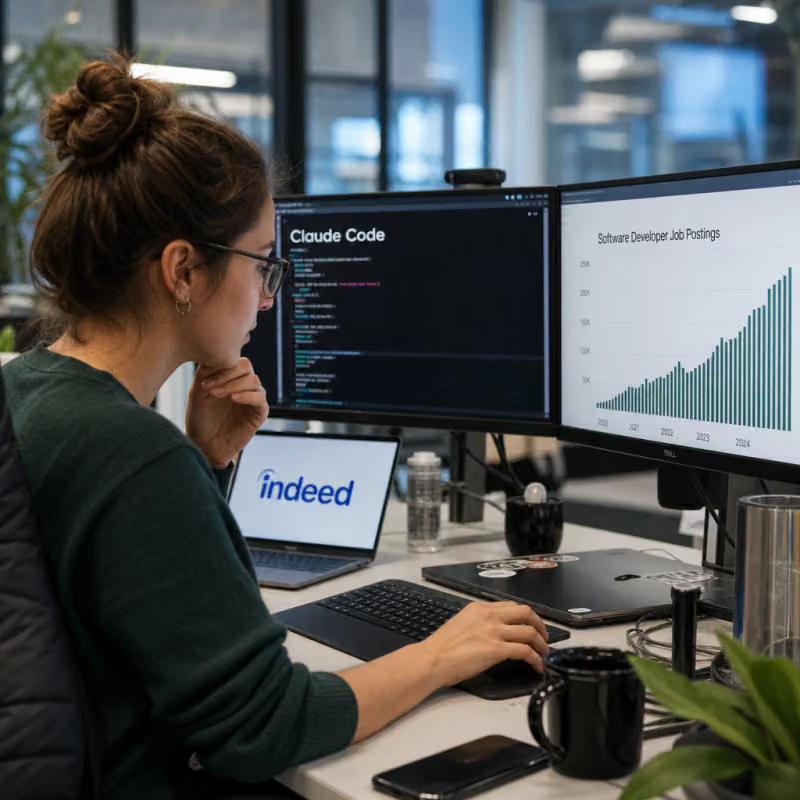
Job postings for software developers in the USA have increased by nearly 15 percent since February 2025, while the overall job market shrank by seven percent during the same period. This is shown by an analysis from the Indeed Hiring Lab dated July 8.
The timing coincides with the launch of Anthropic's programming tool Claude Code in February 2025.
Developer job postings recover more strongly than the overall market
The analysis compares the Indeed-owned job posting index before and after the launch of Claude Code. While the index for all US job postings fell to around 93 points, the sub-index for software developer positions rose to about 114.6 points.
This corresponds to an increase of nearly 15 percent compared to the baseline value from the end of February 2025.
Comparable movements were also recorded by the Indeed Hiring Lab outside the USA: in Canada, the UK, and Australia, developer job postings increased similarly during the same period. According to the analysis, this is not merely an isolated American effect, but a pattern that extends across several English-speaking labor markets.
However, the recovery remains limited: despite the increase, developer job postings are still about 27.5 percent below the level from before the Covid-19 pandemic. The increase thus marks more of a turning point than a full return to previous employment levels.
The starting point for the calculation is the week of the Claude Code launch at the end of February 2025, which the Hiring Lab sets at an index value of 100.
Senior roles and AI job titles drive the increase
A large part of the increase is unevenly distributed across experience levels. About 71 percent of the growth is attributed to positions for experienced professionals, while entry-level positions for newcomers are growing significantly more slowly (independently unverified).
Roughly 37 percent of the new postings also carry explicitly AI-related job titles, for instance roles tied to agentic programming tools or AI-assisted development processes.
For newcomers to the profession, this means the job market for software development is recovering overall, but access remains unevenly distributed. Those who already have experience benefit more than someone who is just starting out.
Claude Code is an agentic command-line tool from Anthropic that independently plans programming tasks, writes and tests code, rather than merely offering individual suggestions. The Hiring Lab has long categorized occupations by how strongly their tasks overlap with the capabilities of generative AI, and software development ranks among the most affected fields.
The current analysis draws on that same categorization to make visible the link between AI exposure and how quickly individual occupational groups are recovering.
Economists urge caution in interpretation
Economist Guillermo Gallacher from the Indeed Hiring Lab describes the timing between the Claude Code launch and the turnaround as a coincidence that cannot be ignored. However, the analysis itself acknowledges that the increase cannot be fully explained by the single tool.
Reliable causal evidence has so far been lacking, since the effects of individual tools are difficult to separate from broader economic swings and seasonal fluctuations in the US labor market.
Gallacher also points to a wider pattern: the more exposed an occupation is to AI, the stronger its recovery tends to be on average. Occupations with high AI exposure, however, had already declined more sharply since 2022 than others, well before the emergence of ChatGPT.
The Hiring Lab cites higher interest rates and the end of the pandemic-era hiring wave as reasons. The current increase can therefore be read both as a catch-up effect following that earlier slump and as a direct consequence of new programming tools.
According to the analysis, the two explanations are not mutually exclusive.
What will matter is whether the upward trend continues as agentic AI tools spread beyond software development into other occupational fields. Only future editions of the Indeed Hiring Lab analysis are likely to show whether the pattern turns into a lasting shift or remains a temporary rebound after the downturn of recent years.