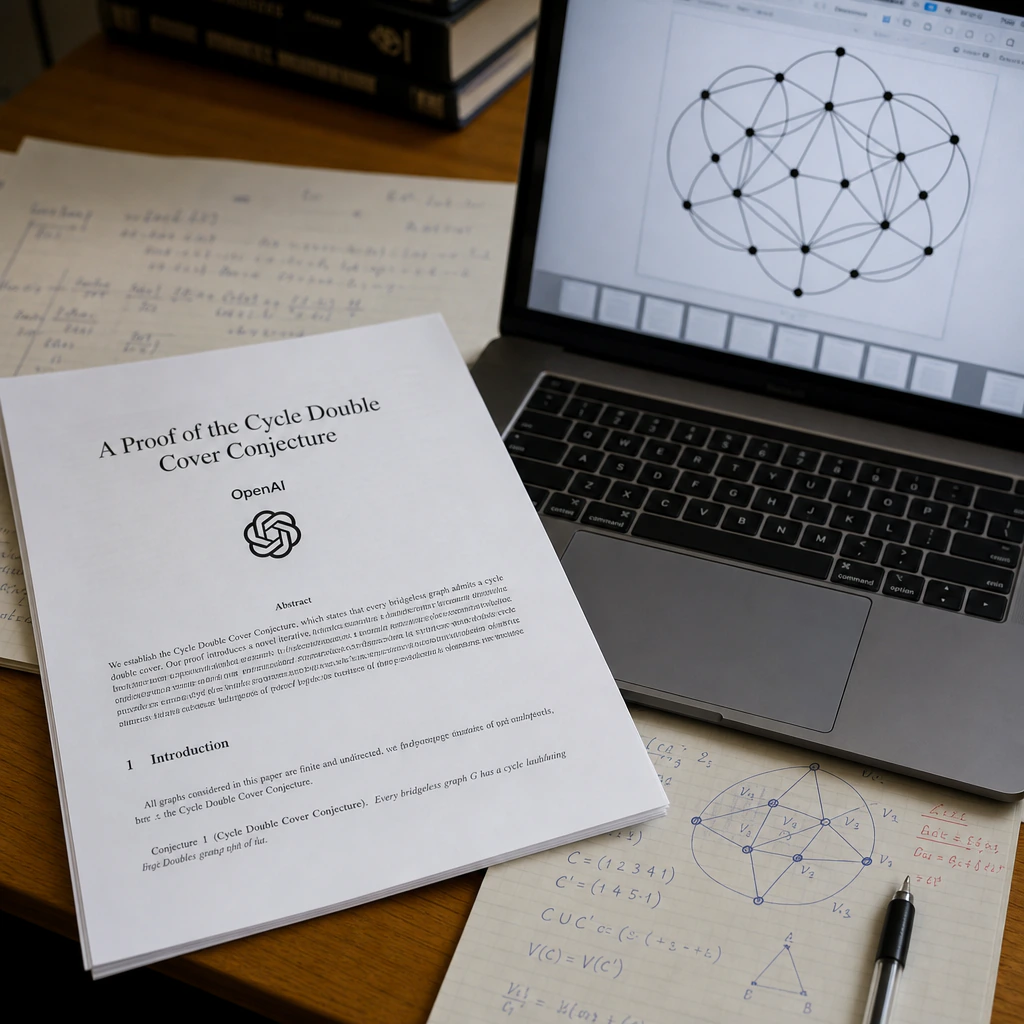
OpenAI published a proof of the Cycle Double Cover Conjecture on Friday, a graph theory problem that has remained unsolved for fifty years. The language model GPT-5.6 Sol Ultra generated the three-page proof in less than an hour, according to the company, aided by 64 subagents working in parallel.
An independent review by mathematicians is still pending.
Model reduces the graph problem to linear algebra
The conjecture states that every bridgeless graph has a so-called double cover: a collection of cycles that covers each edge exactly twice. It was formulated independently by George Szekeres in 1973 and by Paul Seymour in 1979.
It ranks among the best-known open questions in graph theory. According to the published paper, GPT-5.6 Sol Ultra first reduces the general problem to cubic graphs, in which every node has exactly three edges.
The model then applies the so-called eight-flow theorem along with earlier results from mathematician William Tutte to label edges with elements of a finite field. The proof turns these labels into assignments of edges to sets that must satisfy specific conditions at every node.
The remaining part is resolved through linear algebra. OpenAI publicly released both the three-page proof document and the complete, likewise viewable prompt on the internet.
The document itself states that the proof is entirely attributable to GPT 5.6 Sol Ultra, while the language model Codex assisted with the written write-up.
Unusual instruction in the prompt raises doubts
As OpenAI researcher Ethan Knight reported on X, the model GPT-5.6 Sol Ultra had only been made generally available the day before. For the proof task, the model reportedly deployed 64 subagents in parallel and completed the work in just under an hour.
The prompt explicitly allotted at least eight hours of processing time. According to users, the announcement reached the Hacker News front page within an hour.
The prompt itself is drawing criticism in the discussion on Hacker News. It instructed the model to assume, for the purposes of the task, that a complete affirmative proof exists.
Several users regard this instruction as a bias that steered the model toward a fitting construction rather than an independent discovery. One Hacker News user summed up the criticism pointedly: the proof has so far been checked by neither outside experts nor an automated proof assistant.
Whether the submitted proof is actually free of errors is independently unverified and remained an open question at the time of publication. According to experts, no proof-assistant system mature enough to automatically retrace graph theory this advanced currently exists.
Earlier AI successes in mathematics are piling up
The case adds to a growing number of reports about mathematical results produced by language models. Back in May 2026, an internal OpenAI model reportedly disproved a geometry conjecture posed by Paul Erdős.
That result was verified at the time by outside mathematicians, including Fields Medalist Timothy Gowers. The current case differs from that one in a key way: no comparable outside confirmation exists yet for the Cycle Double Cover proof.
Observers in the Hacker News discussion suggest this could be the first problem solved by a language model that had previously appeared on Wikipedia's list of unsolved problems. At the same time, commentators there are asking how systematically manufacturers now test new models against unsolved problems, and how high the success rate of such attempts actually is remains unclear.
Industry outlets estimate the pure computing costs for producing the current proof at $275 to $485 on standard infrastructure. On specialized Cerebras hardware running at maximum throughput, those costs could climb to as much as $13,000, according to Developers Digest.
OpenAI itself has not commented on these cost estimates.
What will matter is whether established graph theorists confirm every single reduction step of the work line by line. Earlier proof attempts for the same conjecture on the preprint server arXiv have repeatedly turned out to be flawed and were withdrawn by their authors.
A solid verdict from the field is therefore unlikely to arrive within days, according to observers, and more likely over the coming weeks.