Bill Gates published a roughly 6,000-word essay on August 26. Its sharpest number: workers aged 22 to 25 in heavily AI-exposed occupations already face a 19 percent employment gap, per the Stanford analysis he cites.
That figure sits inside a larger break from the tone Gates has used for years: in 2023 he compared his enthusiasm for AI to the arrival of the PC and the internet; now the 70-year-old writes that the transition into the AI era will be one of the most turbulent periods in human history even under the best circumstances — and that nobody is preparing for it.
His line: "There is no plan to ease the entry into the AI era." In the accompanying video he sharpens it further: there isn't even a plan to have a plan.
The argument is economic, not apocalyptic
Gates is not warning about superintelligence slipping out of control. He is warning about speed.
Earlier technological leaps took work off people's hands and created new tasks that required thinking. AI takes over the thinking itself — and it adapts to humans rather than the other way around.
That, he argues, is why the disruption will hit law, customer service, medicine, software and manufacturing within a decade rather than across generations.
First in line, he expects, are sales, customer support, software development and paralegal work; later loan assessment, data analysis and the initial triage of patients. Blue-collar work comes under pressure as robots get cheaper.
The hardest hit are the youngest, entering a labour market with fewer entry-level openings.
He offers three proposals:
- New institutions. National bodies that coordinate employment, taxation, energy, elections, public health, the financial system and security together. Internationally, a new organisation, for which he names arms-control inspection regimes, global aviation rules and the ozone treaty as models.
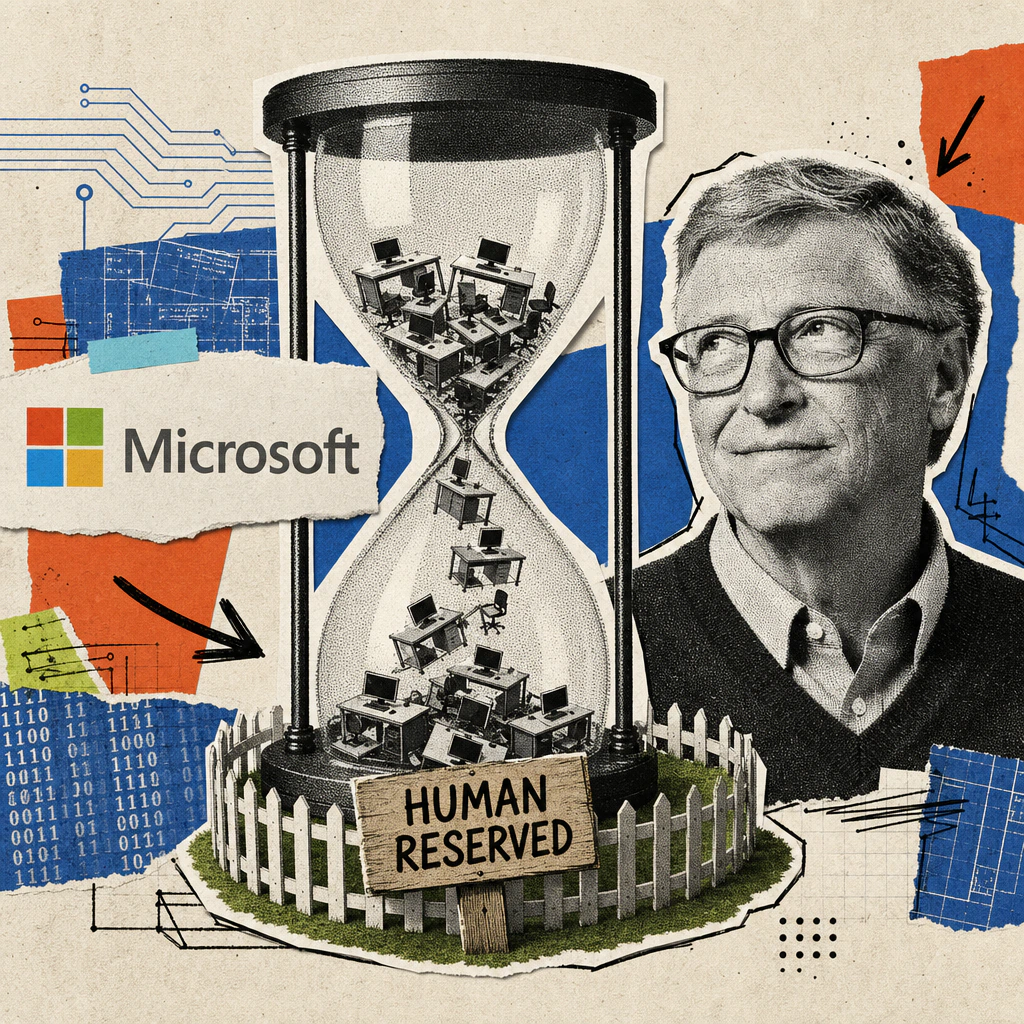
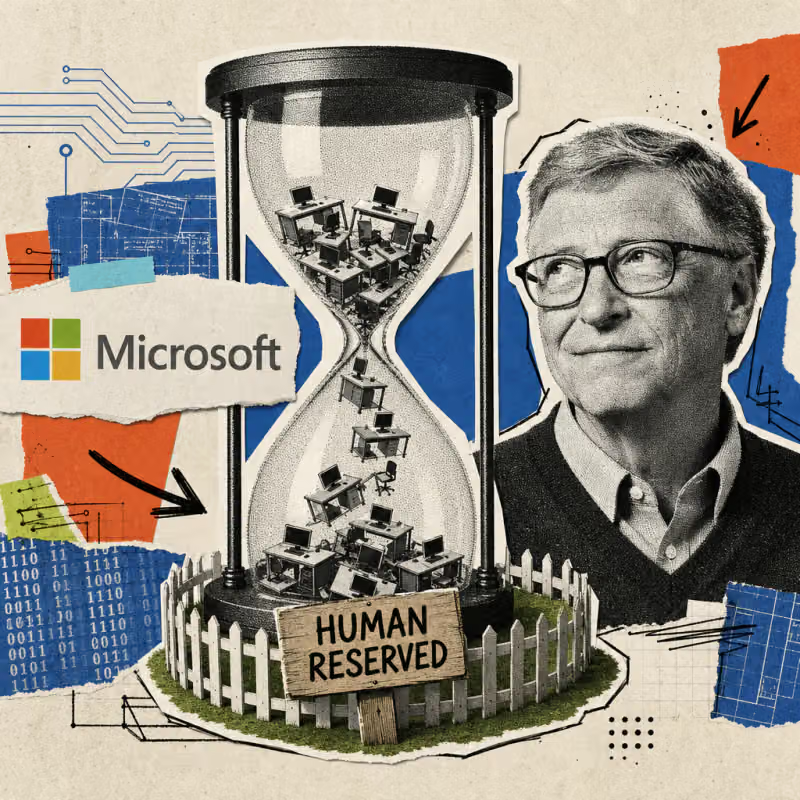
- "Human Reserved." Deliberately keeping certain work in human hands, in care and education for instance — the way a nature reserve is set aside rather than built on.
- Taxes on AI use and robots to fund retraining and social protection.
The data check: sharper, and less comfortable
The most empirically solid part of the essay is the claim about entry-level work. It rests on "Canaries in the Coal Mine?" by Erik Brynjolfsson, Bharat Chandar and Ruyu Chen at the Stanford Digital Economy Lab, which draws on payroll data from ADP.
The version revised in August 2026 runs through June 2026 — and it says two things at once.
First: broad, economy-wide displacement by AI is not visible in the data. Second: the employment gap for 22- to 25-year-olds in highly AI-exposed occupations has widened to roughly 19 percent, measured against where they would stand had they kept pace with peers in less exposed occupations.
In absolute terms, employment for that age group in the two most exposed quintiles fell by about eleven percent between November 2022 and June 2026, while it grew by around ten percent in the three least exposed. The lab tracks the trend in a continuously updated dashboard.
That is more precise than the frame Gates uses — and in a way more uncomfortable. The measurable effect is real but concentrated: at the point of entry, not across the board. Shrinking the debate to "AI destroys jobs" misses exactly the spot where policy could get a grip.
Which occupations the data marks as comparatively safe
Gates mostly describes what disappears. The opposite question — what stays — can at least be approximated with Anthropic's Economic Index.
The index measures no opinions. It records, across the roughly 18,000 task statements in the US occupational database O*NET, where the Claude model actually shows up in real usage data.
The result is heavily concentrated. Computer and mathematical occupations, educational instruction and library work, and sales sit at the top.
Physical-world work sits at the bottom: tasks carried out in the material world barely register. A companion study by Anthropic economists Maxim Massenkoff and Peter McCrory measures "observed exposure" per occupation — computer programmers lead with 75 percent of their tasks covered, followed by customer service representatives, then data entry keyers at 67 percent.
Precisely the two occupations Gates names first.
At the other end sit roughly 30 percent of US workers the study does not cover at all, because their tasks appear too rarely in the data: cooks, motorcycle mechanics, lifeguards, bartenders, dishwashers, dressing room attendants.
Strictly speaking that is a gap in measurement rather than measured safety — but it lines up exactly with work that requires physical presence.
More telling than the ranking is the distinction Anthropic introduced and the Stanford researchers adopted: automation, where the model performs the task, versus augmentation, where it works alongside. Employment among young workers falls in occupations where AI automates — in occupations where it mostly assists, it grows.
Proximity to AI is not what decides the outcome; the mode of use is.
Radiology is the instructive case. The model covers the two most frequent tasks — reading images and writing interpretive reports — with a high success rate.
The rest of the working day, the hands-on and administrative parts, it does not. High exposure does not mean replaceability here.
Two caveats belong with this, or the data gets read for more than it says. The index measures Claude usage, not job security; where little AI shows up today, that can mean "not yet" rather than "never." And it covers software only.
The pressure Gates describes for blue-collar work comes from robots getting cheaper — and those appear nowhere in these numbers.
Our own reporting still cuts both ways
What we have been documenting for months fits that split picture. On one side, more than twenty tech companies have now explicitly attributed 2026 job cuts to AI; Monday.com cut 620 positions, a fifth of its workforce, citing its rebuild as an AI platform.
On the other, the US job market for software developers has grown by almost 15 percent since February 2025 while total job postings in the country fell by seven percent — in precisely the occupation Gates names first.
And Meta scrapped its second round of layoffs after internal data showed that AI agents produced 220 percent more code changes but shipped only 36 percent more features.
In 2026, "AI" is also a label for decisions that have other causes. That does not defeat the warning — it does mean corporate announcements work as an early indicator and not as evidence.
Where this gets awkward for Europe
Two of the three proposals land on hard ground here. "Human Reserved" runs into a care-worker shortage; Gates names Japan in the essay as the counterexample himself, arguing that countries with a shrinking workforce may welcome caregiving robots rather than fear them.
And a robot tax is more than a distribution question in economies whose export strength is automation technology itself.
Above all, the instrument is missing. The EU AI Act regulates the risks of systems, not their consequences for the labour market.
For the question Gates raises, no European body holds the brief. The US Federal Reserve has at least stood up a task force on productivity and jobs, even if its membership has been criticised as one-sidedly AI-friendly.
Nothing comparable, with data access and a mandate, exists in Germany.
A diagnosis without an addressee
Gates discloses in the essay that he remains financially tied to the tech industry. He also writes that he would probably back a credible plan to slow AI globally — but does not expect one, because the economic and geopolitical forces are too strong.
That puts his text alongside the "Pacing the Frontier" appeal signed by more than 1,200 staff at OpenAI, Anthropic, Google and Meta: the people closest to the technology describe the problem and hand the bill to governments.
The most operational sentence sits at the end of the essay: waiting until people are displaced or underemployed will be too late. Whether that becomes more than a well-phrased warning depends less on Gates' reach than on whether any government starts treating the 19-percent entry-level gap as a policy field.
Gates on video
A video released alongside the essay has Gates summarising the three risks himself — watch it on YouTube.