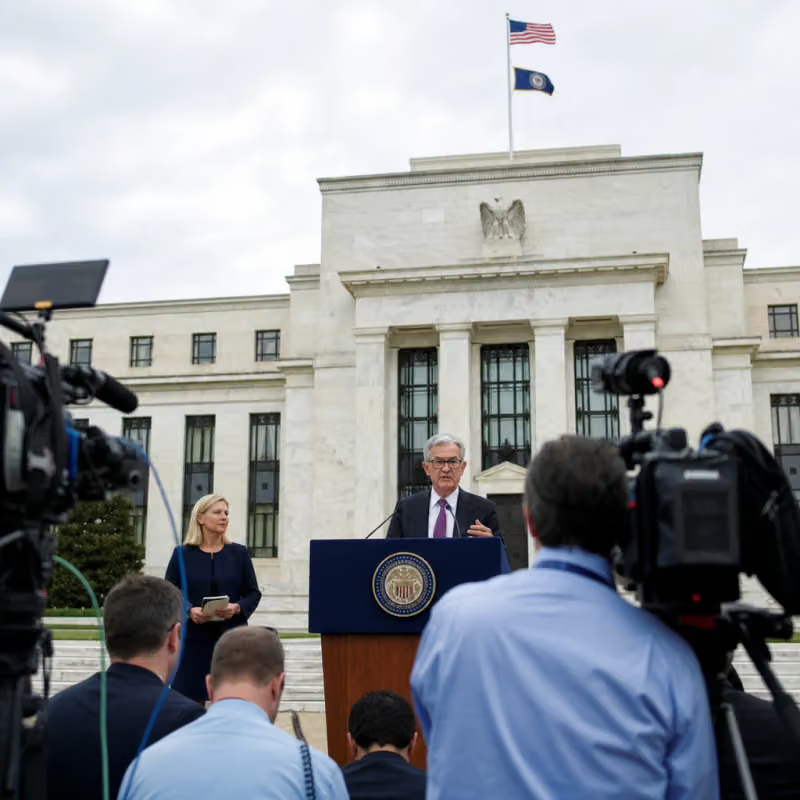
Fed Chairman Kevin Warsh has appointed AI investor Marc Andreessen as co-chair of a new task force that examines the economic implications of artificial intelligence for the U.S. Federal Reserve. Andreessen will lead the committee alongside Stanford economist Charles Jones and Microsoft executive Asha Sharma.
In total, Warsh established five working groups that are to present reform proposals by the end of the year.
Task Force Evaluates AI Impacts on Employment and Prices
The working group is named the Productivity and Jobs Task Force and is one of five committees that Fed Chairman Kevin Warsh launched on July 9.
According to the task description of the Federal Reserve, it is to investigate the economic impacts of new foundational technologies such as artificial intelligence and derive recommendations for monetary policy.
The focus is on the Fed's dual mandate of price stability and full employment: The results are expected to show how AI is changing labor markets and whether it influences inflation trends. In addition to Andreessen, the committee is co-chaired by Stanford economist Charles Jones, who is currently conducting research on leave at Anthropic, and Microsoft executive and Xbox head Asha Sharma.
Warsh justified the move by stating that the U.S. economy has fundamentally changed within a generation and that the Federal Reserve must examine whether its analytical tools and forecasting models are still up to date. The Fed has not yet specified a concrete end date for the final report but refers to the current year as a target framework for initial reform proposals to the Open Market Committee.
Four Additional Committees Reform Fed Institutions
In addition to the AI task force, Warsh established four other working groups that address different aspects of the Federal Reserve's work. One group, led by economist Karen Dynan and former Fed officials Raghuram Rajan and Jeremy Stein, is examining the costs and benefits of the Fed's current balance sheet policy.
A second team, led by Harvard economist Raj Chetty and former Walmart CEO Doug McMillon, aims to improve the quality and timeliness of economic data collection on which many of the Fed's interest rate decisions are based.
A third group is focused on the Fed's communication with markets and the public during periods of economic uncertainty, while a fourth is working on the framework for measuring inflation; among its members are Harvard economist Greg Mankiw, former Fed official William White, and Nobel laureate Thomas Sargent. According to Axios, Warsh places the initiative within a broader institutional reform agenda, through which he is bringing external expertise—also from technology and business—into the traditionally more closed institution for the first time on a large scale.
Critics See One-Sided Composition with AI Advocates
There is already criticism regarding the composition of the AI task force. Andreessen has held a distinctly optimistic view of artificial intelligence for years and has publicly stated that the greater risk lies not in job loss but in failing to utilize AI.
Sharma, on the other hand, reportedly cut around 3,200 jobs as Xbox head, citing relatively low profit margins compared to the industry— a figure that has not been independently verified. Jones takes a mediating position: He describes AI as a double-edged sword with potential for growth but also significant risks, advocating for its use to be expanded only as long as the benefits outweigh the dangers.
The industry service Cybernews pointedly describes the trio as a mix of a risk-taking manager, an AI enthusiast, and a cautious economist, raising the question of whether the perspectives of employees are adequately considered in the analysis.
A potential conflict of interest remains unaddressed: Andreessen's firm, Andreessen Horowitz, is one of the largest investors in AI startups worldwide and directly benefits from how the Fed responds to the technology in regulatory and monetary policy terms.
It will be crucial whether the task force delivers concrete metrics by the end of the year that allow the Fed to distinguish AI-related productivity gains from regular economic dynamics. So far, the Federal Reserve lacks a robust model for how quickly automation changes wages and employment in individual sectors.
Warsh has announced that the results of all five committees will be incorporated into ongoing monetary policy decisions—how much weight AI issues actually receive will only become clear with the first reports.