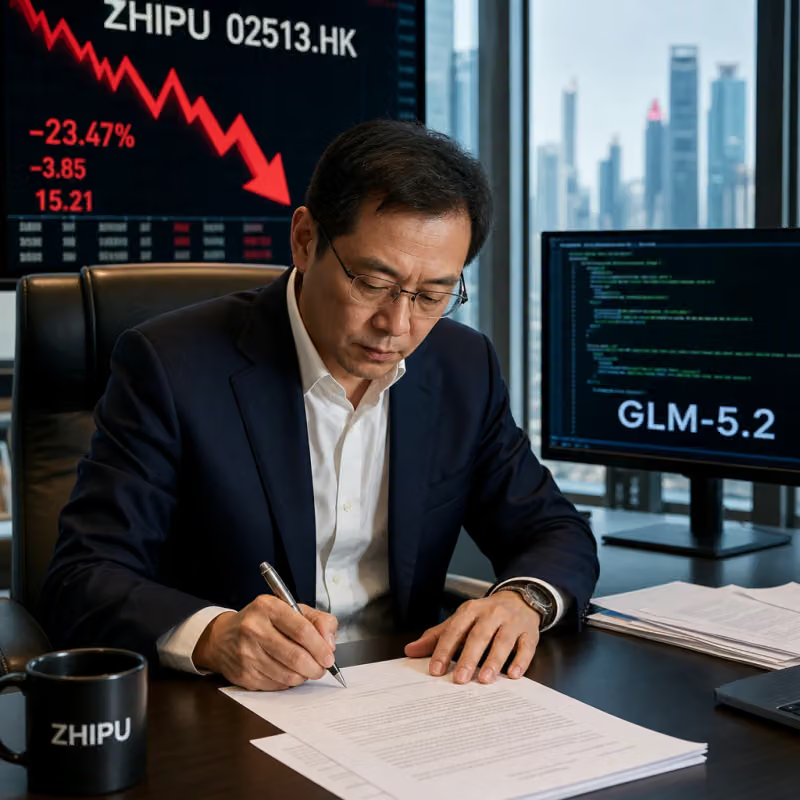
Zhipu co-founder Tang Jie announces the "Touch-High" plan in an internal letter to all employees: The Chinese AI company will focus on AGI research for two years instead of rapid commercialization. The announcement on July 11 comes in a week when Zhipu's stock, traded on the Hong Kong Stock Exchange, lost about 17 percent in a single trading day after a lock-up period expired.
Four Research Areas Consolidate Billions in Investments
The "Touch-High" plan (Chinese 摸高, literally "reach up") identifies four focal points. First, AI systems are to transition from short answers to tasks that extend over weeks or months, such as complete technical projects.
Second, Zhipu is investing in networks of autonomous agents that are supposed to work together around the clock and independently take over individual work steps. Third, the company is focusing on complete self-training: models generate their own training data and improve themselves through self-play mechanisms, a process where systems compete against earlier versions of themselves.
Fourth, Tang Jie announces a "resource investment in the hundred billion range" for safety research, specifically for mechanistic interpretability – methods that allow understanding how a neural network arrives at a decision.
Zhipu has already released its flagship model GLM-5.2 under an MIT license, which allows downloading, modification, and commercial use without restrictions, thus containing significantly fewer requirements than comparable licenses from Western providers. "Not reaching the summit is failure," writes Tang Jie in the letter, which has been quoted by several Chinese media outlets.
Stock Plunge After Lock-Up Period Tests Investor Patience
The letter appears three days after a lock-up period for anchor investors expired on July 8: About 25.68 million shares, approximately 5.76 percent of the capital, became tradable for the first time. According to data from the financial portal BigGo, Zhipu's stock fell by almost 17 percent in a single trading day to 1,754 Hong Kong dollars, dragging the market capitalization below 800 billion Hong Kong dollars, equivalent to about 102 billion US dollars.
From the previous record high of nearly 2,980 Hong Kong dollars, this represents a decline of more than 40 percent, although the price had temporarily risen by more than 2,000 percent since the IPO in January 2026. The competitor MiniMax, also listed in Hong Kong, lost double digits after its own lock-up release.
Just a few days earlier, Zhipu had announced a capital increase of around four billion US dollars through a share placement and additionally hinted at a listing on the Shanghai STAR Market, according to Bloomberg.
These details regarding the capital increase have not been independently verified.
It will be crucial whether Tang's bet on fundamental research pays off, while investors are likely to expect more short-term returns after the record rise of the stock. With the open MIT license of GLM-5.2, Zhipu also positions itself as a counter-model to the more isolated access of Anthropic and OpenAI.
Whether the "Touch-High" plan will hold up is likely to be shown by the expected valuation in 2027 in the context of the planned Shanghai listing.