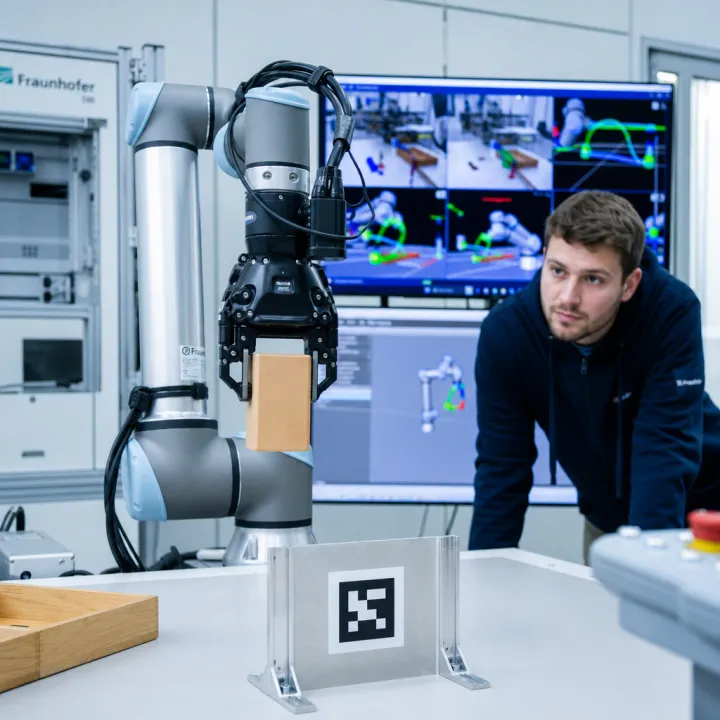
Black Forest Labs from Freiburg presented an open robotics model called FLUX 3 Action on September 23, 2026, which translates camera images and voice commands directly into robot movements. With seven billion parameters, it claims to achieve a success rate of 42.92 percent on the Nvidia benchmark RoboLab-120, surpassing the previous best open model.
Benchmark value not independently confirmed so far
FLUX 3 Action builds on the multimodal base model FLUX 3 and processes video data, robot sensors, and voice commands in a unified system. With seven billion parameters, it reportedly operates with less than half the size of Nvidia’s Cosmos-3-Nano-Policy with 16 billion parameters and works significantly faster. According to Black Forest Labs, the comparison value on RoboLab-120, Nvidia’s benchmark for robot control, is 42.92 percent success rate – 6.1 percentage points ahead of the previous leader among open models, as reported by VentureBeat. This value has not been independently verified at the time of publication: it initially did not appear on Nvidia’s public leaderboard. The trade publication Superpower Daily also points out that the demonstration videos shown only displayed selected scenes and that comparisons between differently sized models are methodologically not directly comparable. It is crucial whether external teams can replicate the benchmark on their own hardware. A separate evaluation by the company Positronic Robotics on a Franka robotic arm achieved 28 out of 30 successfully solved tasks.
Model weights not publicly available for now
Unlike previous FLUX models, Black Forest Labs is currently withholding the weights of FLUX 3 Action. Access is initially granted to selected research and industry partners, including the Swiss robotics startup mimic robotics. Black Forest Labs had already presented the video action model FLUX-mimic in July 2026, which car manufacturer Audi is testing in its production. To complete the new system, Black Forest Labs is also working with Nvidia on a connection to the simulation environment Isaac Lab and the Jetson hardware. Additionally, the company is collaborating with Hugging Face on an integration into the robotics framework LeRobot. The company has not yet announced a date for the broad release, a license, or an API price list. The demonstrations shown are reportedly based on around 200 teleoperated training episodes for fine-tuning on specific tasks. It thus remains open for now how reliably the shown capabilities can be reproduced outside the test environments selected by Black Forest Labs. For industry partners in Europe, it will be decisive whether the technology can be integrated into their own production lines.
Freiburg company establishes itself in Europe’s AI scene
Black Forest Labs was founded in March 2024 by a group of former researchers including Robin Rombach. They had previously worked at the London company Stability AI on the foundations of image generation Latent Diffusion and Stable Diffusion. The company is based in Freiburg im Breisgau, with a second location in San Francisco. After a Series B round of over 300 million dollars, the company is valued at 3.25 billion dollars and is considered one of the most valuable German AI companies according to a compilation by beckmann.ai. With FLUX 3 Action, Black Forest Labs is competing for the first time with a standalone robotics model against competitors like Nvidia. The French company Mistral had also previously introduced a camera-based navigation solution in this field with Robostral Navigate. For the business location, this initiative is a signal that European providers want to do research not only on language models but also on physical AI. Commercial exploitation, however, is still in its early stages.
It will be crucial whether Black Forest Labs actually delivers the promised broader release of the weights and whether external laboratories can replicate the RoboLab-120 results. Until then, FLUX 3 Action remains primarily a signal to the robotics industry, not yet a ready-to-use product. For Germany’s AI economy, it is nonetheless further evidence that Freiburg is building an independent research profile in physical AI alongside the major US labs.