The French AI company Mistral AI presented its first model for robot navigation, Robostral Navigate, on July 8, 2026. The system is designed to control robots solely based on a single RGB camera and natural language instructions through complex spaces – entirely without Lidar or depth sensors.
With this, Mistral is strategically expanding its portfolio towards "Physical AI," the area of artificial intelligence that connects software with real, moving machines.
What Robostral Navigate is supposed to achieve
According to the official announcement from Mistral AI, Robostral Navigate is a model with eight billion parameters that combines camera images and text instructions to derive movement commands for a robot.
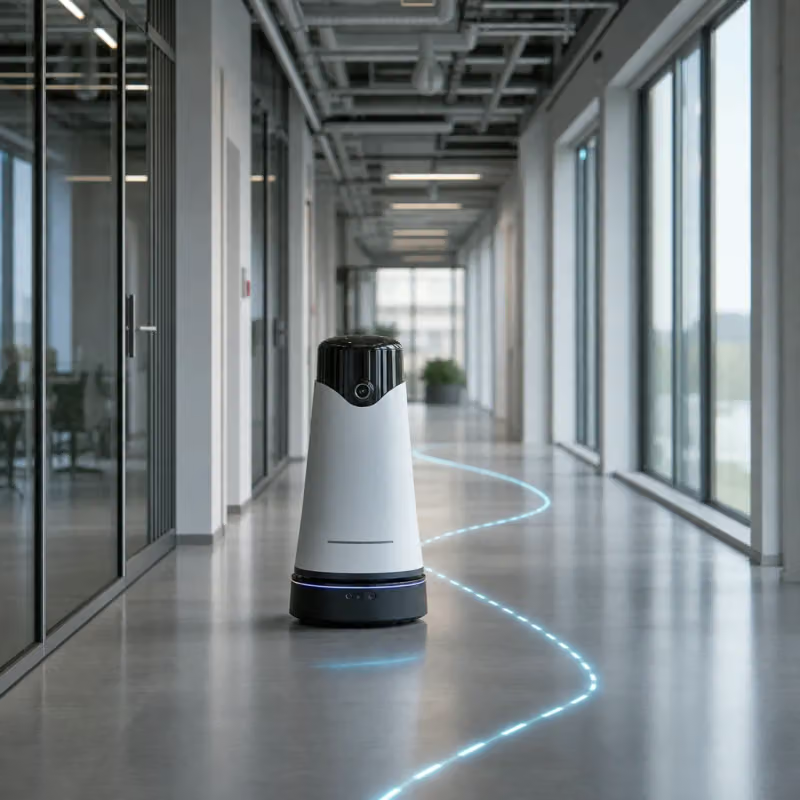
Users are expected to give the system multi-step instructions, such as: leave the lobby, walk down the hallway, enter the storage room, and stop in front of the second shelf. The model either recognizes a target point in the current camera image or, if no target is visible, provides a rough movement direction.
According to Mistral, the system works with wheeled, walking, and flying robots of various designs and sizes and is supposed to be robust against different camera characteristics and unforeseen obstacles. The company cites manufacturing, warehouse logistics, delivery, and hospitality, as well as general indoor and outdoor navigation in office and residential buildings as application fields.
Training and benchmark values
According to Mistral, Robostral Navigate was fully trained internally and based on simulations, using around 400,000 movement trajectories in 6,000 different scenes. A technique called Prefix-Caching with tree-based attention masking reduced the training effort compared to standard methods by a factor of 22; a subsequent online reinforcement learning with the so-called CISPO algorithm improved the success rate by an additional 3.2 percentage points.
On the common navigation benchmark R2R-CE (Room-to-Room Continuous Environments), the model achieved a success rate of 79.4 percent in already known environments and 76.6 percent in unknown environments, according to Mistral.
This is 9.7 percentage points above the best-known solution with only one camera and 4.5 points above systems with multiple sensors, the company states. These values have not been independently verified so far – they come exclusively from Mistral's own publication.
Part of a broader Physical AI strategy
The presentation of Robostral Navigate follows the acquisition of the Vienna-based startup Emmi AI in May 2026, which, according to Mistral's own announcement of the acquisition, specializes in physics simulations and technical engineering models for industry.
Both steps fit into a strategy with which Mistral aims to position itself as a European provider of industrial AI applications in sectors such as aerospace, automotive manufacturing, and semiconductor production.
Mistral is not the only European company making strides in this area: As Reuters reported, the also Paris-based startup Genesis AI had already presented a broader robotics model a few months earlier, which is supposed to master not only navigation but also grasping and manipulating objects. PYMNTS places Mistral's initiative within the larger trend of increasing investments in physical AI, which has recently also prompted other major providers to launch their own robotics initiatives.
Open questions
At the launch of Robostral Navigate, Mistral has not published model weights, a technical paper, or prices. Interested companies are referred to its sales team; Mistral did not provide a specific date for broader availability.
It remains unclear how the model performs outside of the test environments constructed by Mistral itself in real deployments – a point that independent tests have not yet been able to clarify, as corresponding access does not yet exist.