Thinking Machines Lab released its first publicly accessible language model on July 15, 2026. Inkling utilizes a Mixture-of-Experts architecture with 975 billion parameters, of which only 41 billion are active per request.
The start-up founded by Mira Murati makes the complete model weights publicly available, competing against established open models from the USA and China.
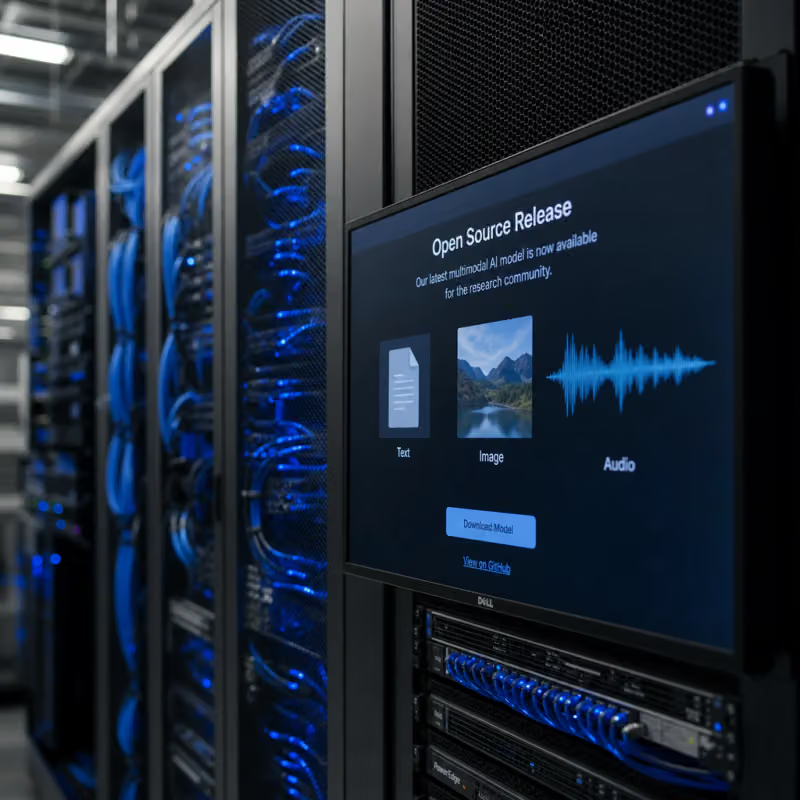
Model processes text, image, and audio without separate encoders
Inkling is based on a Mixture-of-Experts architecture with 256 routing experts per layer, of which six can compute simultaneously per token. The model was trained on 45 trillion tokens from text, images, audio, and video, as detailed by Thinking Machines Lab in its own blog.
A context window of up to one million tokens allows for long documents and conversations. The model processes images in forty by forty pixel patches, audio via so-called dMel spectrograms – both without separate preprocessing modules, directly in the same network as text.
According to company claims, Inkling achieves 77.6 percent on SWE-Bench Verified and 87.2 percent on GPQA Diamond in internal benchmarks. Developers can also set a so-called "Thinking Effort" between 0.2 and 0.99, indicating how much computing power the model should use for a request – a compromise between response speed and quality.
A smaller variant called Inkling-Small with 276 billion parameters and 12 billion active parameters is in preview. For text tasks without tool usage, the main model also achieves 29.7 percent on the knowledge test Humanity's Last Exam and 97.1 percent at the Mathematics Olympiad AIME 2026.
Tinker platform turns fine-tuning into a business model
Thinking Machines Lab does not generate revenue through model access itself, but through its in-house platform Tinker, where companies can specifically retrain Inkling for individual areas of expertise. This approach contradicts the strategy of large providers, who try to optimize a single model for as many applications as possible, the company explains.
Founder Mira Murati confirmed the launch on the platform X: The model is trained from the ground up, the weights are open, and can now be fine-tuned on Tinker.
The complete weights are available through Hugging Face as well as providers TogetherAI, Fireworks, Modal, Databricks, and Baseten. For a limited time, there is a 50 percent discount on the use of the model on the Tinker platform.
Murati had left OpenAI in 2024 and founded Thinking Machines Lab; the company now has around 200 employees and brought its first product to market after about nine months of development, reports TechCrunch.
So far, the start-up has primarily financed itself through Tinker as a pure fine-tuning and hosting platform for external open models; Inkling is the first self-trained model in its own offering.
Start-up consciously does not position Inkling as the best performer
In its own blog post, Thinking Machines Lab admits that Inkling is "not the most powerful model available today, neither open nor closed." This restraint stands out, comments Axios – many providers promote new models rather with best scores.
In an internal security test by the company Cognition, Inkling also notably rarely refused requests, which Thinking Machines Lab interprets as evidence of lower susceptibility to censorship compared to some open models from China – unverified independently.
For the early retraining phase, some data was sourced from other open models, including Kimi K2.5 from Moonshot AI; future versions are expected to be developed entirely independently. Journalist Hayden Field interpreted the restrained tone of the announcement text as a conscious attempt to temper expectations and sees Inkling more as a benchmark for future models of the start-up rather than a finished attack on the market leaders.
This places Thinking Machines Lab in a field where recent Chinese providers like Moonshot AI and DeepSeek have also released open weights, while US companies predominantly prefer closed models.
It will be crucial whether companies actually prefer fine-tuning via Tinker to a finished specialized model or whether the additional effort consumes the promised cost savings. It also remains to be seen how Inkling performs in direct comparison with the latest open models from China once independent labs verify the company's benchmark values.