

arXiv:2607.08716 – Remember When It Matters: Proactive Memory Agent for Long-Horizon Agents
Note: This is the summary of a current, (not yet) peer-reviewed arXiv preprint. The results described come from a single study and have not yet been independently verified.
What is it about?
AI agents that work on a task over many steps – such as executing command line commands or engaging in multi-step customer service interactions – often lose sight of important information over time. The paper “Remember When It Matters: Proactive Memory Agent for Long-Horizon Agents” refers to this phenomenon as “behavioral state decay”: requirements, observations from the environment, or previous failures may still be somewhere in the log or context window, but they practically no longer affect the agent's next decision.
Instead of relying primarily on the storage and retrieval of information like previous approaches, the research team proposes a separate system: a second, parallel-running “Memory Agent” that observes the course of a main agent (the so-called Action Agent) and actively decides when a memory should actually be fed into the ongoing process.
What is it good for / what does it bring?
In the authors' tests, the additional Memory Agent significantly improves performance without needing to change the actual main agent. On Terminal-Bench 2.0, a benchmark with 85 autonomous command line tasks, the success rate with Claude Sonnet 4.5 as the main agent increases from 37.6% to 45.9% – an increase of 8.3 percentage points.
On τ²-Bench, which includes 278 interactive tasks from the areas of airline, retail, and telecommunications, the rate rises from 55.0% to 61.8% (+6.8 points). Even with the more powerful Opus 4.6 as the main agent, there are still gains of around 2.4 to 2.5 points.
The effect is not equally large across all task areas: In the airline sector of τ²-Bench, the authors observe an increase of about 10 points, while in the telecommunications sector, it is only about 2.6 points – an indication that the benefit of the method depends on the type of task.
Practically, this means: an agent that handles long tasks forgets less often why it must adhere to a certain rule, which environmental facts have already been observed, or which solution paths have already failed. This can mean fewer rule violations, fewer repeated failures, and overall more reliable results in practice.
How does it work (simplified)?
The system consists of two components that work in parallel: the unchanged main agent that performs the actual task, and a separate Memory Agent that becomes active at fixed intervals.
The Memory Agent operates in two phases. In the first phase, it maintains a structured “Memory Bank” with three types of entries: a private status that only internally records progress, stable knowledge such as requirements and verified observations from the environment, and procedural memories of previous attempts, their outcomes, and possible diagnoses.
Through targeted tool calls, it can create, update, or delete entries.
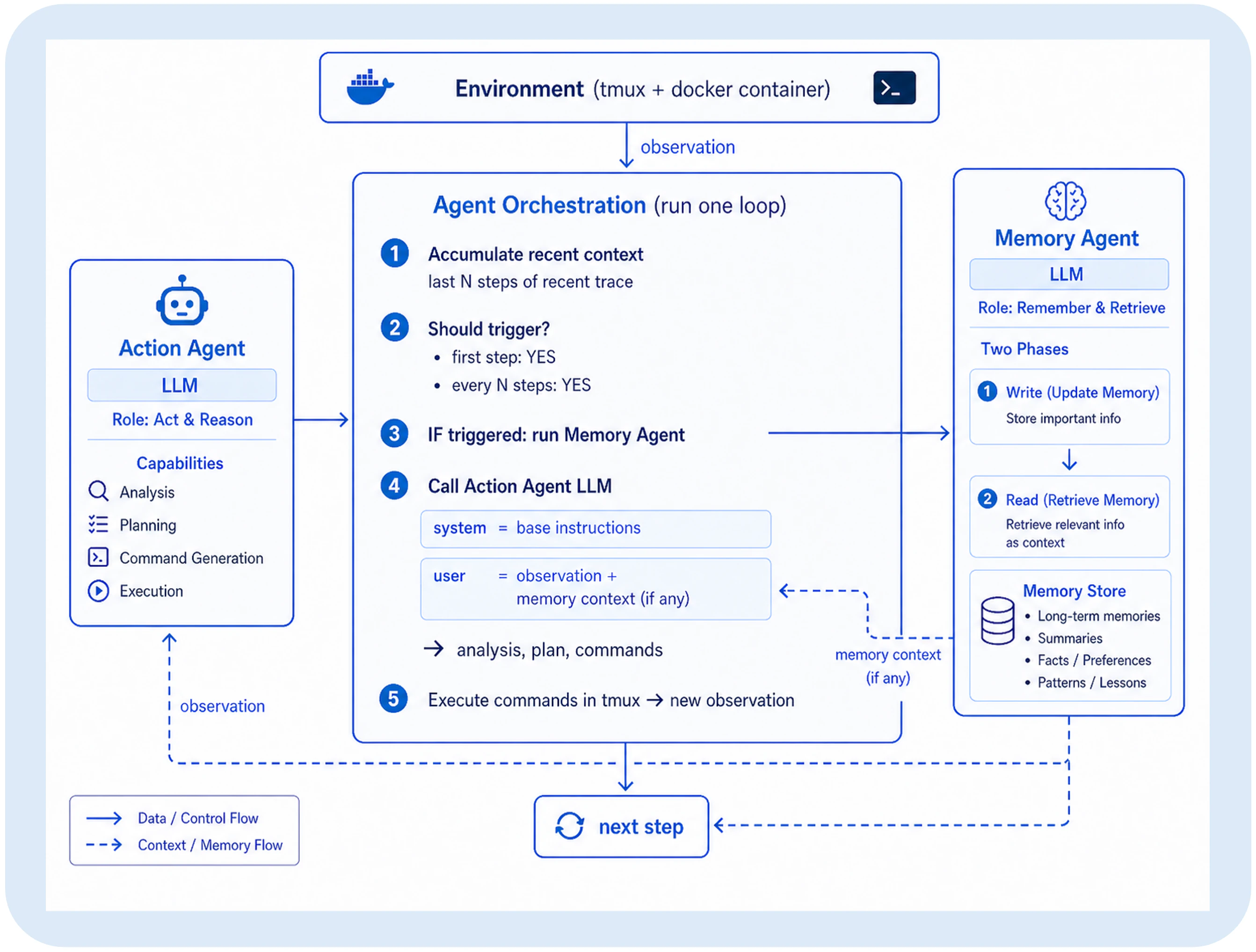
Fig. 1a: System integration – the Action Agent (left) interacts with the environment, while the Memory Agent (right) runs in parallel and maintains the Memory Bank. Source: arXiv:2607.08716, License CC-BY 4.0.
In the second phase, the Memory Agent decides whether to provide the main agent with a brief, Memory Bank-based reminder before its next step – or whether to consciously do nothing. This explicit option to remain silent is considered crucial by the authors: only when memories are fed in at the right moment, rather than constantly filling the context with additional hints, does the method have a positive effect.
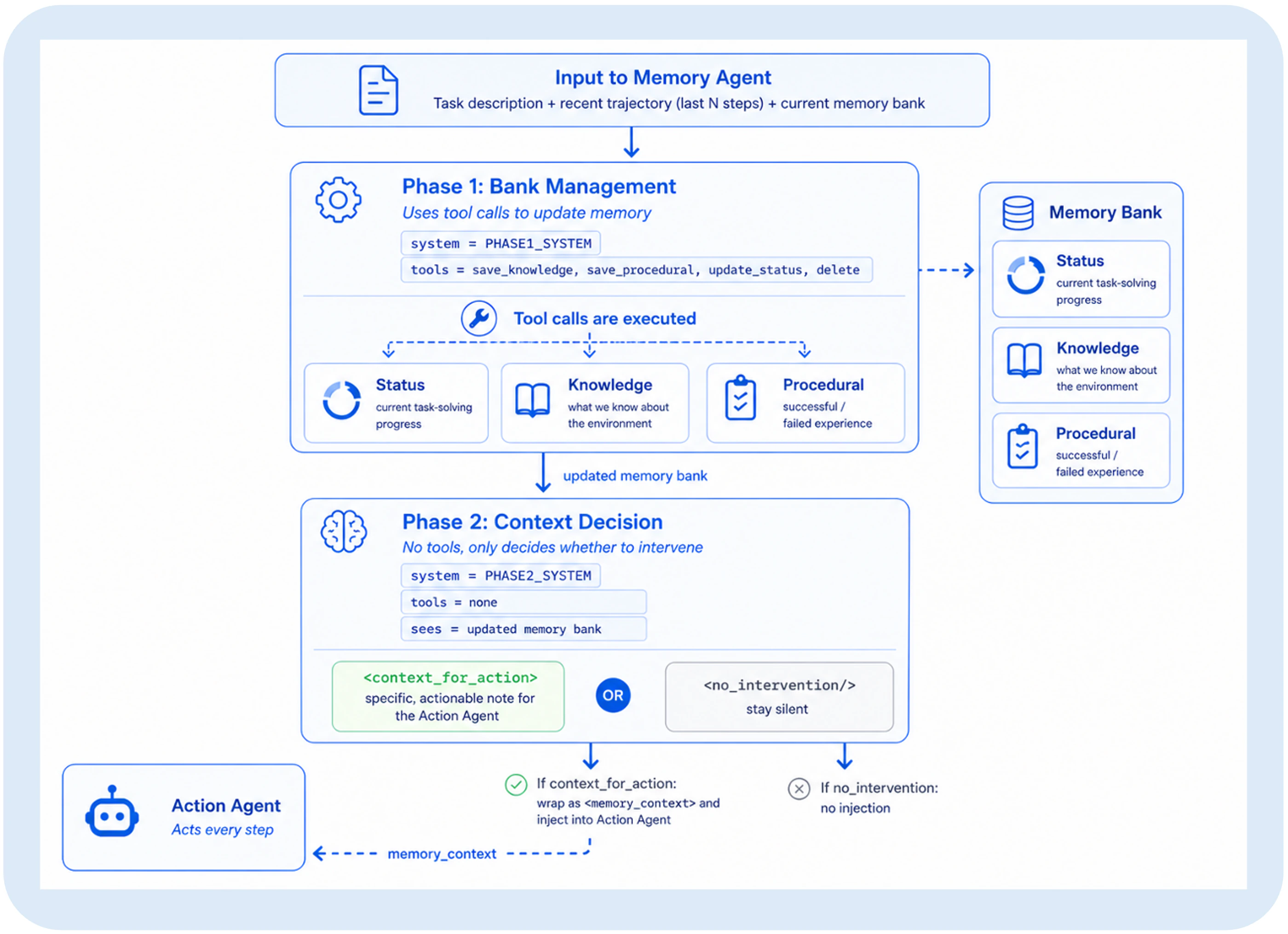
Fig. 1b: Internal structure of the Memory Agent – Phase 1 manages the Memory Bank (status, knowledge, procedural entries), Phase 2 decides on selective intervention based on this. Source: arXiv:2607.08716, License CC-BY 4.0.
The authors also demonstrate with a training experiment that this decision strategy is not necessarily tied to a very large model: a significantly smaller open model (Qwen3.5-27B), which was trained on the intervention strategy using supervised fine-tuning (SFT) and reinforcement learning (GRPO), transfers part of the effect to a withheld test dataset from Terminal-Bench (+3.5 points).
This suggests that the ability to recognize the right moment for a reminder can indeed be learned.
Comparison variants also show that neither simply providing the complete Memory Bank in context nor forcing reminders at every step performs as well as the selective two-phase strategy – both alternatives fall several points short.
Classification & Limitations
The method is intended as an additional, interchangeable module: it does not change the basic instructions or tools of the main agent and can therefore fundamentally be combined with different underlying models. The authors themselves point out that the fixed timing with which the Memory Agent is activated may not be optimal – event-driven triggers, such as after an error or a recognizable context change, were not investigated in the work.
Additionally, occasional misjudgments occur, such as overly confident conclusions or redundant memories, and the additional computational effort due to the extra inference steps of the Memory Agent is not quantified in the paper.
It remains important to note: this is an arXiv preprint that has (not yet) undergone a peer review process. The reported numbers come from the authors' own experiments and have not yet been independently reproduced or verified.