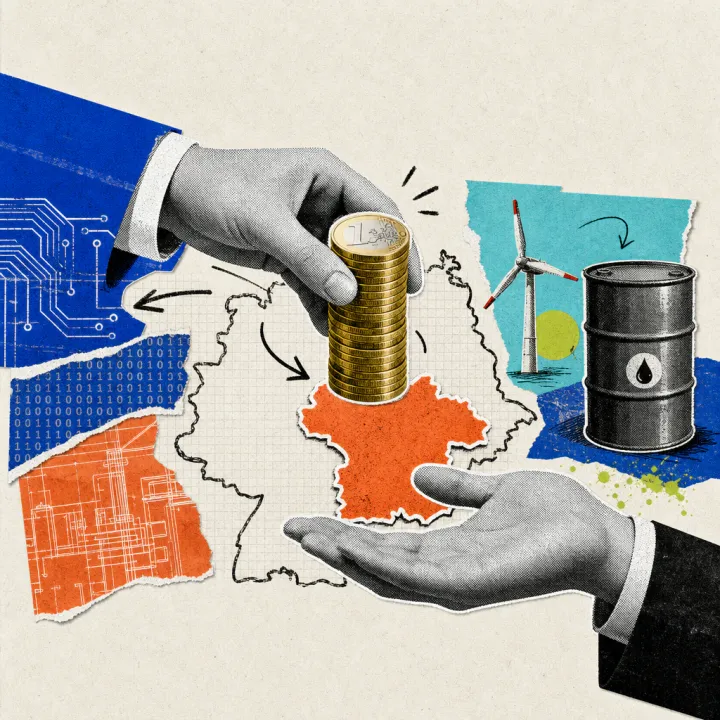
Germany was long seen as a straggler in the global AI race – the result of a chain of neglected compute infrastructure, federal friction and regulation ahead of enabling conditions. In 2026 the picture looks different: eight AI-driven companies have reached billion-dollar valuations in the country, and with Helsing, Germany now fields Europe’s highest-valued defence tech start-up. This ranking counts only what is documented – valuations from officially confirmed funding rounds and investments, no rumours, no IPO fantasy. Listed corporations such as SAP or Siemens are deliberately left out.
As of: 6 August 2026
| # | Company | Valuation (documented) | Base | Focus |
|---|---|---|---|---|
| 1 | Helsing | $18bn (Jul 2026) | Munich | Defence AI |
| 2 | Celonis | $13bn (2021) | Munich | Process intelligence |
| 3 | Neura Robotics | approx. $7bn (Jun 2026) | Metzingen | Humanoid robots |
| 4 | n8n | $5.2bn (May 2026) | Berlin | AI workflows |
| 5 | Black Forest Labs | $3.25bn (Dec 2025) | Freiburg | Image AI (FLUX) |
| 6 | Parloa | $3bn (Jan 2026) | Berlin | AI agents in service |
| 7 | Quantum Systems | approx. 3bn (Nov 2025) | Gilching | AI drones |
| 8 | DeepL | $2bn (2024) | Cologne | Language AI |
| 9 | Agile Robots | over $1bn (2021) | Munich | Industrial robotics |
| 10 | Aleph Alpha | approx. €0.5bn (2024) | Heidelberg | Sovereign AI |
1. Helsing – 18 billion dollars
The Munich company, founded in 2021, develops AI software for defence, combat drones, underwater reconnaissance systems and, with the CA-1, an uncrewed fighter jet. In July 2026 Helsing closed a Series E round of 1.8 billion dollars – the largest funding round ever raised by a German start-up. The valuation rose by around 50 percent to 18 billion dollars as a result. Backers include Dragoneer, Lightspeed, General Catalyst, Goldman Sachs Alternatives, JPMorganChase and the Canadian pension fund CPP Investments; the company says the majority is to remain in European hands. In early 2026 Helsing also received a major order from the Bundeswehr for the Lithuania brigade.
2. Celonis – 13 billion dollars
The Munich process intelligence pioneer uses AI to analyse the real workflows inside corporate systems and expose inefficiencies. The valuation of 13 billion dollars dates from the last big funding round in 2021 – making it the oldest in this ranking, though current overviews such as the WiWo start-up ranking 2026 still carry it as a reference. Celonis has steadily extended its product with AI agents and a Process Intelligence Graph in recent years and counts hundreds of large corporations among its customers.
3. Neura Robotics – around 7 billion dollars
The most spectacular riser of the year comes from Metzingen in Baden-Württemberg. In June 2026 Neura Robotics raised up to 1.4 billion dollars in a Series C round – from Amazon, Nvidia, Qualcomm, Bosch, Schaeffler and the European Investment Bank, among others. Insiders put the valuation at around seven billion dollars. The company develops cognitive and humanoid robots such as the 4NE1 (unit price around 98,000 euros, delivery from the end of 2026) and wants to scale production to millions of units by 2030. According to the company, the order backlog already exceeds one billion euros.
4. n8n – 5.2 billion dollars
The Berlin platform for AI workflow automation has managed what is probably the steepest valuation path in German tech history: from around 300 million in March 2025 via 2.5 billion in October 2025 to 5.2 billion dollars in May 2026, when SAP took a stake of just under 1.3 percent and began integrating n8n technology into its own products. More than 650,000 developers use the platform; investors include Accel, Sequoia and Nvidia’s venture arm. That makes n8n currently the most valuable “pure” software AI company in the country.
5. Black Forest Labs – 3.25 billion dollars
Barely two years after being founded by the Stable Diffusion researchers Robin Rombach, Andreas Blattmann and Axel Sauer, the Freiburg AI lab is a fixture of global image AI. The FLUX models sit inside products from Adobe, Meta, Microsoft, Canva and Deutsche Telekom. In December 2025 the team of only around 50 people raised 300 million dollars, led by the a16z vehicle AMP and Salesforce Ventures – valuation: 3.25 billion dollars.
6. Parloa – 3 billion dollars
The Berlin company is building a management platform for AI agents in customer service and tripled its valuation within eight months: in January 2026, 350 million dollars flowed in a Series D round led by General Catalyst, valuing Parloa at three billion dollars. Annual recurring revenue passed the 50 million dollar mark; since May 2026 there has also been a strategic partnership including an investment from SAP.
7. Quantum Systems – around 3 billion
The drone maker from Gilching near Munich became a unicorn in early May 2025 and had already tripled its valuation by November 2025 in a round led by Balderton; a further 150 million followed in February 2026. Its AI-assisted reconnaissance drones (including the Vector family) are in continuous use in Ukraine, and at the end of 2025 Quantum Systems also acquired the autonomy start-up Fernride. Together with Helsing, the company stands for the defence boom currently shaping the German AI landscape.
8. DeepL – 2 billion dollars
The Cologne language AI pioneer was valued at two billion dollars in May 2024 in a round led by Index Ventures – the last documented figure. A target valuation of up to five billion dollars is circulating for the planned US listing, which is deliberately not counted here. DeepL serves more than 100,000 business customers, but recently cut around a quarter of its workforce and is realigning towards agentic language workflows.
9. Agile Robots – over 1 billion dollars
The Munich DLR spin-off combines industrial robotics with AI-based control and image processing and reached unicorn status back in 2021. According to media reports, the company is negotiating a funding round of around 800 million dollars in 2026 – so far only the billion-dollar figure from the SoftBank round at the time is confirmed, which is why Agile Robots is ranked conservatively here.
10. Aleph Alpha – around 500 million euros
The Heidelberg company was once Germany’s great LLM hope, but has bowed out of the expensive race for foundation models and positions itself with the PhariaAI platform as a provider of sovereign AI for public authorities and regulated industries. Investment circles most recently put the valuation at about half a billion euros – carried by strategic shareholders such as the Schwarz Group, SAP and Bosch. Large open language models from Germany now tend to emerge in state-funded research consortia instead, for example Soofi S with 31.6 billion parameters.
Methodology and side notes
The ranking covers privately held companies based in Germany whose business model rests on AI at its core, sorted by the most recent documented valuation. Two cases deserve a footnote: Personio ($8.5bn) leans heavily on AI, but is HR software at its core and therefore stays out. And Cognigy from Düsseldorf delivered one of the largest documented German AI valuations of all with its sale to NICE for around 955 million dollars in 2025 – as a corporate subsidiary, however, it no longer counts as an independent German company.
The shift at the top is striking: as recently as December 2025 Black Forest Labs was regarded as Germany’s most valuable AI company, in May 2026 n8n took over – and above all of them, defence and robotics now sit enthroned. Where capital flows on this scale is where it is currently being decided whether Germany will play at the front of the AI race for good.