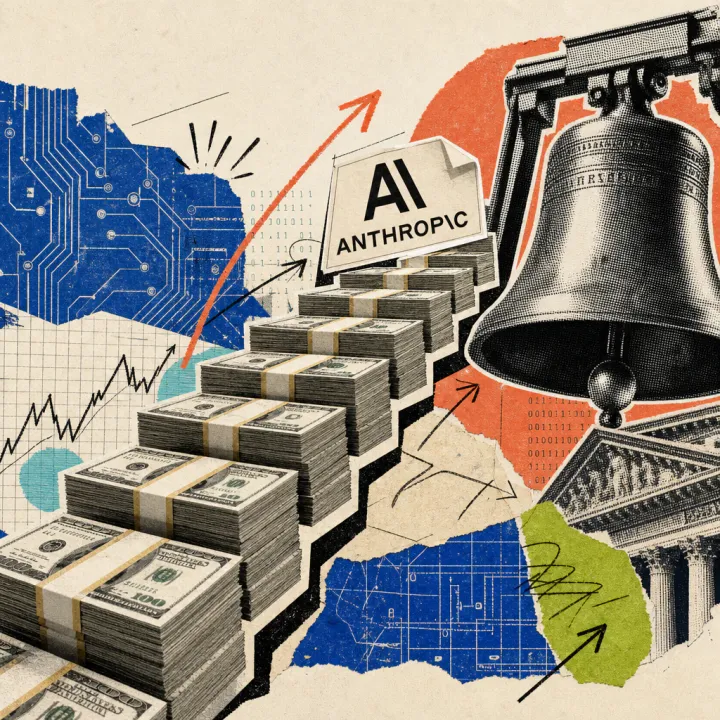
Google, together with Broadcom, Apollo, Blackstone, and Morgan Stanley, has assembled a web of contracts worth around 200 billion dollars to supply the AI provider Anthropic with computing chips. About 150 billion dollars of that amount goes toward chip purchases, as reconstructed by the Financial Times. The total figure has not been confirmed independently of the companies involved.
Special Purpose Vehicle Buys Chips Without Balance-Sheet Risk
At the core of the structure is a purpose-built vehicle called Compute SPV: it buys the chips with debt from outside investors and leases them to Anthropic, which services the lease payments from ongoing revenue. The model resembles the aircraft financing Boeing and General Electric have used for decades to sell planes and engines without carrying the full default risk themselves. The detour is necessary because Anthropic has no credit rating of its own, and banks won’t extend a traditional multibillion-dollar loan to the still-unprofitable company. Apollo Global Management put the first tranche at 35 billion dollars on June 9, 2026, for roughly one gigawatt of compute – equivalent to about one million chips on Broadcom’s so-called AI XPV platform. Apollo and Blackstone supply the debt, Morgan Stanley arranged the credit structure, and Broadcom, as the manufacturer, backstops part of the hardware’s resale value. Bonds tied to Google’s guarantees reportedly trade at an interest rate of around 7.1 percent, while comparable securities without a link to a major cloud provider cost closer to 9.3 percent. The gap is seen as a sign of how much Google’s creditworthiness cushions the risk of the still-young AI provider.
Blackstone Negotiates a Second Billion-Dollar Loan
Just two months after the first tranche, Blackstone is already negotiating a second loan of at least 36 billion dollars, according to Bloomberg – more than the June deal. Details on volume, tranche structure, and whether Blackstone will again lead the consortium remain undecided, the report says; requests to Google, Apollo, and Broadcom went unanswered or uncommented. The timing coincides with Anthropic’s preparations for a possible IPO in October: extra compute capacity without new equity dilution bolsters the growth story ahead of the listing. Anthropic had only raised fresh capital in May at a 965 billion dollar valuation and spent the summer expanding its infrastructure planning by hiring compute specialists. Alongside the Google web, the company has reportedly also locked in about 10 billion dollars of compute capacity from the Nvidia-affiliated provider Volta – a sign of how widely Anthropic is now spreading its chip supply chains to avoid depending on a single partner.
Google Carries the Largest Residual Risk
Despite the outsourced balance-sheet structure, Google still bears the biggest risk: the company guarantees operation of the leased data centers and is on the hook for up to 44 billion dollars should Anthropic stop making lease payments. Broadcom backstops part of the chip purchases in return, while specialized operators such as TeraWulf, Cipher Digital, and Hut 8 build data centers with a combined 2.4 gigawatts of capacity backed by Google. Originally launched as crypto miners, these firms are increasingly shifting their business toward AI infrastructure. Credit analysts read the structure as a sign of the market’s maturity: debt tied to Google’s guarantees reportedly trades at lower interest rates than comparable bonds with no link to one of the major cloud providers.
What matters now is whether Anthropic’s revenue growth can sustain the lease payments over the long run – it remains unclear just how profitable the company actually is beyond a handful of large customers. If growth slows, the default risk would hit not just Anthropic but, through the chain of guarantees, Google and the lenders involved as well.