The Chinese technology company Xiaomi has released its robotics foundational model Xiaomi-Robotics-1 as open-source software. Since August 3, code and model weights have been available on GitHub and Hugging Face, with Xiaomi publicly announcing the step two days later. Trained with over 100,000 hours of real motion data, the system outperforms previous open models in internal benchmarks by up to 58 percent.
Model learns from over 100,000 hours of motion data
Xiaomi-Robotics-1 combines a pre-trained language-image model with a diffusion transformer architecture that calculates specific motion commands for robotic arms. The released version includes 1.5 billion parameters. According to the manufacturer’s project page, the training data comes from more than 1,700 everyday scenarios, recorded with portable UMI cameras instead of real robots – significantly reducing the costs of data collection compared to traditional teleoperation recordings. For fine-tuning, an additional 7,200 hours of recordings from real robots were added, partly from in-house resources and partly from filtered open datasets.
In four standard test series for robot manipulation, the model achieves new best scores according to the manufacturer: In the RoboCasa365 test, the success rate increases by 23.2 percent compared to the previous high score, and in the RoboDojo test by 58.3 percent. The model also outperforms all previously published systems in the RoboCasa and VLABench test series. The figures come from Xiaomi’s own preprint and the project page, and an independent review by third parties is still pending. According to the GitHub repository, the architecture is designed for use on commercially available graphics cards, but Xiaomi does not specify concrete minimum requirements.
New tasks succeed with few demonstrations
The practical advantage of the model is particularly evident in new, previously unseen tasks, according to Xiaomi: With less than ten hours of additional demonstration, the system achieves a success rate of 75 percent in complex grasping tasks – meaning three out of four attempts succeed. Previous robotics models required significantly larger amounts of task-specific demonstration data for comparable adaptations, which has slowed down the setup of new applications. This could accelerate the transition of robotic arms in warehouses or workshops to new sorting and packaging tasks, as fewer manual training runs per task would be necessary.
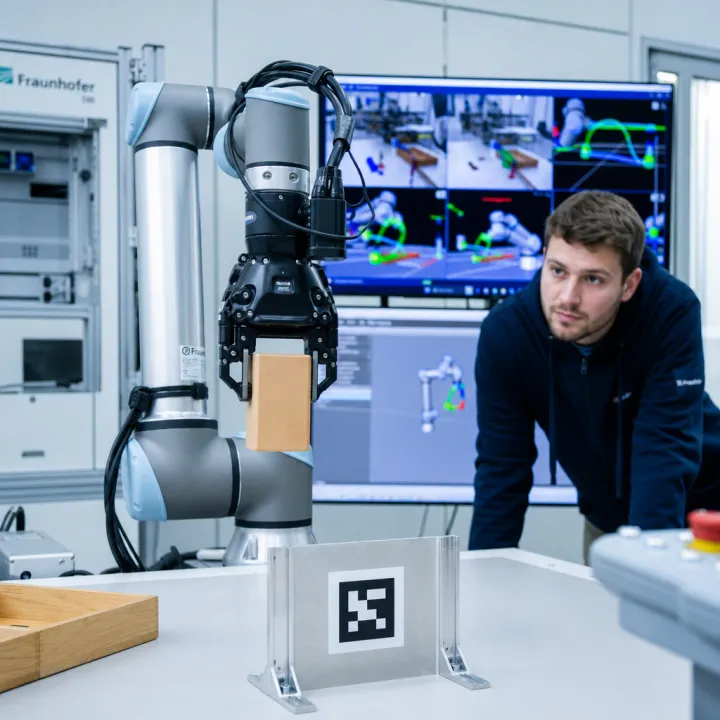
The model also follows instructions in natural language and is expected to transfer to unknown environments and new objects without the need to reprogram the control logic for each individual case. Currently available are the 1.5 billion parameter version on Hugging Face and the complete training and evaluation code on GitHub and ModelScope, each under the commercially usable Apache-2.0 license. The model is not intended for private households – it is aimed at developer teams programming their own robotic arms or mobile manipulators.
Xiaomi joins the growing field of open robotics models
The release is part of a series of open foundational models for robots that Chinese companies have presented in recent weeks. Just in July, the Ant Group robotics unit Robbyant released its model LingBot-VA 2.0 as open-source, which controls robotic arms in simulation tests with a success rate of 93.6 percent. The Beijing research institute BAAI also presented Orca, a world model for robot control, which operates entirely without labeled action data.
At the same time, international providers like 1X, Generalist AI, and Boston Dynamics are making their own advancements in robotic hands and gripping systems, while companies like Figure and Tesla are already testing humanoid robots in logistics centers. The competition is increasingly shifting from pure language models to systems that combine perception, language, and motion control in a single model – and open weights further lower the entry barrier for smaller robotics startups.
It will be crucial whether developers outside of China can actually integrate the model into their own robotic platforms – so far, Xiaomi has primarily demonstrated the capabilities on robotic arms in its own lab. It also remains unclear whether the release contributes to Xiaomi’s own plans for household robots, for which the company has not yet provided specific timelines.