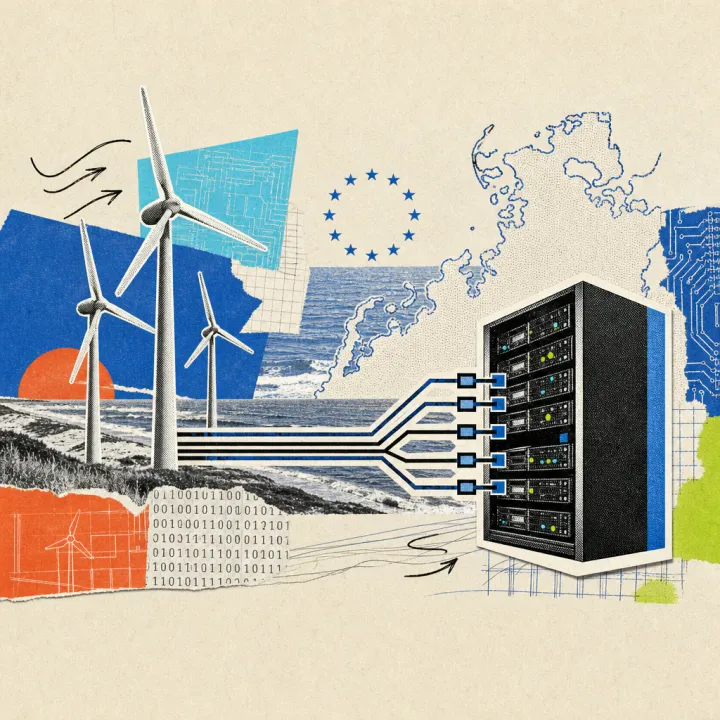
The EU research organization EuroHPC JU has commissioned the construction of the AI supercomputer LUMI-AI. The French technology company Bull is building the facility for 387.8 million euros in Kajaani, Finland, and is expected to deliver ten times the AI computing power of the current LUMI system starting in the second half of 2027.
Bull is building the system with AMD chips and liquid cooling
The French company, a subsidiary of Atos, is building LUMI-AI on the new BullSequana XH3500 architecture. Its core consists of AMD Instinct MI430X graphics processors and sixth-generation AMD Epyc processors with 256 cores; IBM supplies the storage, and Bull handles the networking together with Nokia. Compared with the current LUMI system, the new facility is expected to deliver ten times the AI computing power and nearly double the classical high-performance computing capacity – these manufacturer claims have not yet been independently verified.
Cooling runs through a patented direct liquid cooling system using warm water, which, according to operator information, will then feed into the district heating network of the city of Kajaani. The site sits in the new CSC data center in the Renforsin Ranta business park, right next to the LUMI-IQ quantum computer – the facility is meant to combine classical high-performance computing, AI training, and quantum computing in one location. Operations are due to begin in the second half of 2027, though the operator has not yet named a fixed start date.
Six EU countries are sharing the costs with Brussels
LUMI-AI is operated by the LUMI AI Factory consortium, whose members are Finland, Czechia, Denmark, Estonia, Norway, and Poland. EuroHPC JU and the six countries each cover half of the 387.8 million euro contract sum. Germany is not part of the consortium.
For EuroHPC JU, LUMI-AI is already its sixth contract for a so-called AI factory – an existing high-performance computing center upgraded for AI training. The program runs alongside a second, much larger EU initiative: at the end of July, the organization opened the tender for up to seven new AI gigafactories worth more than 30 billion euros in expected investment, mostly privately funded. The EU Commission is expected to decide on locations only in early 2027; a German applicant consortium is also hoping for an award there.
Whether companies outside the six consortium states will later gain access to the computing power, or whether it stays largely reserved for research institutions and firms from Finland, Czechia, Denmark, Estonia, Norway, and Poland, remains open. Meanwhile, what matters for Germany’s own AI ambitions is whether the separate gigafactory tender leads to an award as planned in early 2027 – so far, much of the private billions it needs has not been secured.