Update, September 21, 2026: Following a Reuters investigation, Anthropic confirmed it has been operating its own biology lab in the San Francisco Bay Area for months. There, the company says it is also testing whether Claude can guide robotic systems so that experiments run with minimal human staffing – human oversight remains mandatory for safety reasons. Read more: Anthropic confirms its own biology lab in California
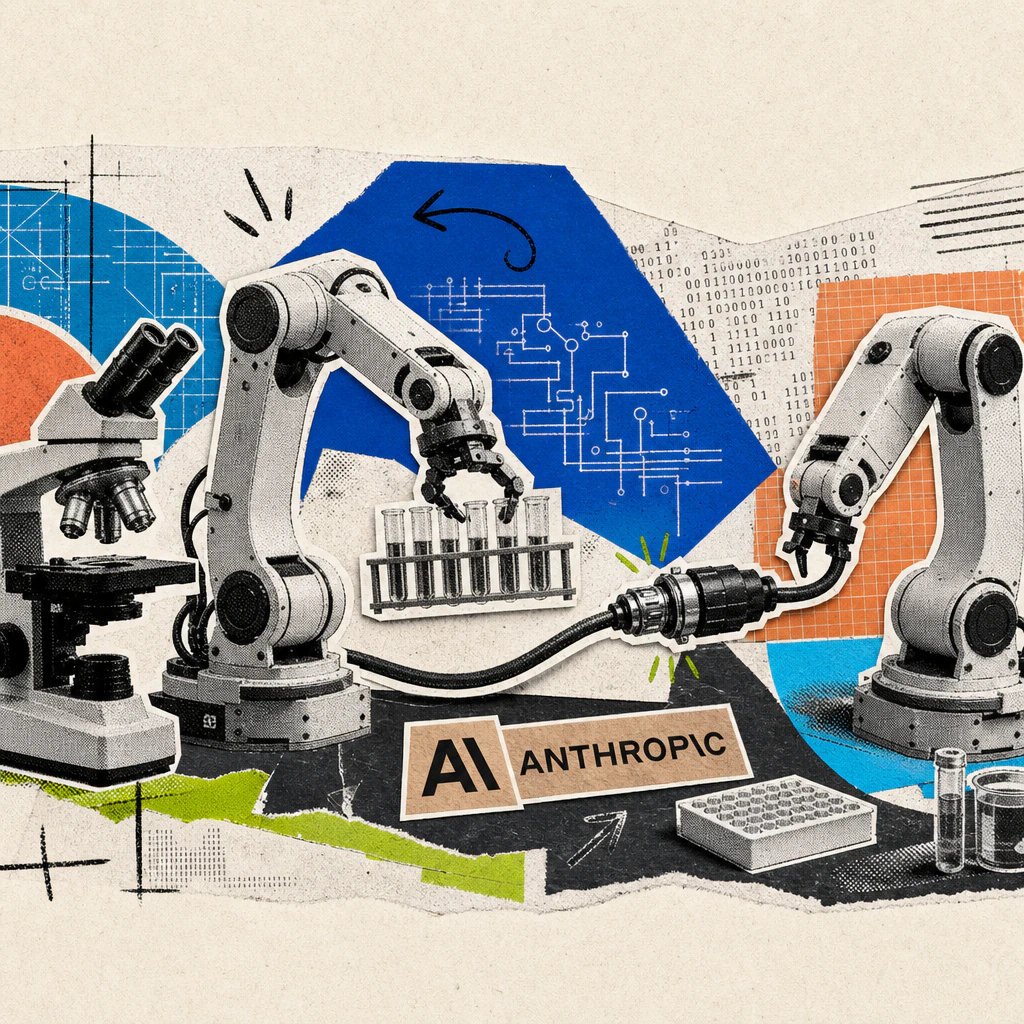
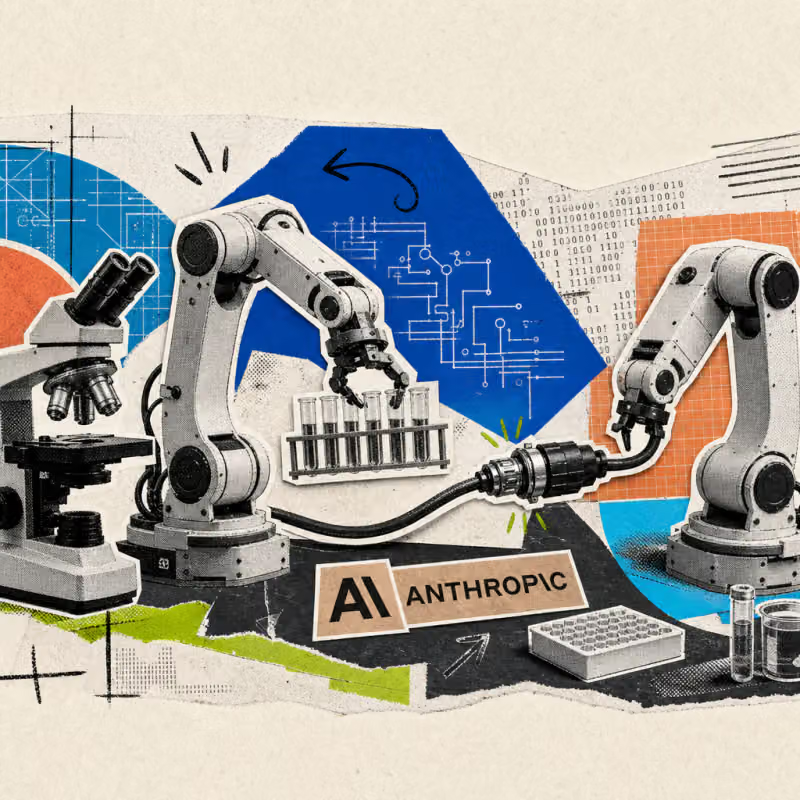
Anthropic is launching a testing phase for the Model Hardware Standard (MHS), a common interface through which AI agents like Claude can directly control laboratory equipment and factory machines. According to the company, this reduces the integration of new hardware from weeks to just a few hours.
Among the initial partners are Genentech, QuEra, and Doosan Robotics.
Standard connects software and machines directly
MHS reduces the integration of devices to a common driver format and a few basic commands on which AI agents can then build. So far, most laboratory devices and machines do not communicate with each other, making integration take weeks or months and requiring specialists with expert knowledge.
The standard works with any device that has a programmable interface and is explicitly model-independent – companies are not bound to Claude. MHS was developed from a collaboration between Alek Kemeny from Anthropic's team for socially beneficial applications and Arco Bast, a postdoctoral researcher at the HHMI Janelia research campus.
As partners, Anthropic names, among others, the cloud provider Amazon Web Services. It aims to support MHS through its robotics library Strands Robots.
Other partners include laboratory automation companies Automata, Danaher, Qiagen, and Tecan. The robotic arm manufacturers Doosan Robotics and Universal Robots, as well as the research institution Carnegie Mellon University, are also part of the testing phase.
Access is initially through a waiting list for selected research laboratories and industrial companies. Participants must register specific devices and use cases before Anthropic sets up the integration together with the respective team.
Initial practical tests show significant leaps
The biotech company Genentech has already used MHS for a drug experiment with automatic real-time error handling. The quantum computer provider QuEra improved the laser stabilization of its machines with the standard from 58 to 99.3 percent, according to its own statements.
This figure has not been independently verified. Doosan Robotics and Universal Robots are testing MHS on their robotic arms, for example, for automated quality control and the coordinated operation of multiple arms within a shared manufacturing cell.
Other manufacturers are also increasingly opening their robotics to external AI systems, such as Xiaomi with an open-source robotics foundation model.
At Anthropic, they see their initiative as a first step towards "physical AI." This refers to systems that not only process text and images but also operate real devices. A rollout date for the general public has not yet been set, nor is there a price list for later regular operations outside the testing phase.
So far, access is limited to the mentioned partners from research, biotechnology, and robotics; other interested parties must apply through the waiting list.
Built-in safety limits aim to prevent accidents
Specialized media such as the British portal The Register point out that language models only know the physical world through text and images. They lack practical intuition for machines.
Anthropic also cannot reliably predict how its models will behave in new situations. The company addresses this by incorporating limits such as speed and angle restrictions directly into the standard, so that an agent cannot instruct a device outside of safe parameters.
Additionally, Anthropic is working on a safety roadmap for physical deployment and intends to use the testing phase to develop further safety assessments in collaboration with partners. Context is also provided by the EU: From January 20, 2027, the new Machinery Regulation 2023/1230 will come into effect, which explicitly covers AI-supported safety functions and machines with evolving behavior for the first time.
A standard that technically establishes safety limits from the outset is likely to make it easier for manufacturers in Europe to meet these requirements.
It remains to be seen whether the built-in limits will also work reliably outside of the carefully selected pilot partners once Anthropic releases the standard as announced in an open-source format. The company has not yet provided a specific date for this – it is expected to follow only after the safety assessments from the testing phase are completed.