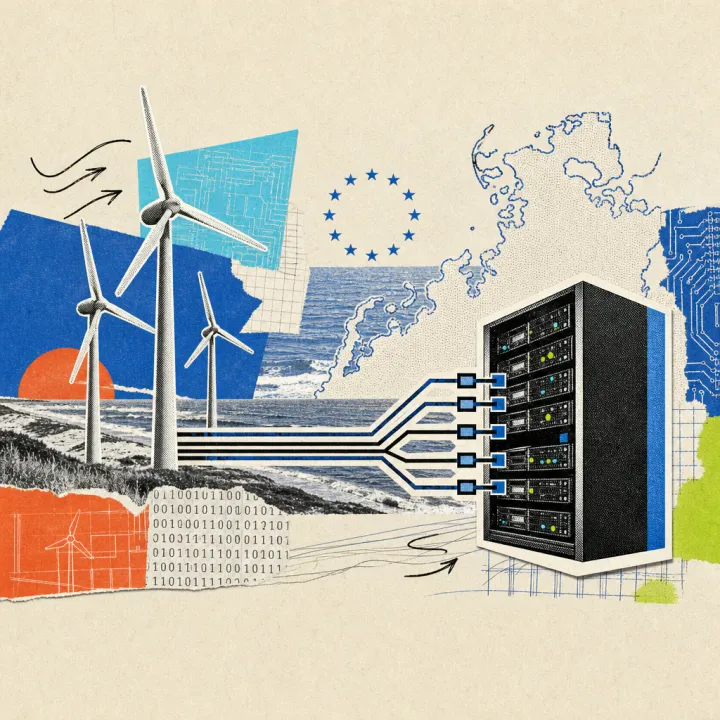
The EU has opened its call for up to seven AI gigafactories. Consortia and special purpose vehicles can bid until November 12, 2026, with selection due in early 2027. Investment of more than 30 billion euros is expected – yet only a small part of the public share is actually locked in.
Two lots set size and funding per project
The call splits into two lots. Lot one covers up to four facilities with at least 75,000 AI accelerators, counted in Nvidia H100-class units, and offers up to one billion euros in public support per project. Lot two covers up to three larger facilities with at least 100,000 accelerators and up to two billion euros each.
The facilities are to span at least seven member states. Once contracts are signed, operators have at most 18 months to go live. Core infrastructure must remain under European control, sensitive operational data must be shielded from third-country access, and the systems have to meet European data protection and security requirements. Unlike a conventional subsidy, the public sector acts as an anchor customer here, buying compute capacity rather than paying out grants. That purchase guarantee is meant to make construction financing viable for private backers. Commission President Ursula von der Leyen first announced the plan in February 2025 at the AI summit in Paris.
Only consortia and special purpose vehicles may bid
Individual companies cannot apply. Eligibility is limited to consortia or purpose-built special purpose vehicles that bring together firms, public bodies, investors and other partners. The call sets no minimum or maximum number of participants, and no fixed division of roles among them. Bids go in through the EU procurement portal, with November 12, 2026 as the cut-off.
Bidders may choose the site freely as long as it sits on EU territory: a single location, several locations within one member state, or a facility distributed across national borders. Financially they have to shoulder the large majority themselves – for every euro of public money, roughly two euros of private capital are expected. The compute hardware may come from Europe or from allied countries. Priority access to the resulting capacity is earmarked for start-ups, scale-ups, small and medium-sized companies, industry, universities and public authorities – a criterion bids will be measured against.
Telekom, Schwarz Digits and Ionos weigh bids
Several bidders are taking shape in Germany. According to reporting by Table.Media, consortia around Deutsche Telekom, Schwarz Digits and Ionos are in discussion. In Bavaria, the Blue Swan consortium is bidding with Schweinfurt as its site, and Saxony-Anhalt has registered interest too. Federal Research Minister Dorothee Bär calls it a declared goal of the German government that the country host an AI gigafactory, while noting the consortia still have to win on merit. Bavaria’s science minister Markus Blume promotes Schweinfurt on a package of land, grid connection and research environment.
Interest ran high at first: the preliminary expression-of-interest round drew 76 responses covering 60 sites across 16 member states. By the time the actual call opened, the field of expected bidders had shrunk to roughly ten, according to the outlet Techtimes. Repeated delays are seen as the cause: the call was originally due at the end of 2025, then in early 2026, then in the summer. Deutsche Telekom said it would first review the documents.
Funding and chip dependency remain unresolved
Funding is the sore point. Of the up to ten billion euros in public money, around one billion is currently secured from existing programmes; the rest hinges on the next multiannual EU financial framework for 2028 to 2035, still under negotiation. A Commission official conceded the institution cannot pre-empt decisions on the future budget. A cap compounds the problem: public grants may cover only a small share of project costs, and no binding commitments from private investors exist.
Criticism also centres on chips. The Commission has signed letters of intent with Nvidia, AMD and Qualcomm; 18 members of the European Parliament subsequently asked how gigafactories reduce strategic dependencies when the entire compute layer originates in the US. Energy is unsettled as well: a facility with 100,000 accelerators is estimated to draw 120 to 150 megawatts, while European industrial electricity costs two to three times what it does in the US or China. The same weaknesses already surfaced in the chain of German AI missteps.
What matters now is whether private investors will actually put up the bulk of the money while the public share depends on how budget negotiations end. Until selection in early 2027, it also remains unclear whether enough consortia will materialise for all seven facilities. The real test comes afterwards: within 18 months, sites would have to be built whose grid connection and electricity price have not been settled anywhere.
Update, August 10, 2026: The German government raised its own funding share for a domestic AI gigafactory by around 200 million to one billion euros, financed from the special fund for infrastructure and climate neutrality. Details in the follow-up article.