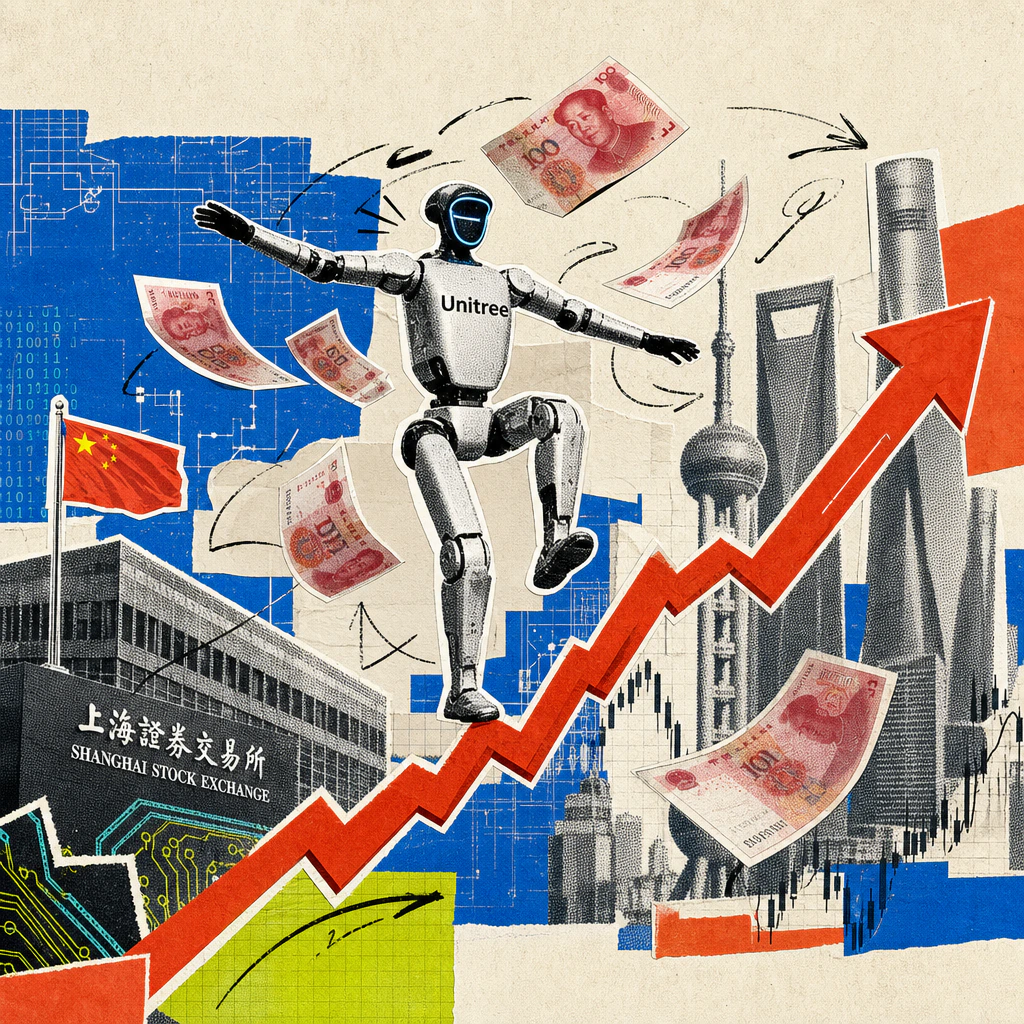
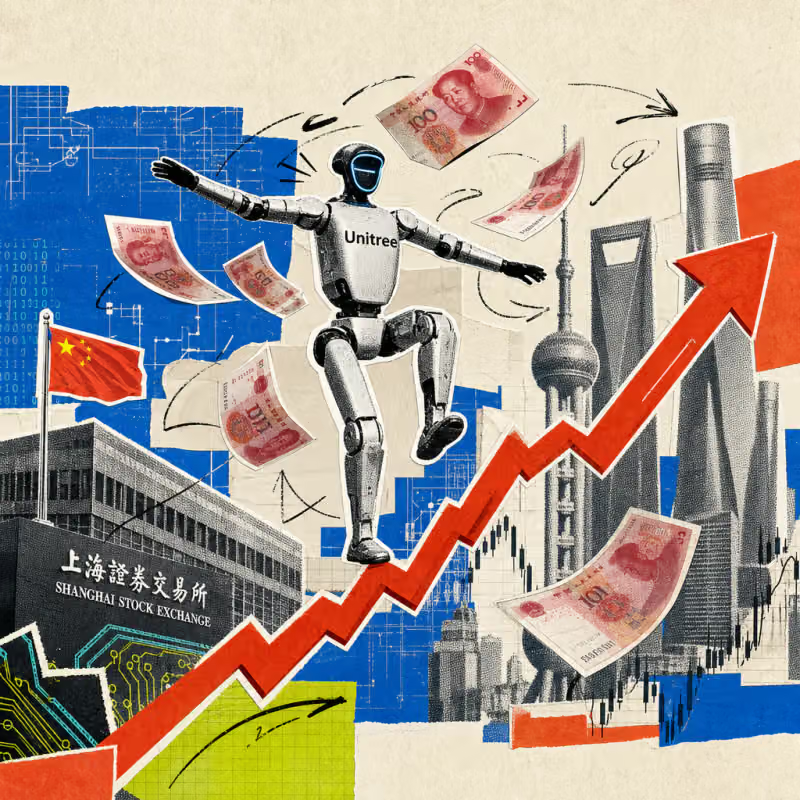
The Chinese robot manufacturer Unitree was first traded on the stock market on August 19 and closed its first trading day on the Shanghai STAR Market 460 percent above the issue price. The stock temporarily surged by up to 629 percent, and the market capitalization reached approximately 50 billion dollars at the end of trading.
Price closes 460 percent above the issue price
The stock started trading significantly above its issue price of 150.80 Yuan and climbed during the day to as high as 1,100 Yuan, an increase of 629 percent.
At the close of trading, the price was 845 Yuan, a daily gain of 460 percent. This brought the market capitalization at its peak to approximately 66 billion dollars, settling at around 342 billion Yuan or about 50 billion dollars at the end of trading, as reported by the South China Morning Post.
The price jump significantly exceeded the average first-day gain of new listings in China of 279 percent this year. Notably, the broader Star Market Composite Index lost 7.2 percent on the same day, while the Shanghai Composite Index fell by about 2.4 percent.
Investors specifically targeted Unitree while the overall market weakened. Approximately 23.2 billion Yuan changed hands during the session – an unusually high trading volume for a single debut stock and nearly four times the total proceeds of 6.1 billion Yuan that Unitree raised in early August.
Wang Xingxing and Meituan among the biggest winners
Company founder Wang Xingxing still holds about 31 percent of the shares; his stock package was worth approximately 103 billion Yuan at the close of trading, as reported by Fortune.
Forbes estimated his wealth at 2.4 billion dollars immediately after the pricing in early August; after the price jump, his stake is now worth approximately six times that amount, although the exact basis for such wealth estimates remains unverified.
Early company investors also benefited significantly. The food delivery service Meituan reportedly holds about 8.7 percent of Unitree and thus achieved around 70 times its original investment – one of the most lucrative bets of the company on the Chinese robotics industry.
Strategic investors like the AI company DeepSeek, which secured shares worth 141 million Yuan at the time of pricing, are subject to a twelve-month holding period and cannot realize their price gains for the time being. If the price remains at least close to the current level until the end of this lock-up period in August 2027, DeepSeek, Tencent, PetroChina, and China Southern Power Grid would be sitting on unrealized billion-dollar gains from an entry that was only a few weeks ago.
Analysts dispute the substance of the boom
The Japanese bank Nomura cites Unitree's rapid product development and continuous innovation as the basis for its competitive advantage. HSBC analysts express significantly more skepticism: The order and delivery boom among robotics manufacturers could prove deceptive if the actual AI capabilities of the machines do not meet expectations.
The dispute reflects a larger debate about the robotics market. According to industry data, about 97 percent of all humanoid robots delivered worldwide in the first half of 2026 were from Chinese manufacturers.
Unitree's valuation already exceeds that of its U.S. competitor Figure AI, which was valued at 39 billion dollars in its last funding round in September 2025, while many Western providers have so far generated little commercial revenue.
It will be crucial whether Unitree's valuation stabilizes on the stock market or whether the gap between the order boom and actual AI performance, as pointed out by HSBC, will push prices down again in the coming weeks.
The trading debut is also part of a broader wave of Chinese AI IPOs, which includes the planned Hong Kong IPO of Moonshot AI – a barometer of how much investors are currently willing to pay for Chinese AI and robotics bets.