Update, August 20, 2026: Trading has begun – the stock closed its first day on Shanghai’s STAR Market 460 percent above the issue price, briefly touching 629 percent. More in the article on the trading debut.
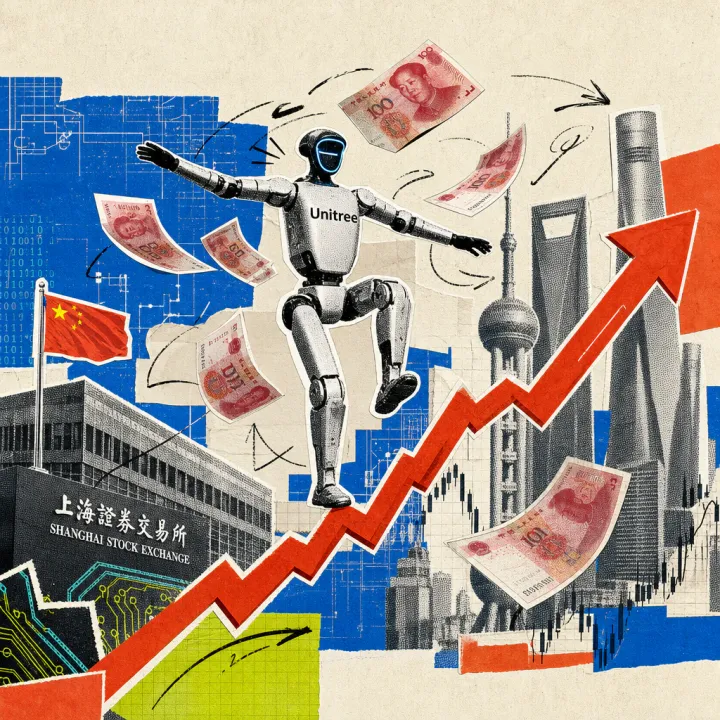
The Chinese robotics manufacturer Unitree has set the issue price for its IPO at 150.80 Yuan per share, achieving a valuation of approximately nine billion dollars. Starting August 10, retail investors can subscribe on the Shanghai STAR Market. Unitree will thus become the first maker of humanoid robots listed on a Chinese stock exchange.
Subscription opens Monday, allocation follows mid-August
The issue price is 45 percent above the consensus of 104 Yuan that analysts had expected before the bookbuilding – a sign of strong demand from institutional investors, as reported by US broadcaster CNBC. Unitree had originally planned for a valuation of around 42 billion Yuan and aimed to raise about 4.2 billion Yuan. In the end, that turned into a 61 billion Yuan valuation and 6.1 billion Yuan in proceeds from the sale of roughly 40.45 million new shares, ten percent of the enlarged share capital.
The timeline leading up to trading:
- August 5-6: Bookbuilding with institutional investors
- August 6: Setting of the issue price
- August 10: Subscription window for retail investors
- August 12: Payment due
- August 14: Allocation announced
The actual first trading day has not yet been officially set but is expected to follow within weeks of the allocation. Regulatory review took just 104 days – the fastest approval the STAR Market has recorded to date.
DeepSeek and other corporations secure shares in advance
Strategic investors in the placement include AI developer DeepSeek as well as Tencent, PetroChina and China Southern Power Grid, according to Global Times. DeepSeek’s parent company, Hangzhou DeepSeek AI, subscribed to about 933,400 shares worth 141 million Yuan; the investment is reportedly meant to help the robots better handle complex real-world scenarios. For Tencent, PetroChina and China Southern Power Grid, the stakes are reportedly part of a broader strategy to integrate humanoid robots early into their own supply chains, data centers and energy infrastructure. Strategic investors receive their shares through a special placement of just over eight million shares, a bit over a fifth of the total offering, and are typically subject to a twelve-month lock-up.
Founder Wang Xingxing reportedly holds a stake of just over 31 percent but retains majority voting control through a tiered voting-rights structure. Forbes put his wealth at 2.4 billion dollars after the pricing – making the 36-year-old a billionaire for the first time, though the exact basis for that estimate is not independently verified.
Founder pledges more investment in AI models
Unitree says it has been profitable since 2024 and grew profit by more than 200 percent between 2024 and 2025. Revenue quadrupled last year to 1.7 billion Yuan, of which about 868 million Yuan came from humanoid robots alone; more than 40 percent of revenue came from abroad. The largest commercial customer is online retailer JD.com, according to ChinaTalk.
At an investor meeting on August 7, Wang said the company would step up investment in AI foundation models for embodied intelligence, scenario-based data collection and reinforcement learning, and expand its lineup to include bipedal, quadrupedal and mecha-style robots. The goal, he said, is to deploy robots in physically demanding or hazardous environments and free people up for other work. The embodied-AI industry is still at an early stage, Wang said, comparable to the early days of home appliances and personal computers. Nearly half the IPO proceeds are earmarked for training the company’s own AI models over three years, with the rest going toward hardware development and manufacturing expansion.
The listing arrives amid rising tensions and is part of a wave of Chinese AI listings that also includes the planned Moonshot AI IPO in Hong Kong. Just days earlier, the US FCC had banned new humanoid and quadrupedal robots from China from the American market, with market leader Unitree the main party affected. Already-approved models may still be sold in the US for now, but future models could face new restrictions. What matters now is whether the rich valuation holds once trading actually begins, and whether investors grow more cautious given the political risks – and whether a profitable maker like Unitree can truly outcompete privately funded, still largely loss-making rivals like Figure AI or Tesla Optimus.