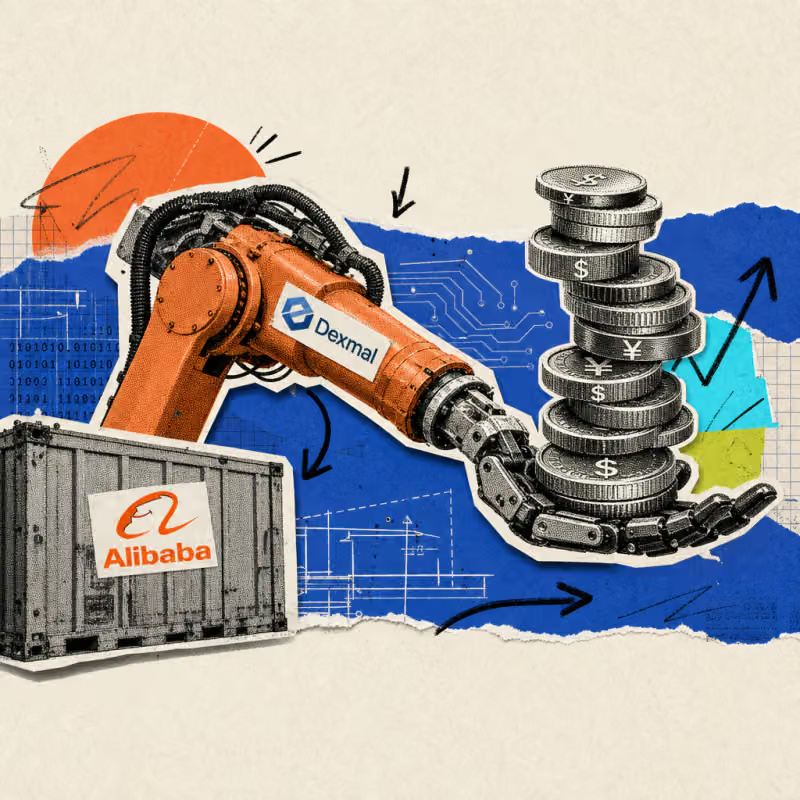
The Chinese robotics provider Dexmal is negotiating a new funding round with a target valuation of 20 billion yuan, equivalent to around three billion dollars. This was confirmed by founder and CEO Tang Wenbin according to Bloomberg at the World Robot Conference in Beijing.
The valuation would correspond to more than twenty times the previous capital that Dexmal has raised since the end of 2025.
Investors from Alibaba's orbit financed the company's rise
Dexmal, originally founded as Dexmal OriginMind, raised its first funding rounds at the end of 2025. The Series A was led by the mobility- and robotics-focused fund NIO Capital, with participation from Hongtai Fund, Legend Capital, and Qiming Venture Partners, among others.
The subsequent Series A+ was led by online retailer Alibaba. According to industry portal Aibase, the two rounds together raised approximately 140 million dollars.
Founder and CEO Tang Wenbin is a graduate of Tsinghua University's Yao Class and previously co-founded and served as CTO of image-processing specialist Megvii. The company, founded in March 2025, is headquartered in Beijing and, according to Gasgoo, maintains additional offices in Hong Kong, Singapore, Japan, and South Korea; a US expansion is reportedly planned.
Dexmal builds software and hardware for so-called embodied-AI robots, machines that use AI models to handle physical tasks in changing environments. Its core product is the base model DM0, complemented by the open-source framework Dexbotic, which the company says is used by more than 1,000 developers.
Merger with logistics specialist Atomix bundles real operating data
In June 2026, Dexmal merged with logistics robotics provider Atomix in a stock swap. As Gasgoo further reported, it marks the first deep tie-up between a "model company" and a "scenario company" in China's embodied-AI sector.
Atomix runs flexible warehouse logistics in more than 20 countries for around 100 brands, including Uniqlo, Coca-Cola, and tea chain Mixue, and says it handles over 600,000 shipments daily. The merger is meant to shift Dexmal from manually collected training data to real logistics data from the Atomix network – supplying exactly the kind of practical data embodied-AI models need for training.
Financing tied to the merger also involved AI providers Zhipu AI and StepFun, as well as camera maker SenseTime. Together with Hugging Face, Dexmal also runs RoboChallenge, which it describes as the first large-scale testing environment for real robots in the embodied-AI industry, where models from different manufacturers compete under identical conditions.
Industry observers see such pairings of model developers with operators of real deployment settings as a possible blueprint for other Chinese embodied-AI providers that still lack usable practical data.
Beijing's billions in funding are propelling the whole industry
The move fits into an industry-wide wave of capital. More than 140 humanoid robotics providers are reportedly active in China, and Chinese municipalities are said to have already funneled more than 26 billion dollars into the embodied-AI sector through urban investment funds.
Market researchers also expect the global humanoid robot market to grow from roughly 5.4 billion dollars today to more than 50 billion dollars by 2035. Just on August 19, rival Unitree celebrated its stock market debut on Shanghai's STAR Market, briefly climbing to a market capitalization of up to 66 billion dollars.
Dexmal's targeted three-billion-dollar valuation would stay well below that, though it is negotiating – unlike its now publicly listed rival – as a private company. The target valuation is independently unverified: Tang Wenbin confirmed talks are ongoing but named neither a closing date nor concrete investors for the new round.
Capital is also flowing heavily into humanoid robots outside China, for instance at US providers Figure and Agility Robotics – intensifying competition for market share across multiple continents at once.
Whether Dexmal actually reaches its target valuation, or investors first wait for solid revenue figures from the logistics business given the still-young Atomix merger, remains open. Just as important will be whether China's funding wave translates into exportable technology – or whether, as with Unitree, valuations are being driven more by expectation than by actual robot deployment.