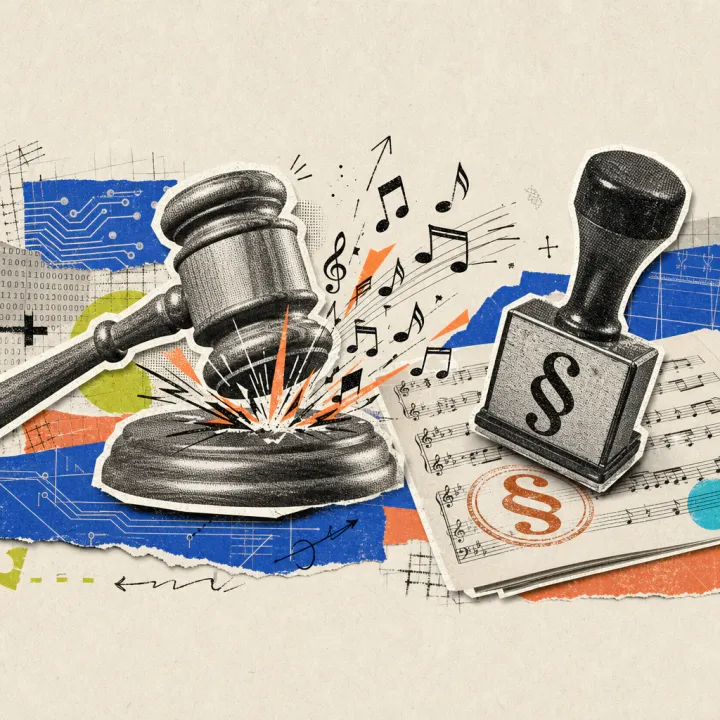
The Federal Court of Justice heard for the first time on Thursday whether AI training datasets may contain copyrighted photos without the permission of the copyright holders. The professional photographer Robert Kneschke sued the Hamburg association LAION, whose open dataset with 5.85 billion image-text pairs trains AI models worldwide. The responsible I Civil Senate announced that a ruling would be made at a later date.
LAION provides the training basis for numerous AI image models
The Federal Court of Justice heard the case under the file number I ZR 281/25 in Karlsruhe. LAION provides the dataset LAION-5B free of charge for research and industry. It does not contain image files itself, but web addresses along with image descriptions. To verify the association of image and text, the association temporarily downloads the photos, automatically matches them with the description, and then deletes them again. Kneschke discovered one of his photos, which he sells through an image agency, in this dataset. The image agency had expressly prohibited automated evaluation in its terms of use. Kneschke sees this as a violation of his copyright, regardless of the fact that LAION does not permanently store the image file itself. The dataset also forms the basis for numerous commercial and open image generators that build on publicly available training data. Based on LAION data, among other things, the image models of the Stable Diffusion series were created. LAION does not publish exact numbers on how many other AI systems are based on the dataset.
Two Hamburg instances saw the use as covered by research
Both the Hamburg Regional Court and the Hamburg Higher Regional Court had already dismissed Kneschke’s lawsuit. The courts relied on two exceptions in the Copyright Act: the general text and data mining exception under § 44b UrhG and the more specific research exception under § 60d UrhG. Both allow automated analyses of protected works under certain conditions, for example, if rights holders have not excluded the use in a machine-readable manner in advance. The Higher Regional Court classified the temporary download and matching of the images as pure automated analysis, which is covered by both exceptions. The judges ruled that the later commercial use of the models trained with LAION data by third parties is not relevant. Because the case has fundamental significance beyond the individual case, the Higher Regional Court expressly allowed the appeal to the Federal Court of Justice. The I Civil Senate must now clarify whether the originally intended exception for pure pattern recognition also covers the actual training of generative AI models. Kneschke’s lawyers argue that training goes beyond mere analysis and also processes creative elements of photography.
Photographer associations are already calling for EU-wide improvements
Nick Akinci, the lawyer for LAION from the law firm Heidrich Rechtsanwälte, expressed confidence before the hearing that the proceedings would clarify the legal situation for generative AI in Europe. Photographer associations view this more critically: The collecting society Bildkunst already called for a revision of Articles three and four of the EU Digital Single Market Directive, on which the German exceptions are based, following the Hamburg appeal ruling. According to the association, the ruling blurs the distinction intended by the legislator between commercial and non-commercial use, as commercial AI providers gain effective access to protected works through non-profit associations like LAION. Bildkunst is pushing for a legal clarification from the EU Commission instead of waiting for further court proceedings. Legal scholar Tim Dornis also expressed doubts before the hearing about whether the text and data mining exception covers the training of models that, unlike pure pattern recognition, also process stylistic and creative elements of the templates. Comparable fundamental questions are already being clarified in another German case: in the dispute between GEMA and the music AI provider Suno, the Munich Regional Court ruled in July that training and reproduction of protected music without a license violates German copyright law.
When the Federal Court of Justice will rule is open; it is usual for several weeks to months to pass after the hearing. For AI companies based in or serving customers in Germany, the outcome will determine whether open training datasets like LAION-5B can continue to be used without additional licenses. It will be crucial whether the Senate interprets the text and data mining exception functionally or limits it to pure pattern recognition — a decision with implications beyond the individual case.