
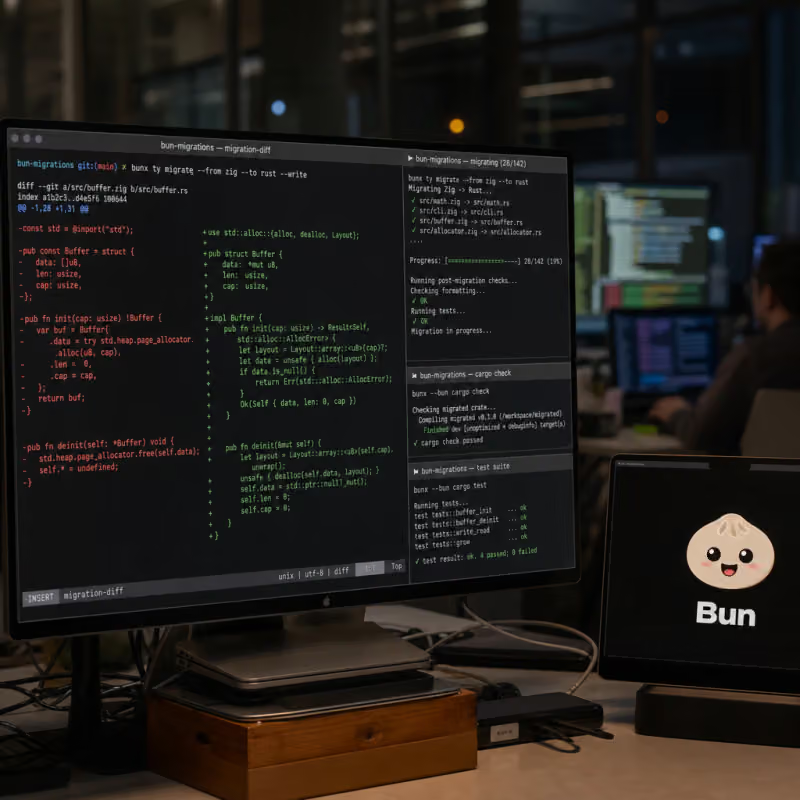
The software developer Jarred Sumner had the JavaScript runtime Bun completely rewritten from the programming language Zig to Rust. Up to 64 parallel instances of the unreleased Anthropic model Claude Fable 5 did the work within eleven days.
The rebuild of roughly 535,000 lines of code cost about $165,000 in compute, according to Sumner – independently unverified.
Automated cross-checking secures the new codebase
The transition ran between May 3 and 14, 2026, across four parallel working copies of the Bun repository. A total of 6,502 commits converted 1,448 Zig files into Rust code and added roughly one million lines net.
The process consumed 5.9 billion input tokens and 690 million output tokens, according to Sumner's report on the Bun blog. Sumner himself reportedly wrote no code, instead monitoring and steering the agents' workflows.
One set of AI instances wrote the code while another set then checked it specifically for errors. This automated cross-checking treated compiler errors like a work queue and resolved about 16,000 error messages that way.
No existing test was deleted or skipped. Every change had to pass the full test suite before it could merge into the main branch.
Address and leak sanitizers as well as test-driven fuzzing were also used. They caught three major bugs before the changes were merged. After release, developers and automated checks identified nineteen further regressions, which have since been fixed.
Anthropic has funded the project since acquiring Bun
Anthropic acquired Bun in spring 2026. The JavaScript runtime counts more than 22 million monthly downloads and also serves as the technical foundation for Anthropic's own Claude Code tool.
The acquisition explains why Anthropic apparently supplied the Bun team with extensive compute for the rebuild.
Independent developer and blogger Simon Willison called the project a case study in so-called agentic programming. Large rewrites of an existing codebase are traditionally seen as risky in software engineering.
Willison sees the combination of parallel AI work and a comprehensive test suite as evidence that this risk can now shift. The switch went largely unnoticed in production, since mainly startup time on Linux got measurably faster – "boring is good," as Willison puts it.
Zig creator Andrew Kelley spoke publicly about the split from his language. He reportedly felt relief at the decision and sharply criticized earlier working methods at the Bun project.
His claims about the earlier collaboration remain a personal account with no rebuttal from Sumner on record.
Bun 1.4.0 ships as the first fully Rust-based release
With version 1.4.0, the Bun team shipped the runtime's first release based entirely on Rust. Binaries came out roughly twenty percent smaller than before, and HTTP throughput rose by up to 4.8 percent.
Several memory leaks in the build function disappeared entirely, since Rust's automatic memory management catches missing frees at compile time.
According to the Bun blog, about four percent of the new code remains marked "unsafe," mostly for interfaces to existing C and C++ code. Claude Code itself now runs on the Rust version of Bun and starts up ten percent faster on Linux, according to the company.
The real crux lies less in the language switch than in the method. If parallel AI agents can reliably rebuild large codebases under strict tests and automated cross-checking, that changes the calculus for rewrites across the entire software industry.
It remains open whether the result can be repeated in comparable time and at similar cost without the tight integration with an in-house AI provider like Anthropic.