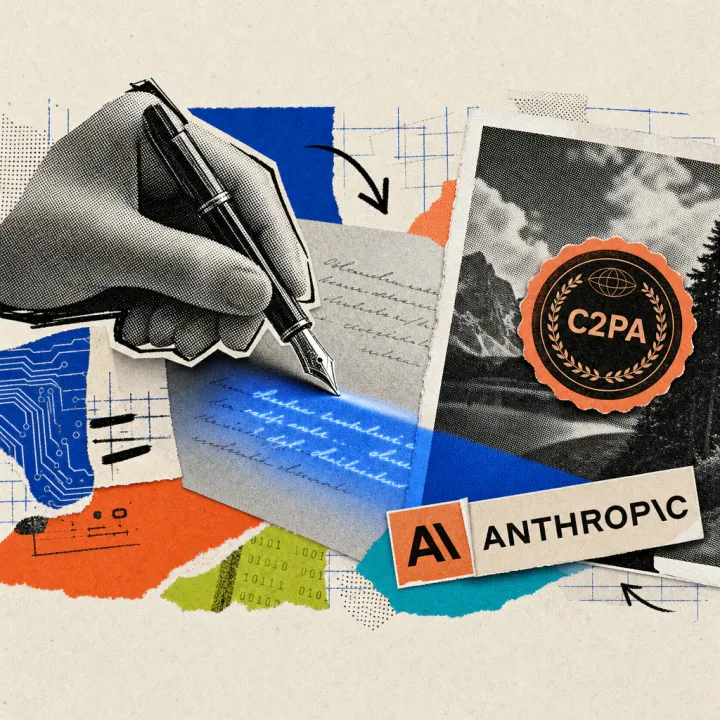
Anthropic revealed technical details of Claude’s text watermark to TechCrunch for the first time on August 15 – the marking has been embedded in every response since August 11. Only rephrasing every single word reliably removes it; light edits usually survive. The method remains largely ineffective for generated program code.
Synonym choice for every word encodes the signal
Anthropic uses a variant of Google’s SynthID-Text method, which DeepMind published in the journal Nature in 2024. According to the Anthropic engineer who disclosed the details to TechCrunch, Claude continuously makes so-called low-stakes choices between near-synonymous words in every text response – for example, between “overcast” and “grey” in a weather description. Across many such word pairs, a pattern emerges that stays invisible to readers but can be read out with the right key. The model itself is not aware of the process, since the watermarking runs independently of Claude’s actual response generation in the background.
Anthropic’s Help Center adds that the watermark does not change the meaning or readability of a response. Because the mark is part of the text itself rather than separate metadata, it travels along automatically when text is copied elsewhere. Short paragraphs or fact-heavy passages with few interchangeable phrasings, however, produce a weaker signal that can become unreadable. For newsrooms and schools, that means even plain, factual text can potentially be traced back, provided it is long enough.
Only a full rewrite reliably strips the watermark
The original report from August 11 left open how much editing it takes for the marking to disappear. The Anthropic engineer specified to TechCrunch: minor edits to individual sentences or a translation usually survive the pattern. It reliably vanishes only once practically every word of a response has been replaced. In practice, that means a paragraph copied straight out of a Claude response stays traceable even after light editorial touch-ups, as long as it isn’t rewritten word for word.
For generated program code, the method largely fails. Because source code usually allows only one syntactically correct solution, there is little room for interchangeable word choice. At best, comments in the code can be marked more reliably than the actual program logic. The four-paper research digest on AI watermarks from late July already flagged this as a fundamental weakness of current methods: all three watermarking techniques tested there lost nearly all forensic value after simple rephrasing. For development teams using Claude to write code, the origin of that code remains practically untraceable.
Detection tool still promised, no date set
Asked directly, the Anthropic engineer confirmed that a public detection API is coming that users will be able to run themselves – but Anthropic still won’t commit to a launch date. It remains independently unverified how reliably that future API will actually catch the edge cases described here, in rewrites and in code. Other providers are reportedly working on comparable watermarking methods that are not necessarily compatible with each other. Until a detection tool exists, companies that want certainty have little to go on beyond providers’ own claims.
Reactions to the disclosure are mixed: some Claude users canceled their subscriptions in protest at the invisible marking, while others welcome it as an overdue step toward transparency in AI-generated content. Access and pricing are unaffected by the clarification: the marking still runs automatically and at no extra cost in the background of every Claude product.
What remains open is whether the promised detection API will transparently flag the now-known gaps around rewrites and code once it ships, or instead hand users a false sense of certainty.