The venture capital firm Andreessen Horowitz announced a new $1.1 billion fund on August 28, 2026, which exclusively invests in the physical infrastructure of artificial intelligence. The Machine Age Fund finances chips, memory chips, data centers, robotics, and power supply – areas that, according to the investors, are reaching their capacity limits.
The new strategy is led by partners Martin Casado and Raghu Raghuram.
Fund consolidates billion-dollar bet on chips, memory, and data centers
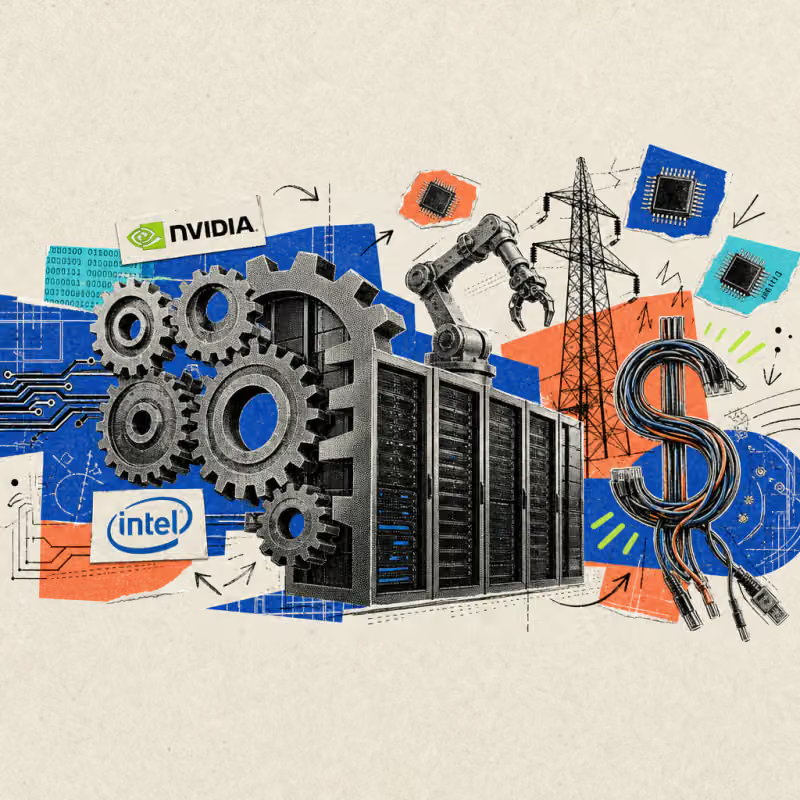
As Andreessen Horowitz states in the announcement of the Machine Age Fund, the capital flows exclusively into physical infrastructure: processors, memory, networking technology, data centers, robotics, power supply, as well as cooling and construction sites for new facilities.
Casado and Raghuram, who have previously invested in data center software and cloud infrastructure, are to lead the new strategy.
The partners justify the fund with a capacity bottleneck along the entire hardware supply chain. As evidence, they cite the computing density per server rack: it has increased 28-fold from the Nvidia H100 to the Rubin rack, while power consumption per rack has climbed from 5 to 10 kilowatts to 100 to 250 kilowatts and could reach up to one megawatt within three years.
The industry-standard annual capacity increase of 20 to 30 percent can no longer keep pace with this demand.
For Germany and Europe, a16z does not specify any targets. The firm's previous hardware investments, such as the drone manufacturer Skydio, the defense technology provider Anduril, and the robotaxi operator Waymo, are all located in the USA.
Whether the new fund will also invest outside the country remains open at the start.
Hardware overtakes software as the largest growth driver at a16z
The share of hardware start-ups in the investment deal flow of Andreessen Horowitz has, according to its own, independently unverified statements, risen from a small fringe segment to now more than one-fifth. As TechCrunch reports, the fund thus aligns with a broader industry trend: AI providers are increasingly securing physical capacities themselves, rather than just developing software – for example, Anthropic, which has established its own data center joint venture with investors Macquarie and GIC.
Previous bets by a16z on physical technology date back several years: Skydio received capital in 2016, Anduril in 2019, Waymo in 2020. With the Machine Age Fund, the firm is consolidating this segment for the first time in its own investment strategy with a dedicated team that is to finance both early-stage and growth-oriented companies.
Similar capacity bets are already underway elsewhere in the industry: Nvidia is supplying a new Japanese AI factory with thousands of Rubin chips, which is to train foundational models for industrial robots, among other things.
Andreessen Horowitz has not named any specific initial investments from the Machine Age Fund at the start.
It will be crucial whether a16z actually creates new capacities with the fund or whether additional capital merely meets already scarce suppliers, thereby exacerbating the bottlenecks. It also remains open whether Andreessen Horowitz will invest beyond the USA.
A publicly named first investment from the Machine Age Fund is likely to be the next concrete milestone.