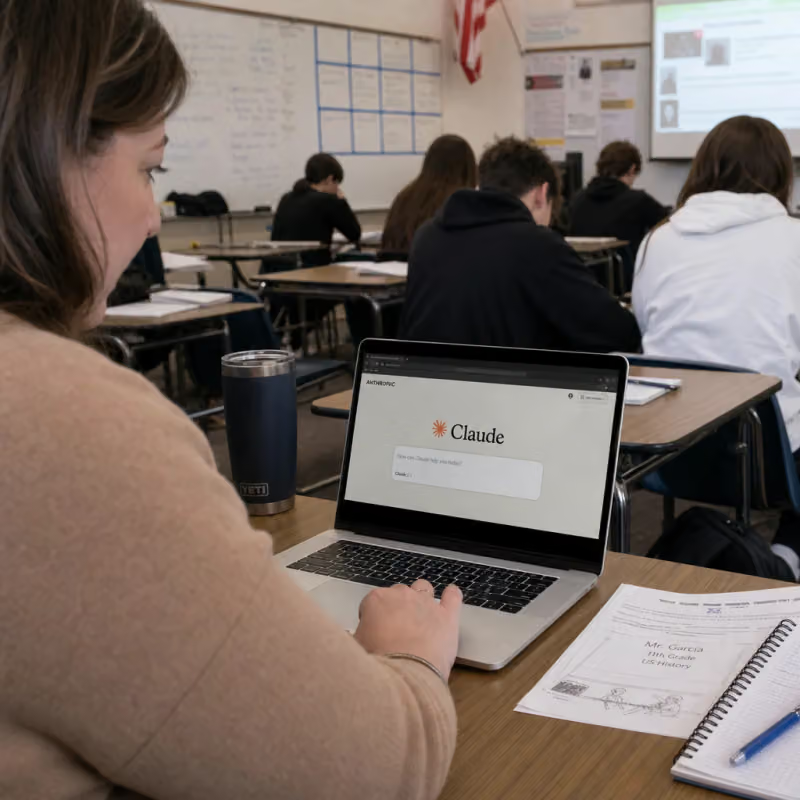
Anthropic is bringing Claude for Teachers, a free AI tool for educators, to US schools. Verified K-12 teachers gain free access to features for lesson planning and differentiation.
Until now, these features were reserved for paying users. Sign-ups are open through June 30, 2027.
Package Bundles Lesson Planning and Class Data Analysis
As Anthropic announced on July 14, 2026, Claude for Teachers is built around established teaching practices. These include differentiation by proficiency level and mastery-based learning, in which material advances only after demonstrated understanding.
The software creates lesson plans connected to state curricula through the Learning Commons platform. It also analyzes class data for further planning. The tool automatically handles recurring tasks such as the daily review of exit tickets.
The feature set also includes Claude Code and Cowork, along with a library of teaching skills developed with Learning Commons whose source code is openly accessible. Nine education platforms integrate directly, including Canva Education, MagicSchool, Diffit, and Brisk Teaching.
For alignment with vetted curricula, Anthropic also partners with providers OpenSciEd and Illustrative Mathematics. According to the company, the program is additionally supported by the Gates Foundation and the organization Teach for America. Anthropic is also offering a freely licensed course on AI fluency for teachers.
In addition, there are video tutorials in which teachers demonstrate using the tools in their own classrooms.
Google and Microsoft Compete for the Same Education Market
The move joins a race among several providers for US classrooms. Google had already signed an agreement with Utah's education authority in June 2026.
It brings Gemini to all of the state's public K-12 schools — a statewide government contract that goes beyond individual teacher accounts. OpenAI and Microsoft are also cooperating with the teachers' union American Federation of Teachers (AFT) on privacy standards and training programs, according to Chalkbeat.
The nonprofit Khan Academy has long been present in schools with its chatbot Khanmigo, which served as a reference project for the other providers in some cases.
Demand is growing independent of individual providers. The share of teachers who say they use AI tools in the classroom rose from 32 percent in 2024 to 61 percent in 2025.
That is according to a survey by Education Week. Anthropic is positioning its offering in a market where free basic versions for public schools have become standard.
Providers increasingly compete for exclusive partnerships with state authorities and unions.
Union and Critics Assess Privacy Differently
Anthropic says it developed the privacy provisions together with the AFT. The company points to a commitment under which student data does not feed into model training.
The offering is supplemented by a dedicated K-12 data processing agreement intended to implement the requirements of the US education privacy law FERPA. AFT President Randi Weingarten said it was important that the company was committing to these principles with Claude for Teachers.
Not all observers view the move positively. Education researcher Daniel Buck of the American Enterprise Institute warned, according to Chalkbeat, that classroom community and learning outcomes could quickly suffer if teachers outsourced instructional tasks to AI systems.
Privacy advocates also criticize the risk that students enter personal information into language models. There is also concern about cognitive offloading, in which thinking processes are increasingly handed off to the software.
At the same time, parent groups in several US states are mobilizing against what they see as excessive technology use in classrooms. Some school districts are therefore already reviewing existing edtech contracts.
What will matter is whether the promised privacy standards hold up in practice. Early indications are likely to come from the results of the pilot program in the Detroit school district.
It also remains open whether Anthropic will expand the offering to other countries after the test phase. For now, it remains limited to the US market, where Google, Microsoft, and OpenAI are already competing for schools.