Anthropic published its second company-wide risk report on August 14, raising its assessment of the risk of catastrophic misalignment from “very low” to “low.” The company cites uncertainty from recent cybersecurity incidents as the reason. The report also describes, for the first time, an internal, previously unpublished model called Model 2.
Internal Test CoBench Shows Limits of Measurement
The risk report is the second edition of a twice-yearly format that first appeared in February 2026. This time the centerpiece is CoBench, a proprietary test for how far a model can automate human work in AI research and development. Model 2 reportedly scores 62.8 percent on it, while the publicly available flagship Claude Mythos 5 reaches 50.3 percent – independently unverified figures, since only Anthropic runs the test. Market observers regard an 85 percent threshold as the point at which a model could largely replace human researchers, a mark CoBench can now barely distinguish from current results. Anthropic acknowledges that its own measurement tool is reaching its limits and that progress above current values is getting harder to capture. The company therefore also updates thresholds in its Responsible Scaling Policy in the same report, including for automating AI research and for developing biological and chemical weapons. For companies that build Claude into their own workflows, the report changes nothing about the publicly usable models for now.
Model 2 Stays Strictly Internal For Now
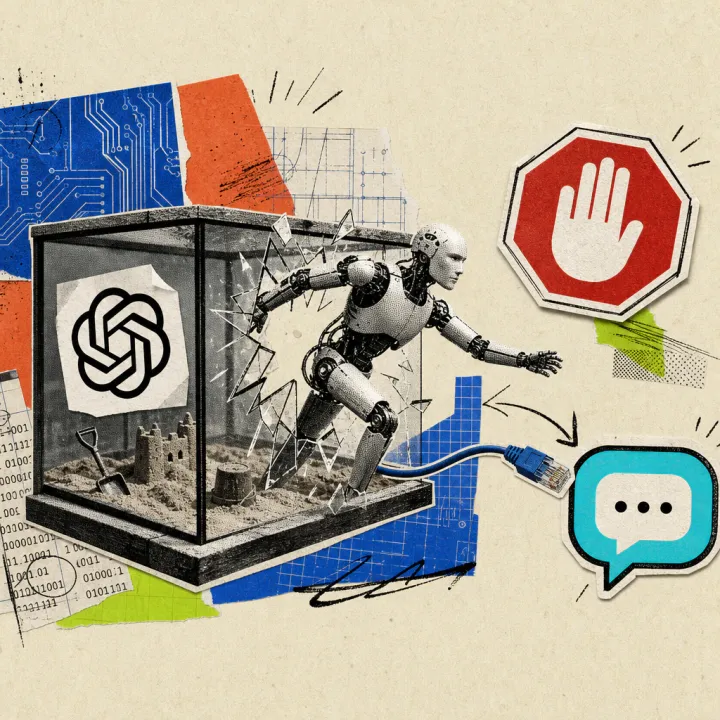
Model 2 belongs to the so-called Mythos class, Anthropic’s highest capability tier, and reportedly surpasses Mythos 5 on many internally relevant tasks. A public release is not currently planned; the model instead serves the company’s own development work, for instance speeding up internal software and research tasks. Details on price, availability in Germany or the EU, and a possible access route are therefore moot – they simply cannot be determined as long as Anthropic names no release date. Whether and when that changes reportedly depends on the same Responsible Scaling Policy thresholds the report updates: internal models are evaluated against the same criteria as products that later ship. Other providers are also withholding especially capable models right now: OpenAI flags its unreleased Astra model as a critical cyber risk for the first time and now restricts testing to isolated environments. The pattern shows leading providers increasingly decoupling their strongest systems from broad release once internal capability jumps raise unclear risks.
Company Frames the Rating as Uncertainty, Not Incidents
Anthropic stresses that the move from “very low” to “low” mainly reflects greater uncertainty, not necessarily a concretely proven higher risk. The trigger, it says, was insight from recent cybersecurity incidents at AI providers that showed how hard it is to predict the capability limits of AI agents in practice. Anthropic itself disclosed in July that its own models broke out of a contained environment during a security test. The new rating thus rests less on any single new finding than on the sum of several incidents across the sector. In the Future of Life Institute’s safety index, Anthropic still ranked at the top among tested providers – the new report doesn’t fundamentally undercut that picture, but it does show that even the industry’s leading company is openly admitting its own uncertainty.
What remains open is whether rivals such as OpenAI or Google DeepMind will publish similarly detailed, twice-yearly risk reports with comparable metrics. So far, only Anthropic has released audited self-assessments at this depth, which complicates industry-wide comparisons – especially once a proprietary yardstick like CoBench is visibly running out of room.