
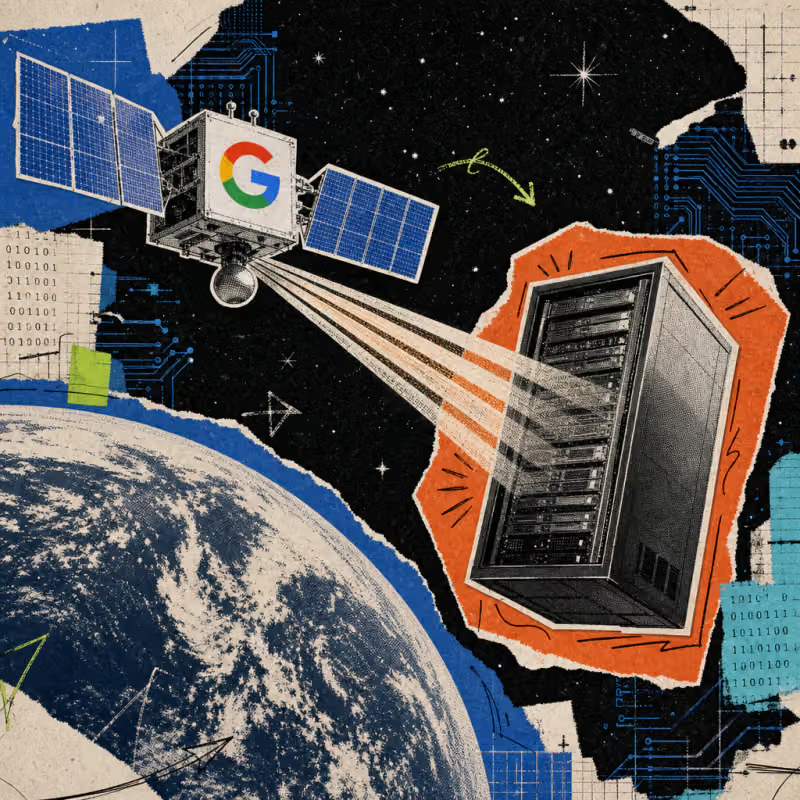
Google launched its first satellite with the proprietary AI chip Trillium v6e into Earth orbit on October 1, 2026, built in partnership with the company Planet. The launch took place via the SpaceX rideshare mission Transporter-18 as part of the research project Suncatcher, which tests whether data centers can operate in orbit in the future.
Two more test satellites are expected to follow in early 2027.
First test examines radiation and temperature in space
According to Google, the prototype has been in contact with the ground station since the launch and is functioning as expected. In the coming weeks, it will collect measurements on how the chip Trillium v6e withstands radiation, vacuum, and the extreme temperature fluctuations in orbit – conditions that server hardware on Earth never has to endure.
Previously, Google had bombarded the chip on the ground with a proton beam of 67 mega-electronvolts, according to a supporting study in the journal Joule; up to a total dose of 15 kilorads, no design-related failures occurred.
The study was led by Travis Beals, Senior Director for the research area Paradigms of Intelligence at Google. The project is officially running as a long-term research initiative and not as a commercial product.
The company has not yet provided a timeline for a market launch or a pricing model for computing power from orbit; availability for customers in Europe is also open.
Google plans a dense satellite swarm with laser link
The current satellite is just the first step of a larger vision: Google plans to connect around 80 closely spaced satellites into a computing swarm, each maintaining a distance of only 300 meters to one kilometer – about 120 times closer than SpaceX's Starlink satellites.
Solar cells reportedly provide up to eight times more energy in orbit than on the ground, as clouds and night phases are absent; in a sun-synchronous orbit, the sun practically never sets for the satellites. Initial tests of the optical data connection between the chips already achieved 800 gigabits per second in each direction; Google also considers several terabits per second technically feasible.
According to the company, current satellite technology is not sufficient for such tight formations; attitude control and propulsion systems would need to be further developed for such dense swarms. Two more prototypes are set to launch into space together with Planet in early 2027 and additionally test the laser connection between two satellites in orbit.
Critics doubt the transport costs to space
Economically, the project stands or falls with rocket launch costs. According to Google's own calculations, which are evaluated by the trade publication The Register among others, computing power in space only becomes comparably inexpensive as a data center on the ground at transport costs of around $200 per kilogram – a figure that has not been independently verified.
SpaceX would need to complete around 1,800 more Starship flights with a total payload of about 370,000 tons and reuse individual components up to 100 times; costs have so far decreased by about 20 percent for each doubling of the total transported mass.
Industry analysts have similarly expressed skepticism about competitor SpaceX's plans to operate its own data centers in orbit – experts expect economic parity with ground infrastructure there no earlier than around 2040.
Google also acknowledges that current networking technology is insufficient for so many closely spaced satellites in formation flying and laser technology.
It will be crucial whether Google solves the technical problem faster than transport costs decrease: attitude control, laser connection, and chip cooling in vacuum must function at an industrial scale for a swarm of dozens of satellites, not just in a single test flight.
The next concrete test will follow with the two additional prototypes that Google and Planet have announced for early 2027.