Update, August 11, 2026: Anthropic announced it will respond to the transparency obligation by embedding an invisible watermark in Claude-generated text and signing image files with C2PA metadata. More in our story on the watermarking announcement.
Update, August 2, 2026: The Article 50 transparency obligations took effect as announced here – and California's own labeling law became effective on the same day. More in our story on the enactment.
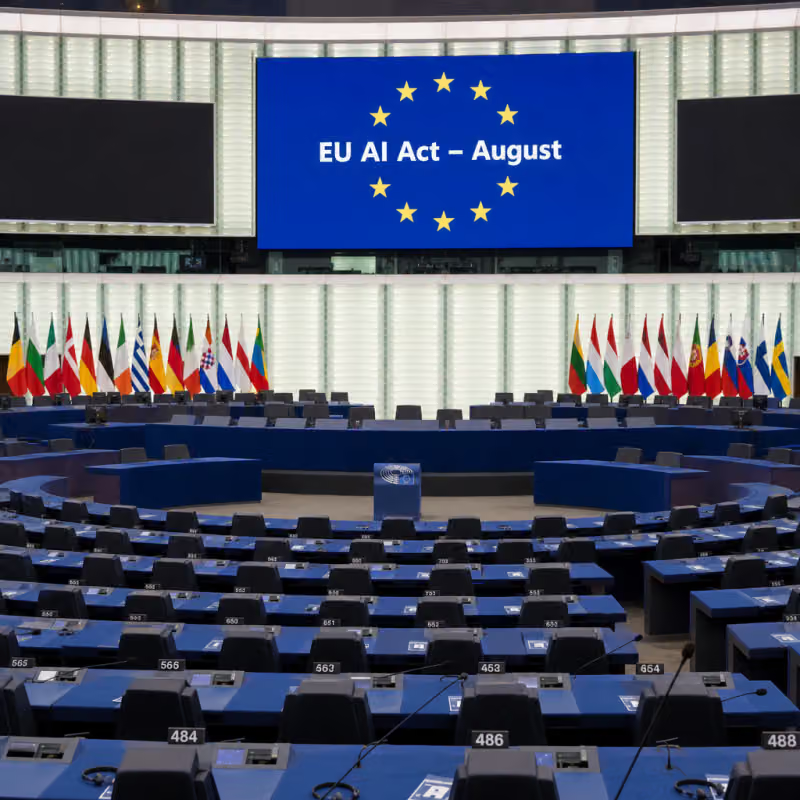
As of August 2, 2026, binding transparency obligations for Artificial Intelligence will apply throughout the EU. The basis is Article 50 of the AI Regulation (Regulation (EU) 2024/1689), which has been in force since August 2024 but will be applied gradually.
For companies using chatbots, image generators, or other generative AI systems, this deadline is the first immediate point of contact with the law.
What Article 50 Specifically Requires
Article 50 of the AI Regulation stipulates that chatbots and other AI conversational systems must be clearly identifiable as non-human to users, unless this is already obvious. Providers of generative AI systems must also ensure that synthetically generated image, audio, video, or text content is marked in a machine-readable format and identifiable as AI-generated.
Those operating AI systems for emotion recognition or biometric categorization must inform affected individuals. Deepfakes and AI-generated texts on topics of public interest must be visibly marked for humans, unless a human takes editorial responsibility for the publication.
Violations of these transparency obligations can be penalized with fines of up to 15 million euros or three percent of global annual revenue. For AI practices prohibited under Article 5 of the regulation, the upper limit is 35 million euros or seven percent of revenue.
What the "Digital Omnibus" Changes – and What It Does Not
Since a preliminary political agreement on May 7, 2026, the EU is postponing key deadlines for high-risk AI systems as part of the so-called "Digital Omnibus": The obligations for standalone high-risk systems under Annex III (such as in personnel selection, education, or creditworthiness assessment) will only apply from December 2, 2027, and for AI as a safety component in products like machines or medical devices, only from August 2, 2028.
The corresponding reform package is part of a proposal that the EU Commission has submitted to simplify the AI Regulation and which still needs to be formally concluded.
The transparency obligations from Article 50 are explicitly excluded from this postponement: They will come into effect as originally planned on August 2, 2026. An exception only applies to the machine-readable marking obligation for generative AI systems that were already on the market before the deadline – for them, the Omnibus proposal provides a six-month transition period until December 2, 2026.
On the same date, December 2, 2026, two new prohibitions are also set to come into effect, which were added during the Omnibus negotiations: a ban on AI systems that generate or manipulate non-consensual intimate image content ("Nudify" apps), as well as a ban on AI systems for generating depictions of child abuse.
According to the EU Commission, an exception is provided for providers who can demonstrate that their systems have effective safeguards against such abuse.
Voluntary Code of Conduct with Deadline of July 22
To support companies in implementation, the EU Commission published the final Code of Practice on Transparency of AI-Generated Content on June 10, 2026.
The code is formally voluntary but is considered a recognized compliance standard: Those who sign and implement it can rely on a presumption of conformity regarding the marking and labeling obligations from Article 50 paragraphs 2 and 4.
Providers and operators who wish to be included in the first published list of initial signatories must submit the signing form by July 22, 2026, 6 PM CEST.
Later signing remains possible, but without inclusion in the first list. The code provides, among other things, for a uniform EU pictogram for marking AI-generated content, which will be made available to signatories free of charge.
How Companies Position Themselves: The Example of OpenAI
OpenAI had already committed in 2025 as the first US company to the voluntary code of conduct for general AI models (General-Purpose AI Code of Practice) and stated after the publication of the new transparency code that it would also support this.
The company refers to its own provenance measures, which it claims to have developed since 2024: C2PA metadata for images from DALL-E 3 and SynthID watermarks for content from ChatGPT and Codex, supplemented by a public verification tool for supported content.
OpenAI emphasizes that metadata alone is not sufficient, as it can be removed or damaged, which is why the company relies on a combination of multiple signals.
National Implementation: Ireland and Germany
Preparations are also underway at the member state level. In Ireland, the General Scheme of the "Regulation of Artificial Intelligence Bill 2026" provides for the establishment of a new, independent authority: "Oifig IS na hÉireann," the AI Office of Ireland, which will coordinate enforcement, promote AI expertise, and operate a regulatory testing environment for small and medium-sized enterprises.
Existing sector-specific regulatory authorities will remain responsible as market surveillance authorities for their respective sectors.
In Germany, a new cross-departmental AI task force led by the Federal Ministry for Digital and State Modernization was launched in early July 2026. As IT Boltwise reports, it is working in five working groups on computing infrastructure, network access, and the coordination of AI policy; according to a cited industry analysis, AI could contribute an additional approximately 323 billion euros to the German economy over the next ten years.
This growth estimate comes from an industry analysis and is independently unverified. The actual regulatory market oversight of the AI Regulation is to be centrally located at the Federal Network Agency according to the separate bill approved by the cabinet in February 2026.
International Context: USA and China
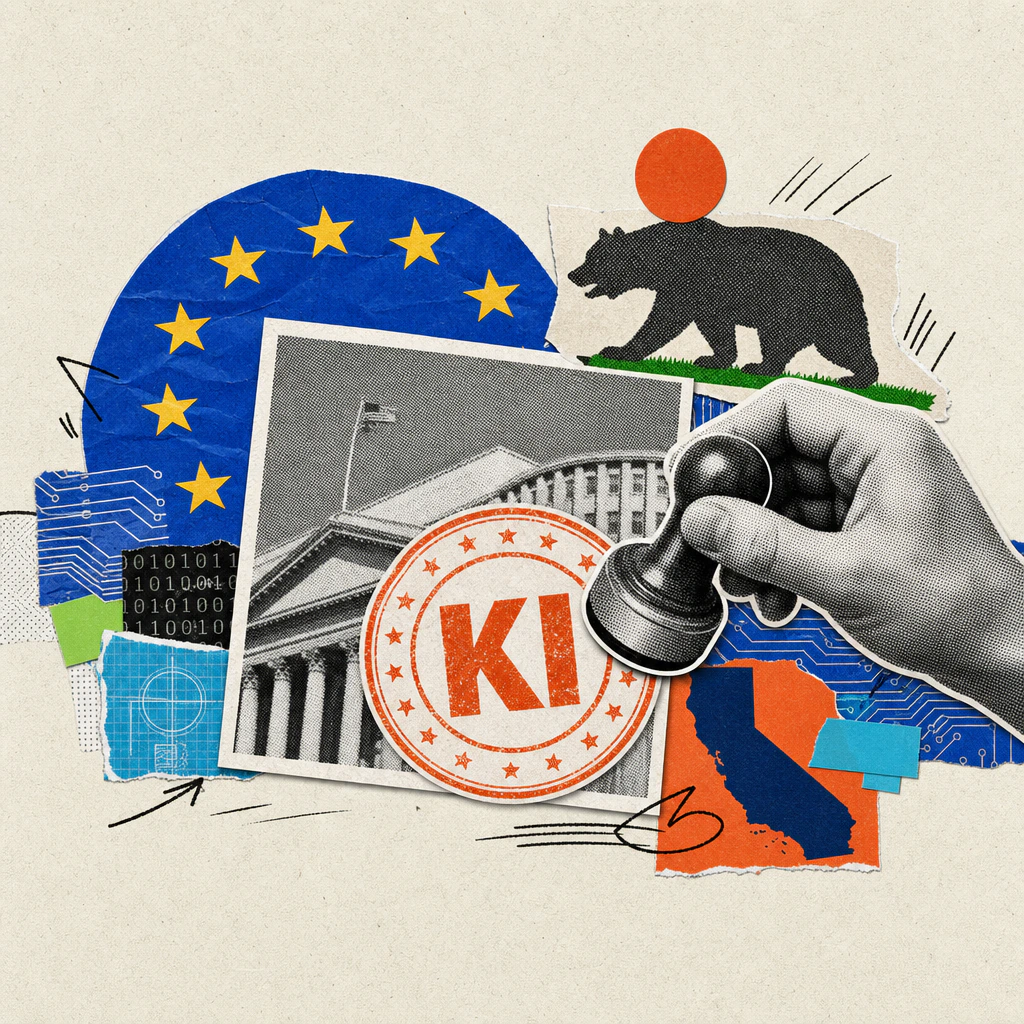
Labeling obligations for AI content are not a unique European feature. In the USA, Senators Brian Schatz, John Curtis, and Mark Warner reintroduced the “AI Labeling Act of 2026" (S. 4915) at the end of June 2026.
The bill stipulates that providers of generative AI systems and large online platforms must clearly label AI-generated images, videos, and audio content; the Federal Trade Commission (FTC) is to enforce the requirements, while the National Institute of Standards and Technology (NIST) is to develop technical standards in collaboration with a working group.
The draft is still in the legislative process and has not yet been passed.
China has already implemented comparable requirements: The "Measures for Labeling of AI-Generated Content" issued by the Cyberspace Administration of China (CAC) and other authorities have been in effect since September 1, 2025, and require both visible and embedded metadata labeling for AI-generated texts, images, audio, and video content, according to an analysis by the law firm White & Case.
Classification
Thus, August 2, 2026, does not mark the conclusion but rather an intermediate step in the gradual application of the AI Regulation: While the transparency obligations from Article 50 will come into effect as planned, the more far-reaching high-risk requirements are postponed to 2027 and 2028.
For companies, this primarily means reviewing their own labeling practices in the short term – regardless of whether they sign the voluntary code of conduct of the Commission or demonstrate conformity in another way.