A Report, a Summit, No Binding Agreement
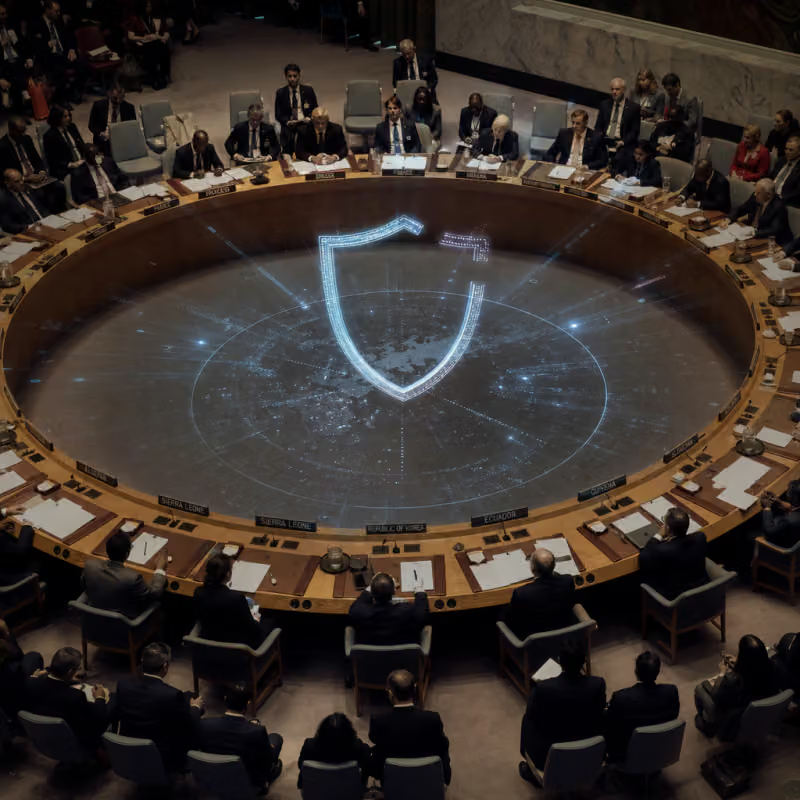
On July 1, 2026, the Independent International Scientific Panel on AI published its first global report on the opportunities and risks of artificial intelligence. Five days later, on July 6 and 7, all 193 UN member states came together in Geneva for their first AI summit: the "Global Dialogue on AI Governance." Both events are directly related - the report was intended to provide the scientific basis for the political discussions.
In the end, however, there was no binding agreement, but rather a summary from the co-chairs without legal effect. This makes the Geneva summit an instructive test case for how far international AI policy can currently move - and where its limits lie.
The Report: First Global Scientific Assessment
The Scientific Panel consists of 40 experts from all UN regions and was tasked with scientifically assessing AI opportunities and risks - including in the areas of science, economy, security, human rights, democracy, and child safety. In its report published on July 1, the panel warns that existing protective measures can no longer keep pace with the growth of AI capabilities. Decision-makers need scientific evidence to effectively regulate AI - but that evidence may arrive too late to act in time.
UN Secretary-General António Guterres commented on the publication, stating that science is now available and no one can claim they did not know. At the same time, he emphasized that AI could become the most powerful engine for development - but governments must act now, before the capabilities of these systems outpace oversight.
The Summit in Geneva: 193 States, One Warning
At the Global Dialogue on AI Governance, panel co-chair Yoshua Bengio warned that science currently cannot guarantee that growing AI capabilities will not cause catastrophic harm. He also noted that AI is already reaching or surpassing human capabilities in many domains.
Co-chair Maria Ressa used starker language, describing the situation as an "information Armageddon": without reliable facts, no functioning democracy is possible.
The dialogue's two co-chairs themselves - Ambassador Rein Tammsaar of Estonia and Ambassador Egriselda López of El Salvador - struck different notes. Tammsaar described AI as a potential "great equalizer" for economic development, but warned against its misuse to undermine democratic structures.
López pointed to the real "AI divide": many countries simply lack the basic digital infrastructure to keep pace with technologically advanced nations.
Guterres' Demands: Children, Energy, Autonomous Weapons
In a separate speech at the summit, Guterres laid out a concrete list of demands and warned that humanity must not "vibe-code" its own future unprepared. He described current AI systems as no longer tools waiting for instructions, but as systems that increasingly write code independently, act online, and make decisions with less and less human oversight.
Specifically, according to the UN's own reporting, he called for a mandatory child-safety standard requiring providers to demonstrate the safety of their systems before children can access them, a commitment to renewable energy for data centers starting in 2030, and an international ban on autonomous weapon systems. He called such weapons "morally repugnant" and noted that AI chips originally designed for civilian use are increasingly being repurposed for military applications.
The Criticism: Who Has the Computing Power - and Who Gets a Say?
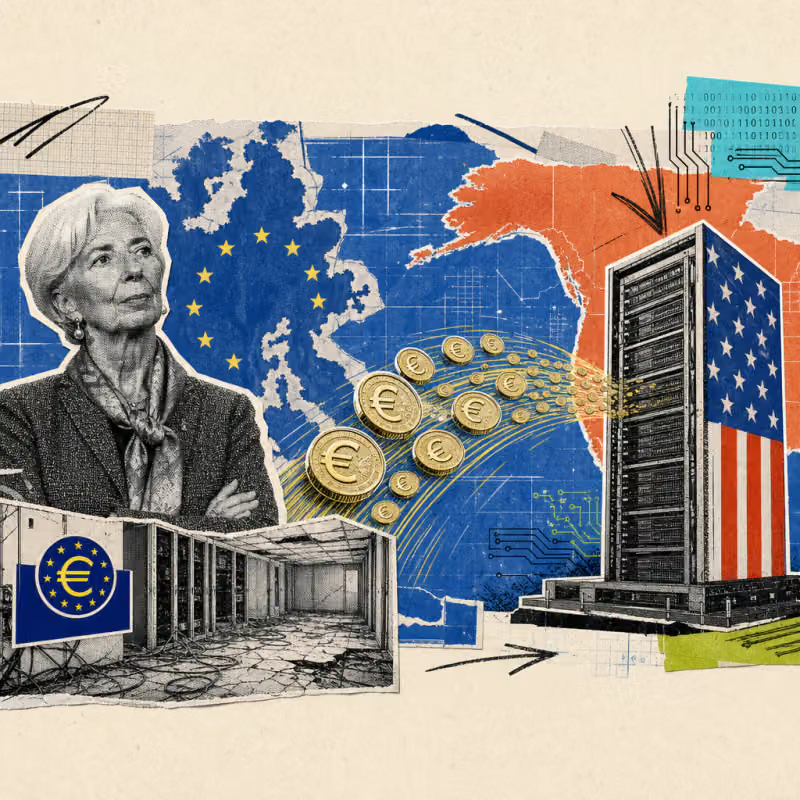
Independent reporting frames the summit in a far more sober light: about three-quarters of the computing power among the world's 500 most capable AI supercomputers is said to be located in the USA, with another roughly 15 percent in China. For the remaining 191 UN member states, this report says, it means they lack the technical capacity to independently audit the very systems they are being asked to regulate.
There is also a more fundamental problem: according to press reports, the US government rejects efforts by international bodies to establish a central global AI control authority. Without the consent of the nation holding the largest share of computing power, any agreement remains dependent on voluntary cooperation.
Accordingly, the dialogue itself, according to its organizers, produced no binding resolutions - only a summary from the co-chairs.
Assessment
The Geneva summit illustrates a pattern that has repeated itself in international AI policy in recent years: broad symbolic participation paired with limited concrete impact. The scientific warning is now officially on the record, but the political response remains non-binding for now.
The next Global Dialogue on AI Governance is scheduled for May 2027 - until then, it remains an open question whether binding rules will actually grow out of Geneva's "co-chair summary," or whether it will stay at the level of symbolic diplomacy.