The Linux kernel now has a clear, official stance on artificial intelligence – and it comes straight from the top maintainer himself. In an email to the Linux kernel mailing list, Linus Torvalds stated unmistakably that the kernel actively uses AI tools in development and will continue to do so. Anyone who has a problem with that can fork the project or leave, he wrote.
The trigger: a dispute over the AI tool Sashiko
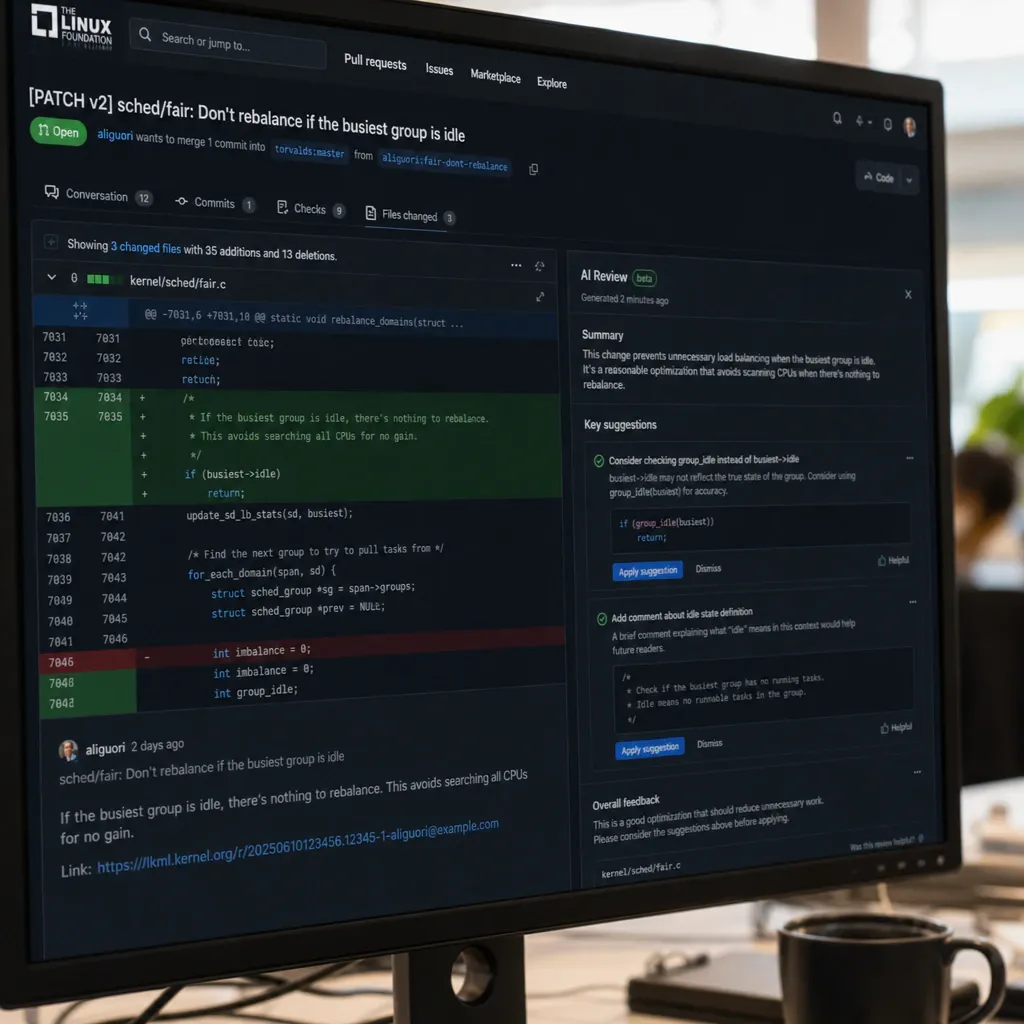
The debate was sparked by an exchange about Sashiko, an agentic AI system that automatically reads in patches submitted to the mailing lists or from local Git repositories, checks them and sends feedback to their authors. It was developed by kernel engineer Roman Gushchin, who works at Google; it now runs as a project under the umbrella of the Linux Foundation and can be hooked up to various LLM providers. In tests on 1,000 recent upstream commits carrying a “Fixes:” tag, Sashiko is said to have tracked down around half of the bugs that had originally been missed.
Developer Laurent Pinchart had proposed that the automatic Sashiko comments be reviewed manually before being sent to patch authors. Gushchin disagreed: that would defeat the tool’s actual purpose – taking work off maintainers’ hands. He saw Pinchart’s position as a generally “very anti-LLM” stance.
The critics: false positives, word salad and a halted review tag
That the debate escalated at all has solid technical reasons. When maintainers in the media subsystem hooked Sashiko up to the mailing list unfiltered as a test, the attempt was called off: the AI produced too many invented problems – developers mockingly spoke of “word salad” – which in the end caused more confusion than benefit and created extra work for human maintainers. The exact false positive rate is also considered hard to measure; estimates put it at around 20 percent.
Developer Krzysztof Kozlowski added further fuel: he criticised Sashiko for marking patches with “Reviewed-by” on its own – a tag that in the kernel workflow normally means the personal assurance of a human reviewer. Gushchin responded and suspended the automatic assignment of that tag.
Pinchart’s reservations were not without backing either: he invoked the “Recommendations When Using LLM-backed Generative AI Systems for FOSS Contributions”, a paper published in June 2026 by the Software Freedom Conservancy (SFC). Among other things, the non-profit organisation recommends full transparency about the use of AI tools as well as respect for contributors who want to reject LLM-backed systems outright – explicitly worded as a recommendation, not an obligation.
Torvalds: “Linux is not one of those anti-AI projects”
This is exactly where Torvalds stepped in – and left no room for interpretation. He confirmed that some individual participants hold a dismissive attitude towards AI, but made clear that this is not the kernel project’s position. In his own words he wrote, “Linux is not one of those anti-AI projects”, and anyone who disagrees can fork the project or leave.
He also took a clear position on substance: “AI is a tool, just like other tools we use” – a year ago that was not yet so unambiguous, today it is beyond question. Anyone who doubts it has evidently not used the tools themselves.
Torvalds did not gloss over the fact that AI also creates friction: extra work for maintainers, occasionally “embarrassing bugs” that only become visible through the tools. His conclusion, though, is not rejection but improvement – the tools should help maintainers instead of piling extra load on them. Nobody will be forced to use AI, he stressed, but anyone who tries to talk others out of using it will be “very loudly ignored” by him.
Technology instead of ideology
Perhaps the most fundamental sentence of the debate came from Torvalds on how the project sees itself: the kernel has never been an ideological project out to enforce a particular attitude towards new tools, but an engineering project. The social component of open source is real and motivating, but it is a side effect, not the actual purpose. Open source is practised in the kernel project because it leads to better technology, “not for religious reasons” – decisions are therefore made first and foremost on technical merit, not out of fear of new tools.
Not every open source project is on board
Torvalds’ plain speaking also marks a fault line within the open source world: while what is arguably the most influential piece of software infrastructure on the internet is now openly betting on AI in development, other projects such as Gentoo, curl or Ghostty have temporarily introduced stricter rules for AI-generated contributions or excluded them altogether – out of concern about low-quality, generated code. Torvalds does not dismiss that concern, but draws the opposite conclusion: instead of avoiding AI, he wants to integrate it better into existing workflows.
Important for context: nobody in the kernel project is forced to use AI. Individual maintainers and subsystems keep the freedom to decide for themselves whether and to what extent they use tools like Sashiko. On Torvalds’ reading, only one thing is off limits: trying to talk others out of using them.
For the kernel as a whole it nevertheless means this: AI-assisted tools are no longer a fringe experiment but part of the officially accepted toolbox – signed off by the developer who has led the project for more than three decades, even if the error rate and open questions about accountability for individual review tags show that the road there is not yet at its end.