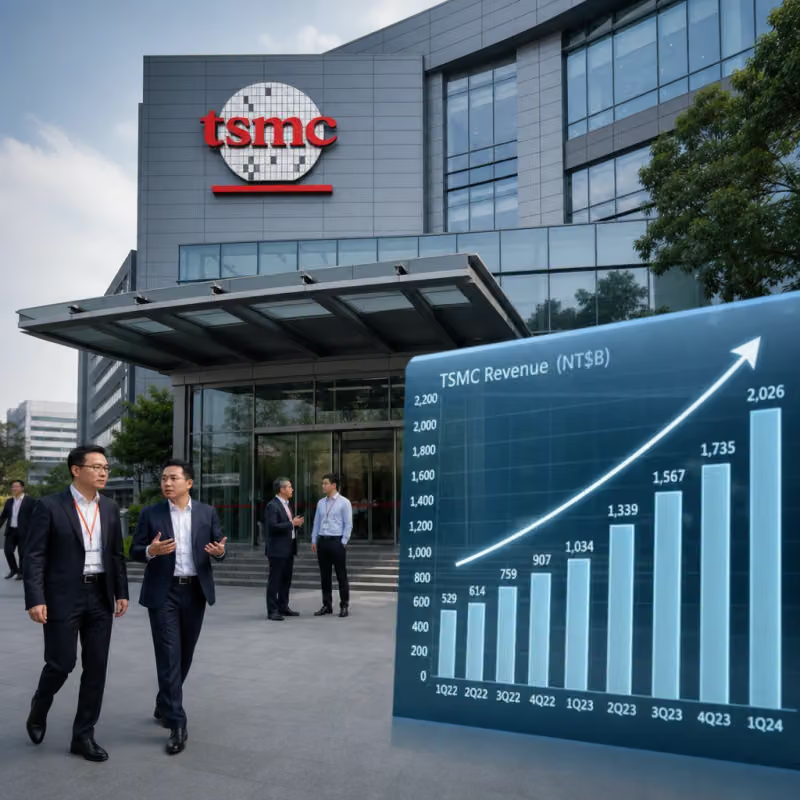
Taiwanese contract chipmaker TSMC reported consolidated revenue of about $39.6 billion for the second quarter of 2026, up 36 percent from the same period last year. In June alone, revenue jumped 67.9 percent, sharply surpassing the previous record month of May.
The surge is driven by unbroken demand for chips used in artificial intelligence applications.
June Figures Surpass the Previous Record Month
According to TSMC's investor relations page, June revenue reached NT$442.68 billion, roughly $13.8 billion. That is 6.2 percent above May, which had previously set the record at NT$416.98 billion.
The increase breaks a seasonal pattern: in each of the previous four years, June revenue had declined from May.
For the first half of 2026, revenue totals NT$2.4 trillion, up 35.6 percent from the same period a year earlier. The quarterly figure also beat the consensus estimate from twenty analysts, who on average had expected NT$1.264 trillion, as CNBC reported.
It also met the company's own April guidance, which had forecast revenue between $39.0 billion and $40.2 billion. TSMC shares rose about one percent following the announcement.
TSMC supplies customers including Nvidia, Apple, and AMD and is considered the world's largest contract manufacturer of advanced chips. The actual chip design remains the customers' responsibility. TSMC handles manufacturing exclusively.
AI Demand Pushes Manufacturing Capacity to Its Limits
Advanced manufacturing processes at seven nanometers and below accounted for roughly three-quarters of total wafer revenue in the first quarter, with three-nanometer technology alone contributing a quarter, according to TSMC's quarterly report.
Capacity for the advanced CoWoS packaging technology needed for AI accelerators is considered fully booked for all of 2026. The most advanced three-nanometer production line is also, according to market observers, almost completely booked through year-end.
Company chief C. C.
Wei described the situation, according to Tech Times, as "extremely tight and sold out through 2026." Nvidia reportedly secures around 60 percent of this packaging capacity.
Together with Broadcom and AMD, that puts roughly 85 percent in the hands of the three largest customers. These customer shares stem from industry estimates and are not independently verified.
To offset the tight capacity, TSMC reportedly raised prices for manufacturing processes at seven nanometers and below by five to ten percent, according to consistent reports. AI customers reportedly absorb the increase without difficulty, while smartphone and PC makers face pressure and are expected to pass the added costs on to consumers in the fourth quarter.
Full Figures and US Investments Follow on July 16
The figures published so far are preliminary monthly numbers that TSMC itself says are unaudited. The company plans to present its full quarterly report, including profit, margin, and updated annual guidance, on July 16, 2026.
Analysts are watching closely whether TSMC raises its full-year guidance from over 30 percent revenue growth in US dollar terms. They are also watching whether the company revises its capital expenditure budget of $52 billion to $56 billion upward.
TSMC is also investing $65 billion of its own money in three fabs in the US state of Arizona. A further $100 billion investment package for expanding US manufacturing has already been announced.
More than 90 percent of the world's leading-edge chip manufacturing, however, still takes place in Taiwan, which customers and investors view as a geopolitical risk.
Just how vulnerable that concentration makes the business became clear, according to Tech Times, in the reporting delay caused by Typhoon Bavi, which pushed back the release of the June figures by two days.
What matters now is whether TSMC actually raises its annual guidance at the July 16 earnings call. A higher outlook would signal that the AI investment cycle continues unbroken despite growing investor doubts about the sustainability of massive AI spending.
If the guidance stays unchanged, that could be read as an early sign of a slowdown.