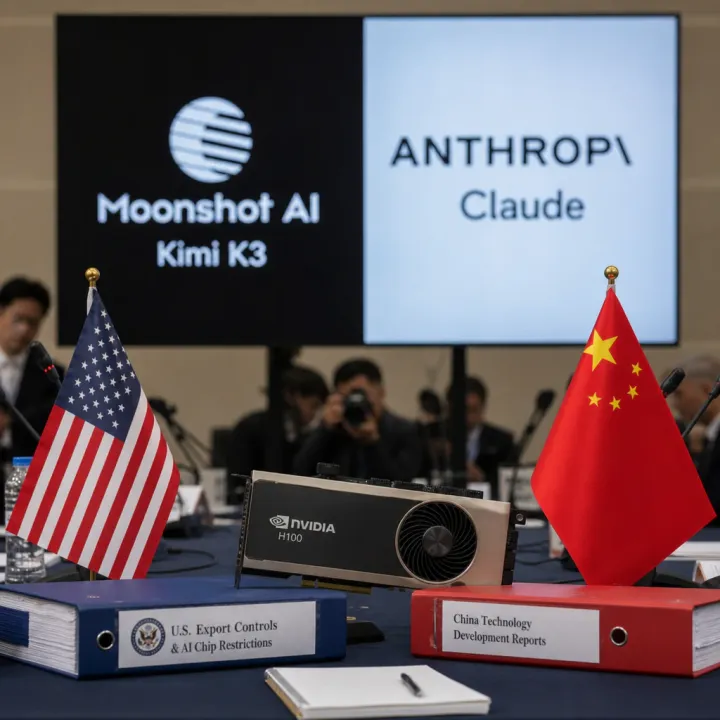
The US government accuses Chinese company Moonshot AI of building its Kimi K3 model through large-scale, concealed distillation of Anthropic’s Fable. White House science adviser Michael Kratsios said so on July 22 on the platform X. Treasury Secretary Scott Bessent is threatening sanctions and Entity List designations if the theft is confirmed.
Kratsios describes an evasion platform with multiple access routes
According to Kratsios, Moonshot built internal software that automatically switched between multiple access routes to US models to conceal systematic distillation. It is the first time a senior US government official has publicly accused a specific Chinese company by name of model distillation. US Under Secretary of State Jacob Helberg also weighed in with similarly sharp language.
Kimi K3 emerged this way: an open 2.8-trillion-parameter model with a context window of one million tokens, which Moonshot released on July 15 – just over two weeks after Anthropic relaunched its Fable model on July 1, as beckmann.ai reported at launch.
Moonshot is also said to have used servers with Nvidia’s GB300 chips, which fall under US export controls and are officially barred from sale to Chinese companies. According to Kratsios, the company obtained the hardware via Thailand. Treasury Secretary Scott Bessent said the practice was not an open invitation to steal American intellectual property. In cases of industrial-scale, covert technology theft, sanctions and Entity List designations are on the table, he said. A congressional committee has been investigating alleged distillation attacks by Chinese providers since April.
Moonshot denies the allegations, experts doubt the timeline
A Moonshot employee responded on the platform X to the allegations: “We trained a brand new frontier model in just fifteen days.” He was pointing to the gap between Fable’s relaunch on July 1 and Kimi K3’s release on July 15. No official Moonshot statement has followed, and several newsrooms received no response to inquiries.
AI researcher Braden Hancock of the Laude Institute told TechCrunch it is unlikely that such a strong model could emerge within two weeks through distillation alone. Nathan Lambert of the Allen Institute for AI adds that distillation becomes increasingly less effective for Chinese providers as their technical gap to the frontier narrows. Extensive reinforcement learning across millions of agents, he says, would be barely affordable through mere API queries.
Anthropic had already stated in February that several Chinese providers – including Moonshot, DeepSeek and MiniMax – had used fraudulent accounts and proxy services to try to extract Claude models’ capabilities. Moonshot, it said, had made more than 3.4 million requests via hundreds of accounts, focused on agentic reasoning and computer use. Whether the same infrastructure was used for Kimi K3 is a question Anthropic left open for the current case.
What will matter is whether the US government produces technical evidence beyond its statements so far – without public proof, the case remains a standoff of claims between Washington and Beijing. For Moonshot, more than reputation is at stake: the company is reportedly preparing a Hong Kong IPO at a targeted valuation of $30 billion. Sanctions or an Entity List designation could seriously complicate that plan, as well as access to the additional computing power the company urgently needs.