
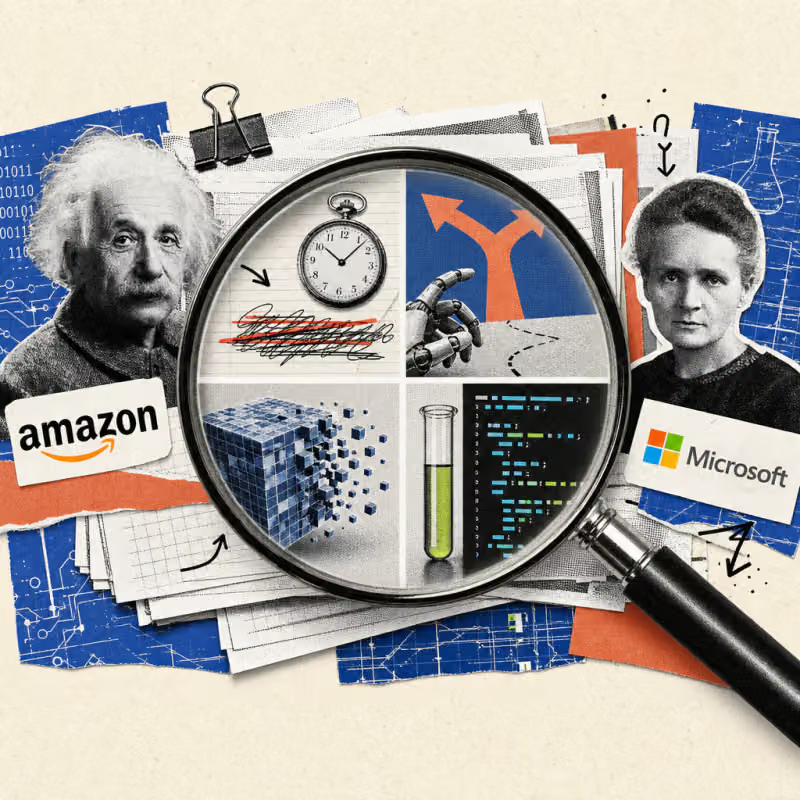
Today's selection from the arXiv new submissions of the past 24 to 48 hours connects four questions that rarely appear together: how reliably memory systems of AI agents track changing facts, how safety behavior can be trained in physically acting agents, how strongly model compression shifts knowledge and biases unevenly, and how far coding agents actually get in repairing scientific software.
The curation was based on substance and dispersion: each paper provides a traceable method with robust numbers in the abstract, and no two works address the same subfield.
StateMemBench: When facts change, many memory systems fail
Xinyi Fan, Miri Liu, Ruozhen Yang, Siru Ouyang, and Jiawei Han present StateMemBench, a benchmark that tests whether memory systems of AI agents not only remember facts but also recognize when these facts have been overtaken by new information – such as a changed delivery address or a retracted decision.
The benchmark includes 234 multi-session scenarios and separately evaluates whether an answer reflects the current or an already outdated state. According to the authors, existing memory systems, retrieval-based baseline methods, and long-context models struggle with this; their own method StateMem, which explicitly tracks overtaking and dependencies, improves accuracy at the current knowledge state compared to the strongest comparison method by 1.8 times (from 0.205 to 0.363), and when added as a lightweight component over six existing systems, even by 32 to 67 points. A previous work had already shown that a separate memory agent increases the success rate in long-term tasks – StateMemBench now provides the first dedicated test for whether such systems can also handle contradictory, time-revised information.
This matters because productively deployed AI agents are constantly confronted with exactly such updates over long interactions.
SafeBranch: Safety training from the agent's own failures
Hyunse Lee, Jiwoo Jeong, Haneul Lee, Kyochul Jang, Youngjae Yu, and Woojin Lee present SafeBranch, a training method for physically acting AI agents that perform tasks in simulated household environments based on vision-language models.
The method utilizes the agent's own unsafe execution attempts: at safety-critical steps, the simulation is reset, the agent is asked for a safe alternative, and a comparison pair is created from both variants that only differs at that one point.
Tested on the benchmarks IS-Bench and SafetyALFRED and their variants with unknown objects, the trained agent achieved about ten times more safe successes than the untreated baseline model, according to the authors – and this without requiring an additional verification instance during execution. The world model Orca had previously shown that robotic capabilities can be trained entirely without action data – SafeBranch adds a safety mechanism that does not require separate runtime monitoring.
This matters because runtime safety checks for physically acting agents incur additional computational costs and latency, which SafeBranch saves through the pre-training.
Asymmetric harms: Compression unevenly affects knowledge and groups
Yuan Wu, Mairui Li, Lesia Semenova, and Chudi Zhong investigate, in their study on the harms of AI model compression, what standard metrics like perplexity or overall accuracy overlook when shrinking language models.
They examine three language models across eleven compression methods for knowledge retention, model confidence, and social bias. The authors report that compression weakens rarely used niche knowledge more than frequently queried core knowledge, and compressed models often remain highly confident in incorrect answers despite newly lost knowledge.
Additionally, stable aggregated bias values, according to the study, conceal opposing shifts in stereotype preferences between individual population groups, which only become visible when examined separately. A previous work had already demonstrated that quantization alters response behavior without classical accuracy or perplexity metrics indicating it – the new study specifically extends this finding to knowledge distribution and demographic bias patterns.
This matters because compression in practice is often seen as an almost cost-free optimization, even though it can specifically target different user groups and knowledge areas according to these findings.
SWE-bench Science: Scientific software remains challenging for coding agents
Zhipeng Xu, Jiahao Lu, Yining Zheng, Yuxin Wang, and Xipeng Qiu present SWE-bench Science, a benchmark for coding agents that specifically tests scientific software – program code whose errors can distort not only program behavior but also scientific conclusions.
The benchmark includes 119 tasks from 98 GitHub repositories across 20 disciplines, divided into three task types from simple bug fixing to independent system integration. Even the most powerful tested system, Claude Code with Opus 5 (max), achieves a pass@1 success rate below 50 percent, according to the authors; among the recurring causes of failure, they identify missing domain knowledge, superficial rather than systematic repairs, and incomplete integration into the rest of the codebase.
A control experiment also shows that domain background knowledge in the prompt does not always help: well-fitting hints improve success rates and efficiency, while poorly fitting hints can lead agents to cling to a false assumption. An earlier report had already shown that about 30 percent of the tasks in the widely used benchmark SWE-Bench Pro are themselves faulty – SWE-bench Science addresses this with a new, domain-specific task corpus and simultaneously shows how much even top models still leave on the table in the scientific domain.
This matters because software is increasingly part of the scientific measuring instrument itself, and errors in it can distort not only code but also research results.
All four works are not independently peer-reviewed preprints – the reported numbers come from the experiments of the respective author teams and have not yet been externally replicated. This is especially true for SafeBranch, whose tenfold improvement has only been demonstrated in two simulated benchmark families, as well as for the compression study, which only covers three models and eleven methods.
Whether the findings hold up across additional models, environments, and independent replications remains to be seen.