The Chinese AI company Zhipu AI (Z.ai) is now positioning its affordable model GLM-5.2 as a competitor to Claude Code and OpenAI Codex in the field of agentic programming tools. With ZCode, the company is launching its own development environment specifically tailored to GLM-5.2.
What ZCode can do
According to the official ZCode documentation, it is an "Agentic Development Environment" (ADE) that aims to translate GLM-5.2's capabilities for long contexts and multi-step programming tasks into a stable desktop application.
A central ZCode agent keeps goals, files, terminal outputs, browser context, execution modes, and the Git status together throughout the entire task. Users can program, debug, test, and review changes with the agent using natural language, supported by a context window of one million tokens.
In addition to the desktop application, the agent can also be controlled via a mobile remote and through bot integrations in Feishu and WeChat, allowing ongoing tasks to be tracked on the go.
The promotional offers for new and existing users
According to Z.ai, new customers can test ZCode for free for five days with up to 3 million tokens daily for GLM-5.2 and an additional 2 million tokens for the faster GLM-5-Turbo. Existing subscribers of the GLM Coding Plan will receive an effectively about 1.5 times higher usage quota until July 31, 2026, as Z.ai reduces costs during peak hours from 2 PM to 6 PM from triple to double billing and outside peak hours from single to 0.67 times billing.
How good is GLM-5.2 really? A practical comparison by Snowflake
GLM-5.2 had already been noted as a powerful but significantly cheaper model before the ZCode launch. According to Z.ai's own technical blog post, the model is only one percentage point behind Anthropic's Opus 4.8 on the long-term programming benchmark FrontierSWE and surpasses OpenAI's GPT-5.5 and Opus 4.7 by several percentage points each.
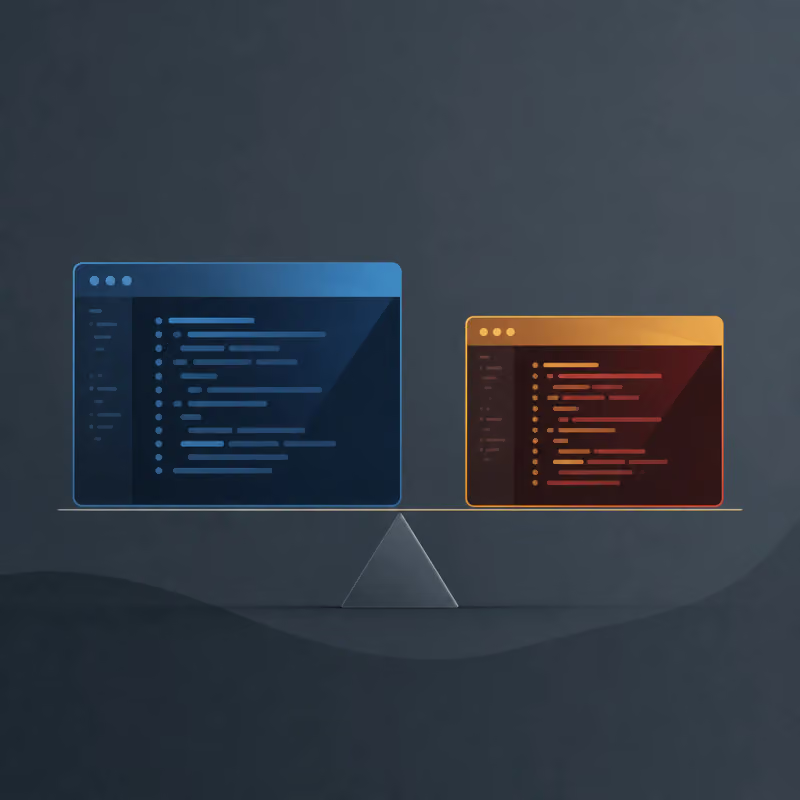
An independent practical test was provided by Snowflake CEO Sridhar Ramaswamy in a widely noted X post: The internal "Coco" team of the data company had GLM-5.2 and Claude Opus 4.7 compete on 103 programming tasks from the so-called dbt-bench, with each task repeated three times.
In three attempts per task, both models were nearly equal with 66 and 67 percent of tasks solved, as OfficeChai reports in its evaluation of the post.
However, in the first attempt, Opus had a clearer lead: 53.7 percent correct solutions compared to 47.6 percent for GLM-5.2.
The efficiency difference between the two models was significant: GLM-5.2 required an average of 99 conversation rounds per task compared to 80 for Opus and incurred nearly double the consumption with 860 million billed tokens compared to Opus's 439 million.
Snowflake's team attributed this to more conversation rounds, more granular API calls, and less reuse of cached prompt content in GLM-5.2. The widespread assumption that GLM checks its own work more thoroughly was only partially confirmed by the evaluations: The model conducts checks more individually and granularly rather than necessarily more comprehensively than Opus.
Classification
ZCode fits into a pattern that has been observable since the release of GLM-5.2 in June 2026: Chinese models are increasingly approaching the performance of Western top models in complex programming tasks while remaining significantly cheaper – although, as Snowflake's practical test shows, with drawbacks in reliability on the first attempt and a sometimes significantly higher token consumption that eats into part of the nominal price advantage.
Whether ZCode can establish itself as a standalone alternative to Claude Code and Codex will therefore likely depend less on pure model benchmarks and more on how well this additional consumption translates into actual total costs for development teams in practice.