Update, August 25, 2026: The price wave described here has now reached the server makers. Nvidia has notified several major customers of price increases of more than 15 percent for its AI servers, citing the higher cost of memory as the explicit reason.
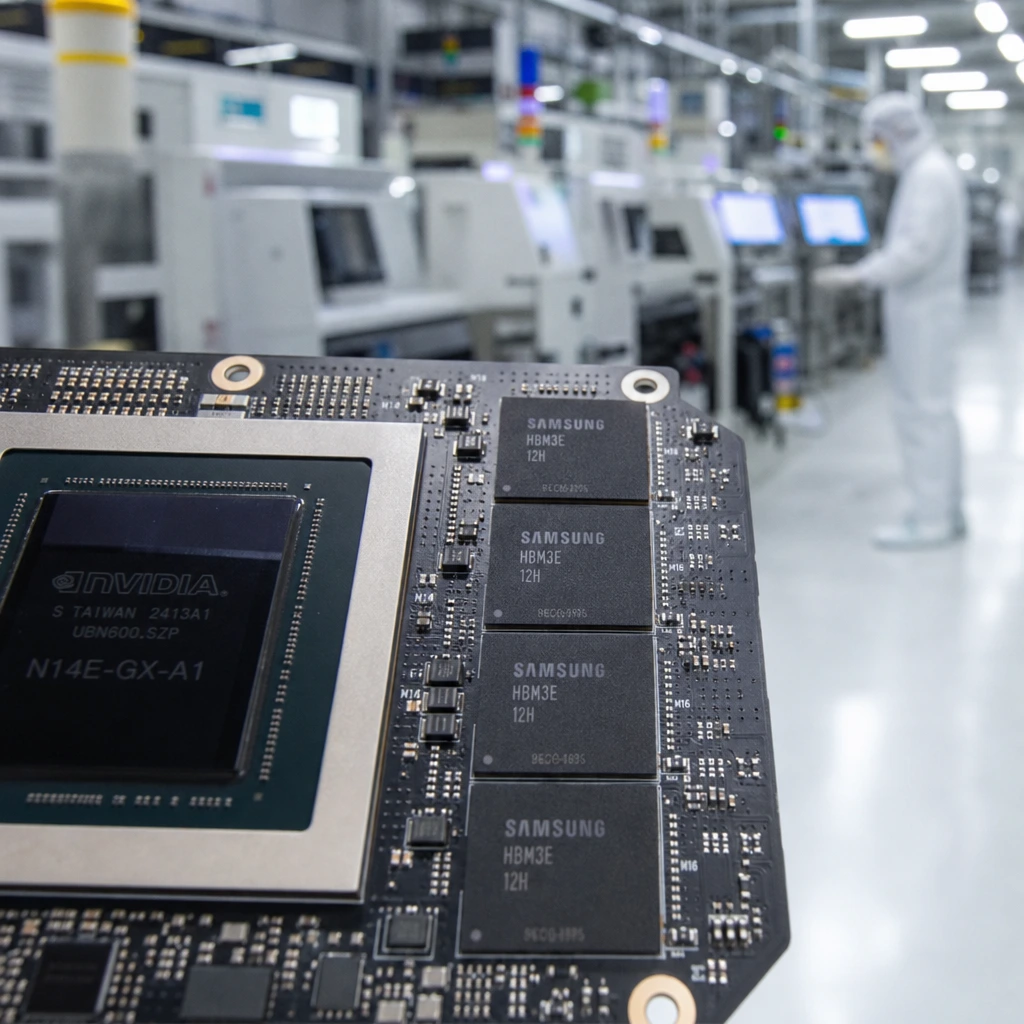
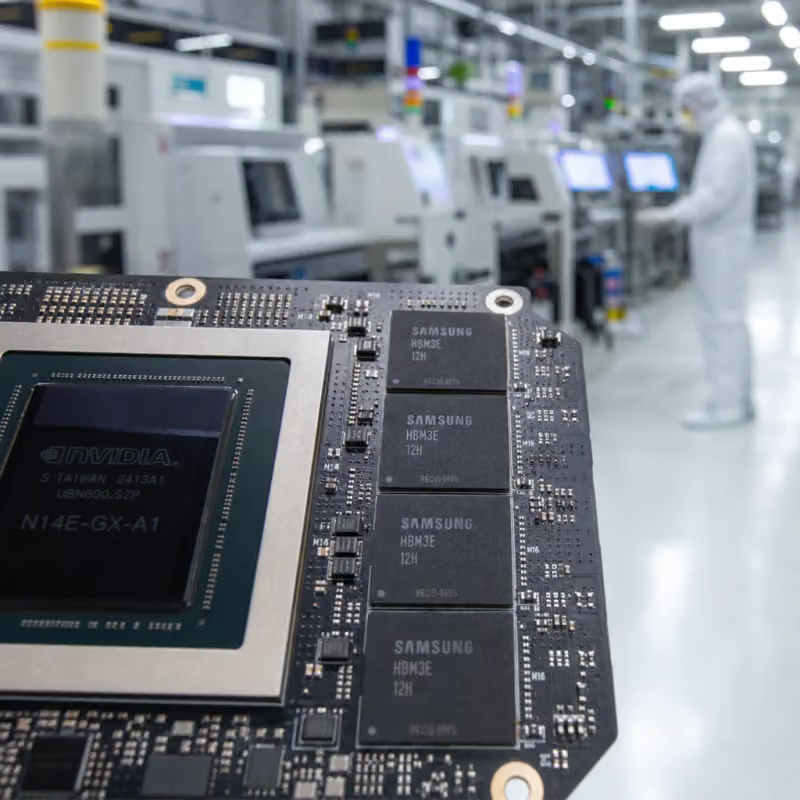
Samsung is backing price increases of 15 to 20 percent for HBM4 memory chips in the second half of 2026, according to a report by trade publication DigiTimes, because demand for AI accelerators is filling up production lines for the associated base dies.
Market researcher TrendForce expects HBM contract prices to as much as double by 2027.
Saturated Production Lines Push Prices Higher
HBM4 (fourth-generation High Bandwidth Memory) is memory that sits directly next to AI accelerators and delivers data at far higher bandwidth than conventional DDR5 memory. Production is more demanding: an HBM4 chip requires roughly three times as much wafer capacity as a comparable DDR5 chip, according to South Korean business outlet Seoul Economic Daily, and the production cycle takes four to six months instead of three to three and a half.
Samsung's production lines for HBM4 base dies built on 4-nanometer technology are now fully booked, according to DigiTimes. That gives the company room, the report says, for price increases of 15 to 20 percent in the second half of 2026.
SK Hynix and Micron also produce HBM4, but compete for the same scarce production capacity for advanced memory chips. Long-term supply agreements are set to tie up 20 to 30 percent of general DRAM capacity for HBM production, the Seoul Economic Daily reports, squeezing other memory segments.
Prices for conventional DRAM memory have already been rising noticeably since the second half of 2025, further straining the overall situation.
Nvidia and Google Are Driving Demand
The price pressure also stems from the growing memory needs of individual AI chips. According to TrendForce, HBM capacity per AI ASIC will grow in 2026 from 96 and 192 gigabytes to 216 and 288 gigabytes, respectively.
For Nvidia's Rubin Ultra platform, planned for 2027, the market researchers estimate up to 384 gigabytes of HBM per graphics processor, on top of growing demand from Google's own AI accelerators, the Tensor Processing Units.
As a result, HBM's share of total DRAM production is rising: TrendForce puts it at 18 percent of wafers used in 2025, 22 percent in 2026, and 30 percent in 2027. In terms of bit output, HBM's share stands at eight percent in 2025 and is expected to reach 13 percent by 2027.
Starting in 2027, roughly half of total production capacity could go to prioritized major customers such as Nvidia or Google, according to the Seoul Economic Daily, putting additional pressure on smaller buyers. Because the three major memory makers mostly set HBM prices through annual contracts, they respond to short-term market swings only with a delay, which analysts say further amplifies the price increases.
Shortages Also Hit Conventional Memory and Packaging
The shift is also affecting conventional memory. TrendForce found that wafer revenue from HBM fell behind revenue from 64-gigabyte DDR5 modules for the first time in the first quarter of 2026, a finding the analysts say prompted several memory makers to align production capacity more closely with achievable prices rather than pure utilization.
According to the Seoul Economic Daily, some suppliers' profit margins on DDR5 memory recently exceeded 80 percent. Bottlenecks are also emerging in chip packaging: Taiwanese contract manufacturer ASE Technology raised its 2026 investment budget from seven to 8.5 billion dollars and is currently building 15 new plants to meet demand for advanced packaging processes such as CoWoS for AI chips.
According to DigiTimes, additional bonding technology from supplier Hanmi Semiconductor is expected to be used for this. The combination of scarce memory and limited packaging capacity is likely to strain AI hardware supply chains at least through the end of 2026, industry observers say.
For cloud providers and AI developers, that means rising costs per graphics processor, since HBM accounts for a growing share of the total cost of modern AI accelerators. TrendForce's forecast that HBM contract prices will double by 2027 is independently unverified and based on market estimates, since Samsung, SK Hynix, and Micron do not disclose their contract terms.
What will matter is whether the additional production capacity expected from Samsung and SK Hynix by the end of 2026 meaningfully eases the price pressure before the next wave of demand arrives with Nvidia's Rubin Ultra platform in 2027.