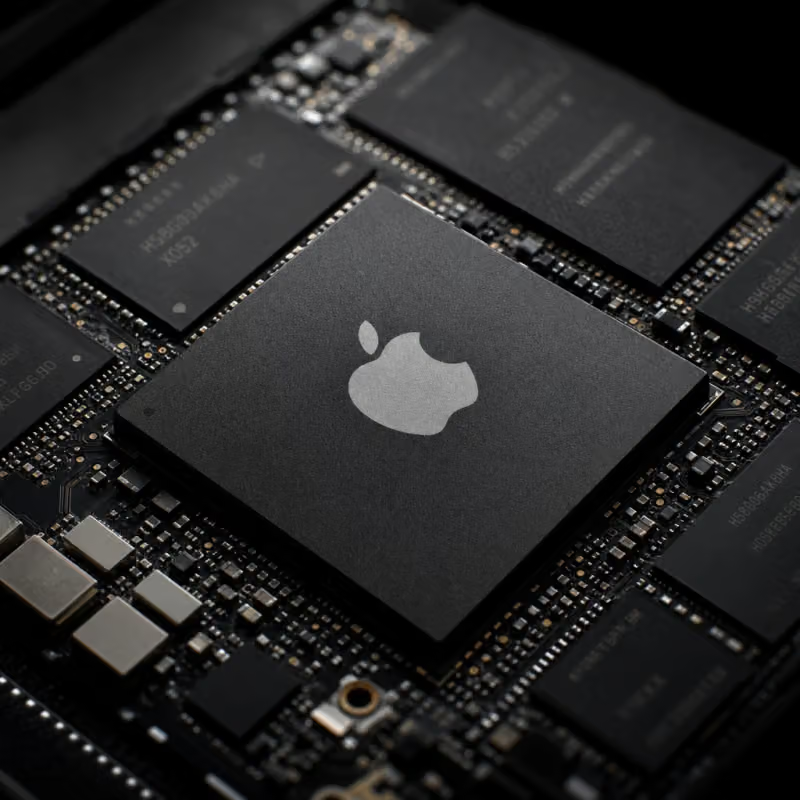
Apple is working on a new chip called the M7 Ultra that will support up to 1.5 terabytes of memory, according to a report from Bloomberg journalist Mark Gurman.
That would be roughly double the capacity of the M5 Ultra planned for 2026, and would mark the first time since the 2019 Intel Mac Pro that a Mac has reached this memory ceiling again.
M7 Ultra would match the old Mac Pro's memory ceiling
The jump would be historic. The current M4 Max can be configured with a maximum of 128 gigabytes of memory.
Earlier M3 Ultra models offered up to 512 gigabytes, though Apple has since dropped the largest tier from its lineup. The M5 Ultra, expected later in 2026, is said to top out at around 768 gigabytes, according to Gurman's report.
At 1.5 terabytes, the M7 Ultra would double that figure again, landing exactly at the ceiling of the last Intel-based Mac Pro from 2019. This specific capacity figure is independently unverified, since it so far stems from a single report and Apple has not commented on it.
At Apple's current memory surcharge of roughly $25 per gigabyte, a jump from 128 to 1,500 gigabytes would push the added cost above $35,000. This calculation is derived by 9to5Mac from Apple's current price list, assuming Apple keeps that pricing logic.
Whether the top configuration actually ships also depends, according to the report, on the state of the global memory chip market. The current generation is already grappling with rising module prices and supply shortages.
Apple is tailoring chip design specifically to AI workloads
The report frames the M7 Ultra as part of a strategic shift. Apple is said to no longer design its processors primarily for higher CPU clock speeds, better graphics performance, or longer battery life. Instead, the design is increasingly geared toward the demands of large AI models.
The large memory pool is meant to let extensive language models run entirely locally on a Mac Studio, without offloading requests to cloud servers. According to Gurman, the targeted AI performance would bring the chip closer to specialized accelerators like Nvidia's Blackwell platform than to a typical desktop processor.
Nvidia's chips, however, remain built for training in data centers and still lead in raw compute performance.
Alongside the consumer chip, Apple is reportedly planning a derivative server version. It is meant to power both on-device and cloud-based Apple Intelligence features.
Gurman's overview of Apple's chip roadmap also lists the designations M6, M7, M7 Pro, M7 Max, and M8, pointing to a multi-year model family stretching to the end of the decade, with annual updates to the Mac Studio and MacBook Pro lines.
What will matter is whether Apple actually offers the 1.5-terabyte configuration at launch or sells a scaled-back variant because of the tight memory chip market. Apple still has time before the M7 Ultra's expected arrival in 2028 to adjust the configuration to component prices.
It also remains open how strongly the server variant planned for 2029 will affect competition over proprietary AI infrastructure, an area where Apple has so far relied more on external cloud partners than on its own data centers.