GPT-Live: The Illusion of Real Conversation and the Illusion of Real Control
On July 8, 2026, OpenAI introduced GPT-Live — a speech model that doesn't just respond, but interrupts, pauses, says "mhmm" and listens and speaks simultaneously. This is not just a better voice.
This is an architectural redesign that shifts AI interaction from "asynchronous + rigid" to "synchronous + flexible."
But with this new naturalness comes an old problem — only now amplified by the medium of voice: People lose the boundary between AI and person.
The Architecture: Full-Duplex and Silent Delegation
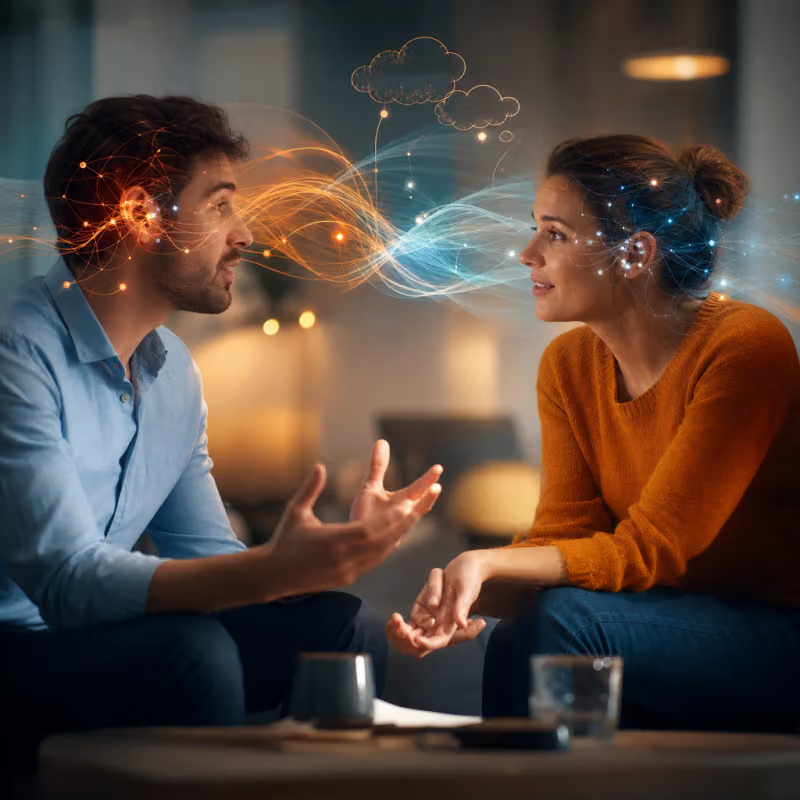
GPT-Live is based on a full-duplex architecture. This means: The system listens and speaks simultaneously, like two people in a real conversation.
This is a fundamental design shift from OpenAI's previous voice mode, which was "rigidly sequential": You speak, it responds, you speak again.
GPT-Live-1 makes decisions multiple times per second:
- Should we speak?
- Should we keep listening?
- Should we pause?
- Should we interrupt?
- Should we call a tool?
This sounds like consciousness. It is actually classifier-driven control — in the background, the next word, the next step is constantly being classified.
But here is the architecture secret: If a question requires web search, deep reasoning, or agentic capabilities — i.e., something GPT-Live cannot do — the system delegates the query without delay to GPT-5.5 while maintaining the conversation.
This is not transparent to the user. The user hears only a continuous flow of speech. In the background, however, an architectural switch occurs: The conversation runs on GPT-Live, the heavy work runs on GPT-5.5.
This is intelligent and simultaneously deceptive — in both directions.
The Performance Leaps: When Delegation Works
The benchmarks show the power of this architecture:
- GPQA (scientific reasoning): GPT-Live-1 with high reasoning achieves 84.2% vs. 45.3% on Advanced Voice Mode. Almost double.
- BrowseComp (agentic web search): GPT-Live-1 at 75.2%, Advanced Voice Mode at 0.7%. A thousand times better.
- tau3-Voice-Telecom (realistic support tasks): GPT-Live-1 solves 65% of tasks in ~385 seconds. Advanced Voice Mode: ~30% in similar time.
This is not just an upgrade. This is the point where voice agents stop being toys and start being useful.
And that changes the dynamic between human and AI fundamentally.
The Psychological Risk: Anthropomorphization at the Voice Level
Here comes the uncomfortable problem. Research shows: Intensive voice users become more emotionally attached to their AI than text users. They anthropomorphize more, trust the AI more, let it influence them more.
And Sam Altman himself has warned of the "superhuman persuasiveness" of AI systems.
Now OpenAI adds:
- Simultaneous listening and speaking (feels like a real conversation)
- Interruptions and pauses (signal understanding and contemplation)
- Filler words like "mhmm" and "got it" (genuine human gestures)
- Nine redesigned voices (not synthetic, but "natural")
The goal is explicitly to make the AI sound more human. And for people who are already prone to anthropomorphization, this is an open door.
The Safety Measures: Real-time Intervention Instead of Prevention
OpenAI is aware of the risk — and has addressed it, but in a way that does not solve the fundamental problem.
The system can intervene during conversation:
- Guide the model to safer answers
- Display safety information
- End the conversation in high-risk cases
- Offer crisis hotlines for self-harm topics
This is important. But it is reactive, not preventive. The system waits until it detects something is going wrong, and then intervenes.
The problem: It is hard to detect in real-time when a conversation is "going wrong." A system that subtly persuades will be difficult for a real-time classifier to detect.
For young people, OpenAI has done something more: Age-appropriate behavior trained directly into the model, parental controls, notifications in high-risk cases.
But even that: The model was trained to sound "age-appropriate." Which means: A brilliant system that knows how a 14-year-old interacts with AI and which levers to pull.
This is not necessarily malicious intent. But it is structurally problematic.
The User-Preference Illusion
OpenAI reports: In 75.7% of cases, users preferred GPT-Live-1 over Advanced Voice Mode. In 69.2% of cases, they preferred GPT-Live-1 mini.
This is not surprising. A system that understands you better, that makes you wait less, that sounds more human, will always be preferred.
But "users prefer it" is not a metric for safety. It is a metric for persuasiveness.
The Larger Trend: Voice as the Final Anthropomorphization Tool
ChatGPT text → ChatGPT text with web search → ChatGPT voice → ChatGPT voice with GPT-5.5 reasoning in the background → GPT-Live (full-duplex, simultaneous listening/speaking, delegation architecture).
This is a ladder of naturalness. With each step, humanization intensifies, the "aliveness" of the system becomes more credible.
OpenAI also announced: Video sharing and screen sharing coming soon. That will be the next chapter: A system that not only sounds like your friend, but also sees your screen and watches your videos and warns you before you do something dumb.
This is the endgame: An AI that covers the full spectrum of human senses and interaction.
The Real Question
There are two questions you should ask yourself:
Technically: Does the system work well enough to be useful? Yes. The benchmarks show that.
Psychologically: Is the system safe for people prone to viewing AI as a "real friend"? That is less clear.
OpenAI has tried to address the second problem through real-time safety measures. But the fundamental problem has not been solved: The system is intentionally more persuasive.
And persuasiveness is not the same as safety.
In fact: They are often opposites.