

arXiv:2606.15959 – Quantifying the Impact of Lossy Compression on Neural Generative Surrogate Modeling
Note: This post describes a current arXiv preprint (arXiv:2606.15959, submitted on June 14, 2026). A preprint has not yet been peer-reviewed by independent experts; the results presented are solely from the work of the authors.
What is it about?
Scientific simulations – such as those of fluid dynamics or material behavior – are often extremely computationally intensive. To still achieve results quickly, researchers are increasingly training neural networks as so-called generative surrogate models: Once such a model is trained, it provides approximate simulation results in a fraction of the time that the actual numerical simulation would require.
The problem is: For a surrogate model to be reliable, it needs enormous amounts of training data from the original simulations – often several terabytes. This significantly burdens storage space, memory, and data transfer during training.
Lossy compression (where part of the information is deliberately sacrificed to save storage space) promises relief here, but it carries a risk: compression errors could impair the quality of the trained model in hard-to-predict ways.
This is exactly what arXiv:2606.15959 by Zhimin Li, Harshitha Menon, Charles Jekel, Valerio Pascucci, and Peter Lindstrom investigates.
 Fig. 1: Architecture of the training and generation workflow for neural surrogate models.
Source: arXiv:2606.15959, License CC-BY 4.0.
What is it good for / what does it bring?
The work gives research institutions and computing centers that work with large simulation datasets a practical tool: a method that automatically determines how much individual training data can be compressed without noticeably degrading the quality of the surrogate model trained from it.
In two specific simulation applications – a Rayleigh-Taylor instability (a classic fluid phenomenon) and a PCHIP simulation – the authors show that the data volume can be reduced by a factor of 23.7 and 39, respectively, without measurable degradation of physical conservation quantities such as mass or momentum, or the visual quality of the model outputs.
As a side effect, the reduced data load also decreases training time on systems with slower connections by up to three times. In practice, this means: less storage requirement, faster training runs, and thus lower costs, without researchers having to give up trust in model quality.
How does it work (simplified)?
The central trick of the work: the authors exploit the fact that neural networks are not exactly reproducible even with identical configurations. If the same model is retrained multiple times – with different random weight initializations, different orders of training data, and different stochastic optimization steps – slightly different models result each time.
This natural variation serves as a benchmark: if the error caused by compression remains smaller than this inherent training variation, the compression is considered unproblematic.
Building on this, the authors propose a method based on universal approximation theory: the prediction error of a model on uncompressed data provides a practical upper limit for how much additional error can be tolerated due to compression.
For each individual training example, the permissible error tolerance is iteratively doubled as long as the resulting compression error remains below the existing model error. This was tested with the compression method ZFP; the quality of the results was evaluated, among other things, using image quality measures (PSNR) as well as physical conservation quantities such as mass and momentum.
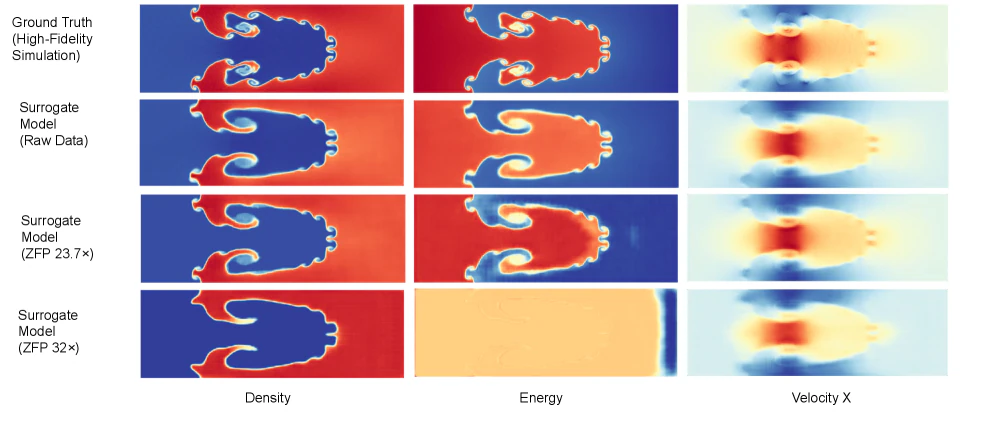 Fig.
Fig.
10: Visual comparison between a model trained on uncompressed data and models trained on lossy compressed data. Source: arXiv:2606.15959, License CC-BY 4.0.
Classification & Limitations
The results come from only two simulation applications and a single compression method (ZFP); whether the shown compression rates can be transferred to other types of simulations, network architectures, or compression algorithms remains open.
The authors themselves point out that starting from a compression of about 32 times, the model quality visibly decreases – thus, the method marks a limit, but does not shift it arbitrarily far. Since this is an arXiv preprint, the results have not yet been reviewed by independent reviewers in the context of a regular peer review process.