
arXiv:2606.15956 – You Don't Need Strong Assumptions: Visual Representation Learning via Temporal Differences
Note: This post describes a (not yet) peer-reviewed preprint on arXiv. The results mentioned have not yet been independently verified by the scientific community.
What is it about?
A research team from the University of Illinois Urbana-Champaign and New York University – including Ninad Daithankar, Alexi Gladstone, Yann LeCun, and Heng Ji – presents a method called Temporal Difference in Vision (TDV) in a recent arXiv preprint.
The starting point is an observation from the history of machine learning: the more computational power and training data are available, the better methods perform that make as few fixed assumptions about the data as possible.
In visual representation learning, this trend has already shown up in the transition from supervised learning to weakly supervised learning to self-supervised learning without human labels.
However, the authors argue that even modern self-supervised methods still rely on strong auxiliary assumptions – such as cropping, masking, or data augmentation. Their experiments suggest that the optimal strength of such auxiliary assumptions decreases as data volume grows.
From this, they derive the search for an approach that relies on as few assumptions as possible.
What is it good for / what does it bring?
TDV uses a causal fundamental assumption instead of artificial auxiliary assumptions: the past determines the future. Instead of teaching a model that two cropped or masked variants of the same image should be "similar," TDV teaches a model to predict the representation of the next image from the representation of the current video frame plus learned motion information.
The practical benefit: despite forgoing common auxiliary assumptions, TDV achieves a quality in experiments on dense spatial tasks (such as segmentation or depth estimation) that is comparable to established state-of-the-art methods like DINO or iBOT.
In practice, this means an image model can learn solely by watching video material, without developers having to predefine which image crops or distortions should count as "equivalent." This reduces the number of manually made design decisions and, according to the authors, could lay the foundation for representation learning without strong assumptions.
How does it work (simplified)?
TDV jointly trains two components: an image encoder that translates a single video frame into a representation, and a motion encoder that extracts compact motion information from the raw pixel difference between two consecutive frames – controlled via cross-attention on the representation of the current image.
The basic idea, as shown in Figure 1: adding the representation of the current image and the encoded motion should yield the representation of the next image.
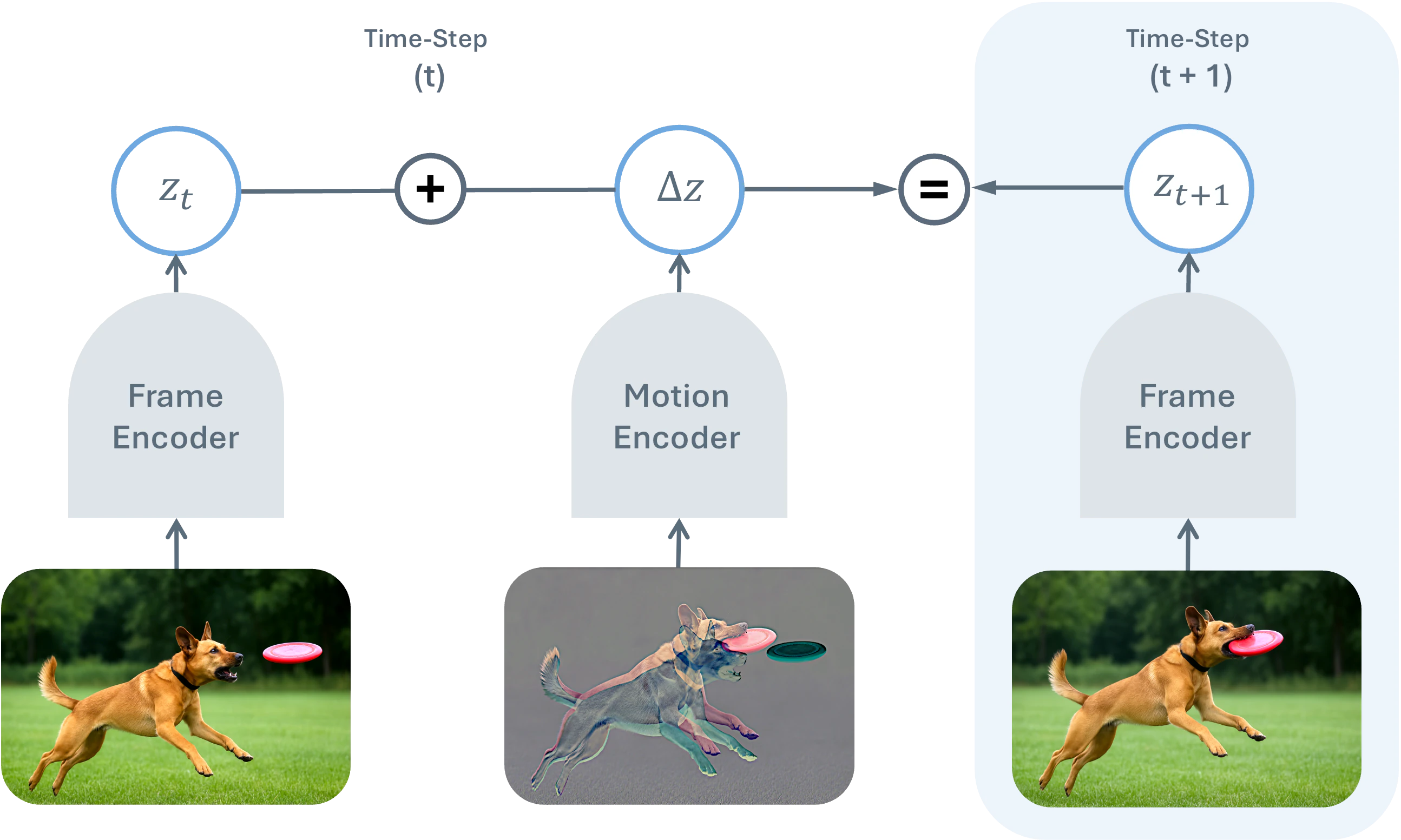
Figure 1: TDV principle – current image plus encoded motion results in the next image. Source: arXiv:2606.15956, CC BY 4.0.
To prevent the model from "collapsing" into a trivial, information-less solution (for example, by outputting the same representation for every image), the authors use a teacher-student setup: a copy of the image encoder updated via exponential moving average (EMA) provides the target signal for the actual next image.
Two loss functions operate simultaneously – a mean squared error on the representations enforces the causal prediction, while a DINO-like cross-entropy on additional projection heads prevents collapse. Gradients do not flow back to the teacher.
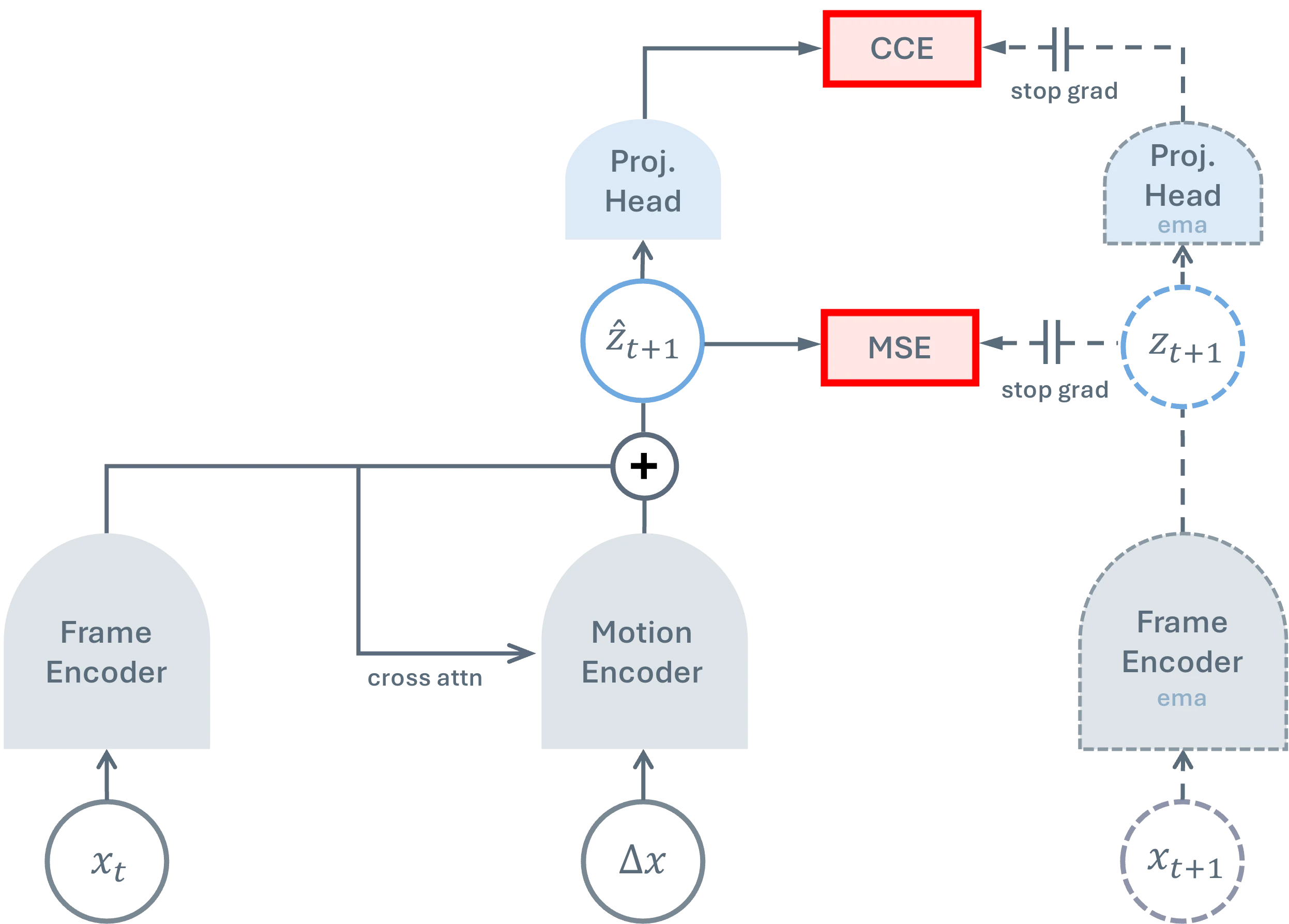
Figure 2: TDV architecture with image encoder, motion encoder, and teacher-student setup. Source: arXiv:2606.15956, CC BY 4.0.
In their own experiments, the authors also show that the optimal degree of auxiliary assumptions (such as the masking rate in competing methods) decreases as data volume grows – a finding that supports the fundamental motivation behind TDV.
Classification & Limitations
The preprint status is important: the results have not yet been reviewed by an independent peer review, and details may change in a later review. The authors also point out that their data scaling experiments cover a limited range of masking rates and data volumes; whether the observed trend – decreasing utility of auxiliary assumptions with increasing data volume – continues with even larger models and datasets remains open.
TDV also relies on video material with sufficient motion between frames; how the method handles very static scenes or very fast movements is not discussed in detail in the preprint.
For classification of the paper, therefore: it represents a promising research direction with understandable experimental evidence, not a production-ready, widely validated method.