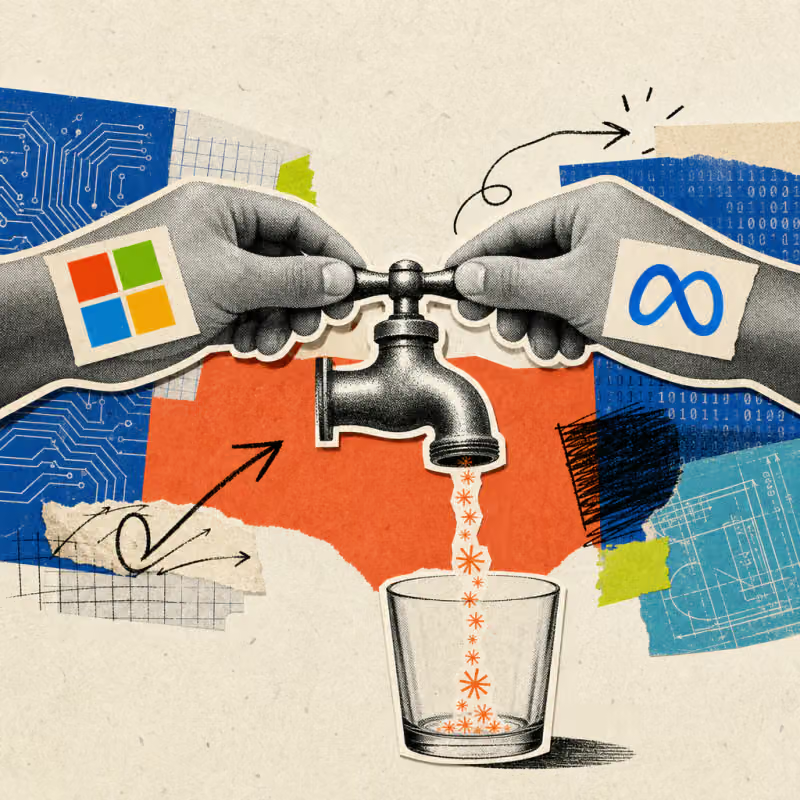
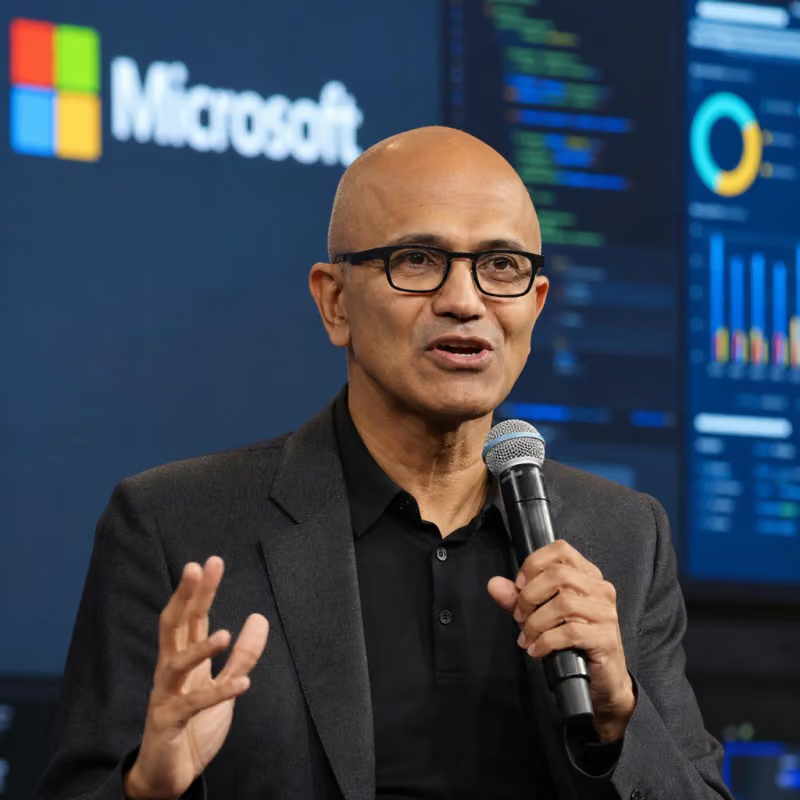
Microsoft CEO Satya Nadella has warned companies in a blog post published on July 12, 2026, about a cost trap with commercial AI models. Those who use external systems not only pay with money but also pass on valuable expertise to the providers.
As a solution, he suggests creating their own learning environments and interchangeable provider layers.
Blog post describes reverse information paradox
Nadella did not publish his warning through an official Microsoft channel but on his personal blog snscratchpad.com. In the post titled "Reverse Information Paradox," he writes that companies essentially pay twice for commercial AI models: once with money and a second time with something more valuable – the disclosed expertise.
Any corrections that employees make to a system's responses flow as "exhaust" into the provider's knowledge and are condensed there into institutional know-how.
Nadella criticizes what he sees as a contradictory stance of the major AI providers. They collect freely publicly available data to train their models but often prohibit corporate customers from examining the same models or distilling them for their own purposes.
He describes this inequality as the core of the problem: those who share their trade secrets to make a model more useful ultimately strengthen the market position of the provider. The post appeared on a Sunday and quickly spread on social networks over the same weekend before US media outlets like TechCrunch and The Register reported extensively on it the following Monday.
Nadella recommends own learning environments instead of vendor lock-in
As a solution, Nadella proposes three measures. First, companies should retain control over their own evaluations and institutional knowledge instead of letting them flow into external systems.
Second, he advises building their own isolated learning environments on trusted cloud infrastructure, where feedback and corrections benefit only their own company. Third, he advocates for modular orchestration layers that facilitate switching between different AI providers and avoid a fixed commitment to a single system.
According to Nadella, this orchestration layer should prevent companies from settling into a single ecosystem and thereby losing negotiating power. Instead, continuous learning loops could be established that strengthen their competitive advantage over time rather than handing it over to providers.
Such an approach resembles strategies that companies already use for cost control in cloud environments but now transfers the principle to the handling of knowledge and training data. The post does not mention specific product names like Azure or Copilot; the suggestions remain at the level of general principles.
Market observers report an increase in open models
Nadella's post also drew responses from representatives of the infrastructure industry. Solo.io CEO Idit Levine reports, according to Android Headlines, that large corporations like T-Mobile, SAP, and the staffing service provider ADP are now operating open models on their own servers instead of relying solely on commercial providers.
According to them, open models have now reached about 90 percent of the capabilities of commercial systems – unverified independently, as the statement is based solely on Levine's assessment.
The platforms Vercel and OpenRouter, through which developers can route requests to different AI models, also reportedly registered a growing share of corporate traffic being redirected to open models. TechCrunch classifies Nadella's post as part of a broader debate about data sovereignty in the AI industry, which has gained new attention due to the Microsoft CEO's initiative.
The Register describes the tone of the post as unusually confrontational towards the leading AI labs, with which Microsoft has close ties through its investment in OpenAI. For companies with strict compliance requirements, this is an additional argument, as open models can be operated entirely within their own infrastructure without sensitive data needing to leave the corporate network.
It remains open how Nadella intends to resolve the inherent conflict: Microsoft sells access to OpenAI's models as well as its own AI services through Azure and benefits regardless of which approach customers choose.
It will be crucial whether companies actually build the proposed orchestration layers or whether they revert to convenient all-in-one packages in the next contract negotiations with the major AI providers.